
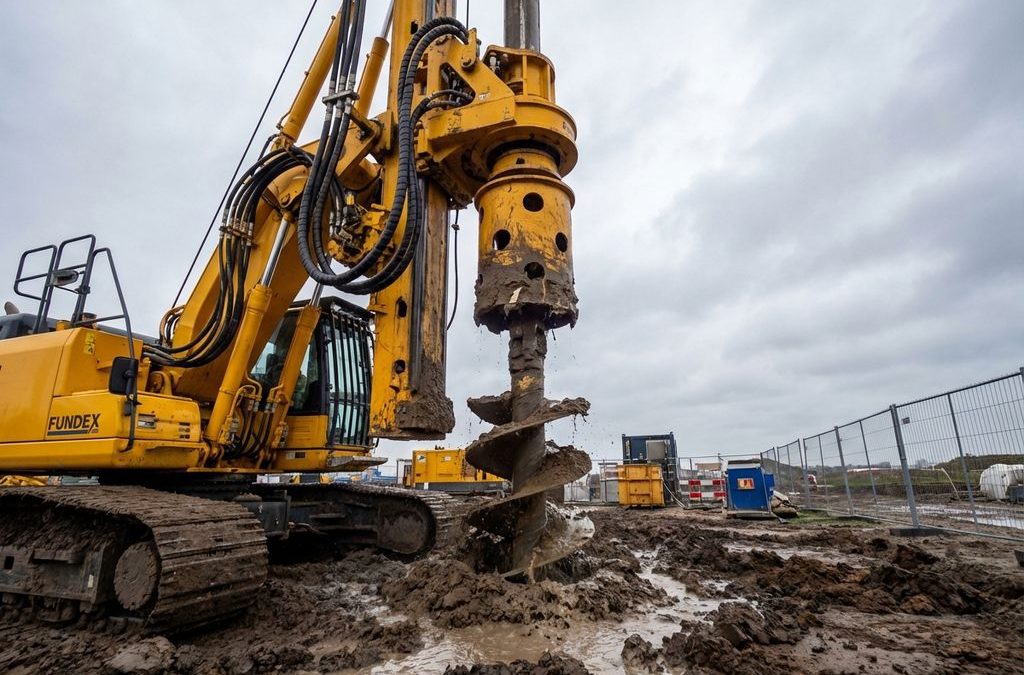
Foundation work in soft soil requires specialized techniques due to the low bearing capacity and high susceptibility to settlement of these soil types. Vibration-free foundation methods, such as screw piles and grouted systems, offer the best results because they stabilize the soil without further weakening it. The choice of the appropriate technique depends on soil conditions, the load, and environmental factors.
What makes soft soil so challenging for foundation work?
Soft soil has a very low bearing capacity (often less than 1 MPa) and a high moisture content, making traditional foundation methods unsuitable. This type of soil is prone to settlement and deformation under load, which threatens the stability of structures.
The biggest problem with soft soil is its limited resistance to deformation. When pressure is applied, the soil can flow away or compact, leading to uneven settlement of the building. Traditional pile driving causes vibrations that can further weaken the soil structure.
In addition, soft soil often has a variable composition that includes organic materials prone to decomposition, which can lead to long-term problems. The high water table, which is often present in such areas, further complicates the work and increases the risk of soil displacement during construction.
Which foundation techniques work best in soft soil?
For soft soil, pile foundations that displace the soil are the most effective solution. Systems such aspiles,piles composite piles with grout injection offer optimal performance because they displace the soil rather than excavating it.
piles particularly well-suited for very soft soil layers because deformation of the pile shaft cannot occur. This method is 100% soil-displacing, without causing soil settlement, thereby maintaining the bearing capacity. The system can withstand high compressive and tensile forces and is suitable for soil layers ranging from 1 to 20 MPa.
In extremely soft soil conditions,piles grout injection offer an alternative. This technique uses precast pile elements that are encased in grout after installation, thereby eliminating the risk of a discontinuous pile shaft. For very heavy soil layers, Superpiles enlarged bases can be used; due to their specific operating method, they perform exceptionally well even in erratic soil layers.
How can you prevent vibrations and noise pollution when building foundations in soft soil?
Vibration-free foundation techniques, such as screw piles and oscillating systems, completely eliminate vibrations by piles “screwing” the piles into the ground. These methods are ideal for urban environments and sensitive locations where traditional pile driving is not possible.
The Fundex technique works by applying axial pressure and torque, allowing the pile to be driven pile into the ground without impact loads. This “piling without piling” principle protects both the surrounding soil and nearby structures from damage caused by vibrations.
piles a completely vibration-free solution suitable for areas with limited headroom or near sensitive adjacent structures. The system can be installed at a distance of just 0.5 to 0.9 meters from existing structures, depending on the rig used. Thanks to the controlled installation method, there is no noise pollution for the surrounding area.
When is soil improvement necessary before laying the foundation?
Soil improvement is necessary when the bearing capacity of soft soil is insufficient even for the most advanced pile foundations, or when surface stability is required during the construction phase. This is particularly the case for subsoils with a bearing capacity below 1 MPa or for highly organic soils.
Various soil improvement techniques can be used prior to foundation installation. Grout injection can strengthen the soil structure by introducing binding agents that increase its bearing capacity. This method is often combined with pile foundations to achieve optimal results.
In some cases, drainage is necessary to reduce the moisture content before foundations can be laid. For very soft soil layers, systems with permanent casing—such as precast concrete elements or permanent steel pipes—can also be used to support the soil during and after installation.
Combining soil improvement with modern foundation techniques offers the best guarantee of a stable and durable foundation. A professional assessment of soil conditions is essential to determine the right combination of techniques for each specific project. For advice on the optimal foundation solution for your project, please contact us for a free quote.
Frequently Asked Questions
How long does it take to install pile foundations in soft soil?
Installation time varies greatly depending on the chosen method and soil conditions.piles usually pile installed within 1–2 days per pile , whilepiles grout injection pile take 2–3 days per pile due to the curing time of the grout. For an average single-family home, 1–2 weeks is a realistic estimate.
What is the cost of installing foundations in soft soil compared to normal soil?
Funderen in slappe grond is doorgaans 20-40% duurder dan in normale grond vanwege de gespecialiseerde technieken en materialen. De meerkosten worden echter ruimschoots gecompenseerd door de vermeden risico’s van zettingsschade en de langetermijnstabiliteit van de constructie.
Can I determine on my own whether my soil is suitable for standard foundations?
Although visible signs such as standing water, soft muddy soil, or an organic odor may be indicative of underlying issues, a professional soil investigation is essential. A geotechnical report based on boreholes drilled to a depth of at least 2 meters below the foundation level provides definitive answers regarding the bearing capacity and the required foundation technique.
What permits do I need for vibration-free foundation techniques?
For vibration-free techniques such as Tubex or Fundex, only standard building permits are usually required. The major advantage is that special vibration or noise permits are often not necessary, which significantly speeds up the permitting process compared to traditional pile driving.
How do I check whether the installed piles have piles load-bearing capacity?
After installation, pile tests are conducted in which the piles are subjected piles controlled loads of up to 150–200% of the design load. Modern techniques such as Tubex also provide real-time monitoring during installation, allowing resistance values to be measured and recorded immediately.
What happens if the soft soil layer is deeper than expected?
If unexpectedly deep soft layers are encountered, piles can piles extended or alternative techniques, such as Superpiles, can be used. Modern foundation systems are designed to be flexible, allowing them to be adapted to actual soil conditions during construction without significant delays.
Do foundations in soft soil require maintenance?
Properly installed pile foundations in soft soil are maintenance-free for at least 50 to 100 years. However, it is advisable to have a visual inspection performed every 10 to 15 years to check for any settlement or cracks in the structure, especially in organic soil layers that can change over time.