
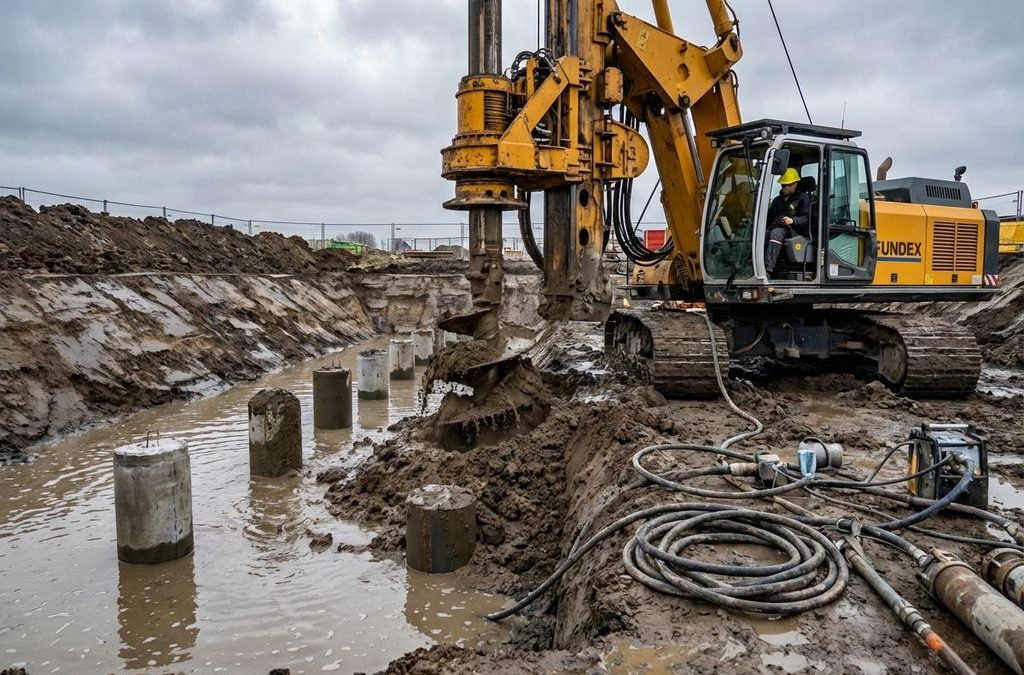
Groundwater conditions during foundation work require careful planning and appropriate techniques. High groundwater levels increase the risk of water pressure, soil settlement, and foundation instability. Effective groundwater control requires preliminary investigations of water levels, the selection of suitable foundation techniques—such as vibration-free pile foundations—and adequate drainage and water discharge systems around the structure.
Why does groundwater pose a challenge in foundation work?
Groundwater exerts pressure against foundation elements and can cause soil settlement due to the leaching of fine soil particles. Fluctuating water levels result in varying loads that compromise the stability of foundations. Furthermore, groundwater complicates the implementation of traditional foundation methods.
The impact of groundwater depends heavily on soil conditions. In very soft soil layers, groundwater increases the risk of pile shaft deformation and reduced bearing capacity. In heavy soil layers with high cone penetration values of up to 80 MPa, groundwater can make it difficult to reach the desired pile tip level.
Water pressure acts on foundation elements both horizontally and vertically. This can cause lightweight structures to float and lead to erosion around foundation points. Seasonal variations in groundwater levels exacerbate these problems, as foundations must be able to withstand both high and low water levels throughout their service life.
How do you determine the groundwater level before you start laying the foundation?
Groundwater monitoring begins with the installation of monitoring wells at various depths to measure current water levels and seasonal variations. Soil borings provide insight into soil composition and permeability, while hydrological studies identify long-term trends. This monitoring must cover at least one full season to yield reliable data.
Monitoring wells are strategically placed across the construction site to detect local variations in groundwater levels. The frequency of measurements depends on the soil type and seasonal factors. In permeable sandy soils, water levels can fluctuate rapidly, while clay layers tend to exhibit more stable conditions.
Additional testing includes permeability measurements to determine the permeability of different soil layers. This information is crucial for the design of drainage systems and the selection of appropriate foundation techniques. Historical data from nearby projects and local water authorities can help complete the picture.
Which foundation techniques work best in areas with high groundwater levels?
Vibration-free pile foundations using permanent steel pipes perform exceptionally well in high groundwater conditions. These techniques prevent soil deformation and provide watertight protection during installation. Grout injection systems are suitable for very heavy soil layers, while permanent casing is ideal for soft soil conditions.
For very soft soil layers with cone values between 1 and 20 MPa, systems with permanent casing are the recommended choice. These prevent pile shaft deformation and can achieve bracing ratios of up to 4:1 forward and 1:1 backward. For very heavy soil layers with cone values up to 80 MPa, grout injection techniques offer the best solution.
Modern foundation machines can install piles at depth, even from pontoons, ensuring that no excess length remains above the cut-off level. This is particularly advantageous for projects with high groundwater levels, where traditional methods fall short. The grout sleeve in sand layers achieves the same diameter as the drill bit for optimal stability.
How do you ensure effective drainage and water runoff around foundations?
Effective drainage combines horizontal drainage pipes around the foundation with vertical water discharge to a lower level or a pump system. Filter material, such as gravel, prevents clogging, while geotextile fabric traps fine particles. The drainage system must be able to withstand seasonal variations and peak rainfall.
Construction begins with digging drainage trenches at strategic locations around the foundation. Drainage pipes are installed with a minimum slope of 0.5% toward the drainage point. Gravel layers around the pipes ensure rapid water absorption and prevent direct contact with the soil.
Drainage may be necessary during construction and in extreme weather conditions. Temporary drainage systems keep the groundwater level under control during foundation work, while permanent systems provide long-term protection. Professional advice helps determine the right combination of drainage and dewatering for specific project conditions.
The choice of groundwater control methods for foundation projects often determines the success of the entire construction project. By conducting thorough preliminary investigations, selecting appropriate foundation techniques, and installing adequate drainage, it is possible to create durable foundations that can withstand fluctuating groundwater conditions. Modern vibration-free techniques offer reliable solutions for virtually all groundwater-related challenges in foundation engineering.
Frequently Asked Questions
How do the costs of vibration-free pile foundations compare to those of traditional methods?
Vibration-free pile foundations are initially 15–25% more expensive than traditional methods, but they often result in greater savings due to shorter construction times, less damage to surrounding structures, and lower maintenance costs. In areas with high groundwater levels, they are often the only viable option, making cost comparisons less relevant.
How long does the groundwater survey take, and when should I start?
A comprehensive groundwater study takes at least 12 months to account for seasonal variations. Therefore, you should begin installing monitoring wells well over a year before the planned start of construction. For urgent projects, historical data and intensive short-term measurements (3–6 months) can serve as a basis, but this increases the risk.
Can I determine for myself whether my construction project will run into problems with groundwater?
Early signs include visible water in ditches, flooding in neighbors’ basements, or high water levels after rainfall. However, a professional assessment is necessary because groundwater levels can vary significantly depending on the location and season. An incorrect assessment can lead to costly modifications during construction.
What happens if the drainage system fails after completion?
A failing drainage system can lead to flooding, foundation settlement, and structural damage. Prevention through regular inspection and maintenance is crucial. If the system fails, repairs can be costly because parts of the foundation often need to be exposed. That is why quality control during installation is essential.
Are special permits required for dewatering during foundation work?
Yes, dewatering often requires a water permit from the water board, especially for large volumes or long-term dewatering. You must also consider the impact on nearby properties. The application process takes 6–12 weeks, so be sure to plan ahead. Temporary dewatering for short periods may be subject to a simplified procedure.
How do I know if my soil is suitable for permanent casing systems?
Permanent casing is ideal for very soft soil layers (cone penetration value of 1–20 MPa) and high groundwater levels. A geotechnical investigation involving soil testing determines the soil conditions. If there is any uncertainty, a test pile can help assess feasibility and performance before the full project is carried out.
What guarantees do I receive for foundation work when groundwater levels are high?
The standard construction warranty is 5–10 years, but in cases of complex groundwater conditions, specialists often request limited liability for unforeseen soil conditions. Ensure that the contract includes clear agreements on risk allocation, quality controls during construction, and maintenance obligations for drainage systems.