
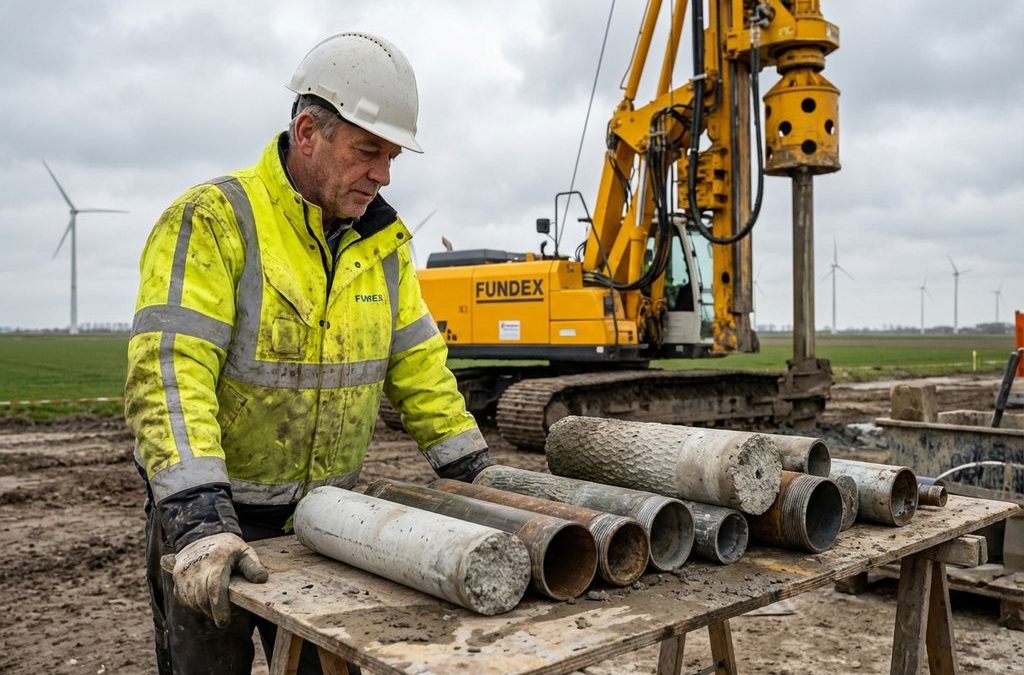
Choosing the right foundation method is crucial to the success of a project and determines the stability, cost, and durability of your structure. The choice depends on soil conditions, environmental requirements, project size, and vibration restrictions. Modern vibration-free techniques offer alternatives to traditional pile driving, while sustainable solutions are becoming increasingly important for future projects.
Why is choosing the right foundation method so important?
Choosing the wrong foundation can lead to costly project delays, structural problems, and significant additional expenses during construction. The foundation forms the basis of every structure and directly affects the building’s stability, lifespan, and maintenance costs.
Project success depends heavily on a thorough preliminary analysis. Soil testing and environmental factors determine which foundation method will perform best. A foundation that is not suited to the soil conditions can lead to settlement, cracks, or even structural failure.
The impact on the surrounding area is becoming increasingly important. Traditional piling methods cause vibrations and noise pollution, which can cause problems in urban areas or near sensitive structures. This can lead to complaints from nearby residents and additional costs for vibration and noise monitoring.
Sustainability considerations are becoming increasingly important for project approval and financing. Clients are increasingly asking for zero-emission foundation solutions and carbon-neutral construction processes. Making the wrong choice could mean that your project fails to meet modern environmental requirements.
Professional advice helps minimize risks and find the most cost-effective solution. Experienced foundation specialists can analyze various scenarios and recommend the best approach for your specific situation.
What factors determine the best foundation method for your project?
Soil conditions are the most important factor in deciding which foundation method to use. Soil strengths ranging from 1 to 20 MPa require different approaches, with very soft layers necessitating special techniques to prevent pile shaft deformation.
Soil conditions determine the technical options available. Hard layers may require grout injection to ensure optimal pile performance, while soft soils often benefit from soil-replacement systems that preserve the natural bearing capacity.
Environmental requirements play a crucial role in urban areas. Vibration-sensitive structures, noise restrictions, and limited workspace often necessitate vibration-free foundation techniques. The distance to adjacent structures can be a determining factor: some methods require only 0.5 to 0.9 meters of space.
Project size and budget influence the choice between different systems. Large projects can benefit from more efficient methods, while smaller projects require flexibility in machine dimensions. Installation areas range from 2 x 3 meters to 9 x 14 meters, depending on the chosen technique.
Drilling rigs and tilting derricks require specialized expertise. Some systems can drill at angles of up to 4:1 forward, 1:1 backward, and 3:1 to the side, which is crucial for complex structures and confined construction sites.
Sustainability goals are becoming increasingly important. Projects often require zero-emission operations, making fully electric foundation equipment essential for future approval.
What is the difference between traditional pile driving and modern vibration-free techniques?
Traditional pile driving uses impact force to drive piles the ground, which causes significant vibration and noise pollution. Modern vibration-free techniques, such as screw piles and bored piles, eliminate these problems by placing piles into the ground piles without impact.
Vibration-free methods work by applying axial pressure and torque, piles screwing piles into the ground. This process causes no vibrations and produces minimal noise pollution, making it possible to work in sensitive environments.
The advantage of traditional pile driving lies in its speed and suitability for certain soil conditions. Piles can be installed quickly and are effective in loose sandy soils where high bearing capacity is required.
Modern techniques offer greater flexibility in applications. They are 100% soil-displacing, without causing soil settlement, maintain the natural cone resistance, and are ideally suited for absorbing large compressive, tensile, and moment forces.
Space requirements vary considerably. Traditional pile-driving rigs often require more space and headroom, while modern compact systems can operate in confined spaces. This makes vibration-free techniques ideal for renovation projects and densely built-up areas.
The choice depends on project-specific factors: environmental sensitivity, space constraints, soil conditions, and sustainability requirements determine which method will work best for your specific situation.
How do you choose between different modern foundation solutions?
The choice of modern foundation techniques depends on specific project requirements and soil conditions.piles ideal for soil conditions ranging from 1 to 20 MPa, whilepiles permanent steel casings are suitable for soil conditions up to 80 MPa when used with grout injection.
piles unique advantages for very soft soil layers where pile shaft deformation must be prevented. They are fully soil-displacing, can absorb large forces, and can be used as temporary foundation piles in confined spaces.
Combined piles with grout injection are the solution for very heavy soil layers. This technique combines the advantages of soil displacement with the added strength of grout injection, enabling optimal performance in challenging soil conditions.
piles economic benefits and greater resistance to lateral forces. They are cost-effective for projects where horizontal loads play a significant role, such as bridge foundations or high-rise buildings.
Twin-tube pile walls are ideal for flood protection structures and basement retaining walls. This technique creates a continuous wall that provides both structural strength and watertightness.
Drilled pipe piles are suitable for highly specialized applications, ranging from parking garages to water infrastructure. The product range includes six specialized lines for various functions: parking, heavy-duty foundations, water storage, waste treatment, water extraction, and water treatment.
The final decision requires a professional analysis of all project factors. Consult with specialists who can evaluate various scenarios and determine the best solution for your specific situation.
When should you opt for sustainable and emission-free foundation methods?
Sustainable foundation methods are increasingly being mandated by governments and clients who require carbon-neutral construction processes. Modern projects in urban areas often must meet strict environmental requirements and be carried out with zero emissions.
Electric foundation machines completely eliminate local emissions and significantly reduce noise pollution. These machines can be powered entirely by electricity and are ideal for projects in areas with strict air quality regulations and noise-sensitive environments.
Financial incentives make sustainable methods economically attractive. Many grants and green financing products are only available for projects that meet modern sustainability criteria. This can significantly reduce total project costs.
Future-proofing plays an important role in the decision-making process. Regulations are becoming increasingly stringent, and projects that already meet future requirements have a competitive advantage and greater value retention.
HVO100 fuels can reduce local CO2 emissions by 90% for projects where a fully electric solution is not yet feasible. This offers a transitional solution toward a fully emission-free future.
Energy Piles additional sustainability benefits by using up to 20 times less energy for cooling and 5 times less for heating compared to traditional systems. This innovative solution combines foundation construction with a sustainable energy supply.
The choice of sustainable methods is determined by the project location, regulations, financing structure, and long-term objectives. Modern foundation specialists can advise you on the most suitable sustainable solution for your specific project and help optimize both performance and environmental impact.
Frequently Asked Questions
How long does a soil survey take, and what is the average cost?
A standard soil investigation typically takes 1–2 weeks, including laboratory analysis. Costs range from €2,000 to €8,000, depending on the project’s size and complexity. For complex projects involving multiple soil layers, the investigation may take 3–4 weeks, but this helps prevent costly mistakes during construction.
What happens if, during construction, it turns out that the chosen foundation method is not suitable?
Aanpassingen tijdens uitvoering zijn mogelijk maar kostbaar. Moderne funderingsspecialisten voeren daarom altijd risicoanalyses uit en hebben backup-scenario’s klaar. Bij onverwachte grondcondities kunnen alternatieve technieken zoals groutinjectie of een andere palentype worden ingezet, maar dit kan 10-30% meerkosten betekenen.
What permits are required for vibration-free foundation methods?
For vibration-free methods, only standard building permits are usually required; no special vibration or noise permits are needed. This significantly speeds up the permitting process. However, you must take into account any reporting requirements for earthwork and potential archaeological surveys, depending on the location.
How do you verify during construction that the foundation piles are being installed correctly?
Modern foundation drilling machines are equipped with real-time monitoring systems that record depth, vertical position, and torque. In addition, test loads are applied to verify bearing capacity. GPS systems ensure positioning with millimeter precision, and all data is digitally recorded for quality assurance.
Can foundation piles be reused or recycled later?
Steel foundation piles are fully recyclable and can be reused during demolition. Concrete piles be ground into aggregate for new applications. Energy Piles their value because the energy system operates independently. Future reusability is increasingly being taken into account in new construction projects.
What are the first steps in starting a foundation project?
Start with a thorough soil investigation and assessment of environmental factors such as existing structures and vibration sensitivity. Next, determine your budget and timeline. Consult a foundation specialist early in the process for a feasibility analysis. This will prevent costly changes later on and ensure realistic planning for your project.