
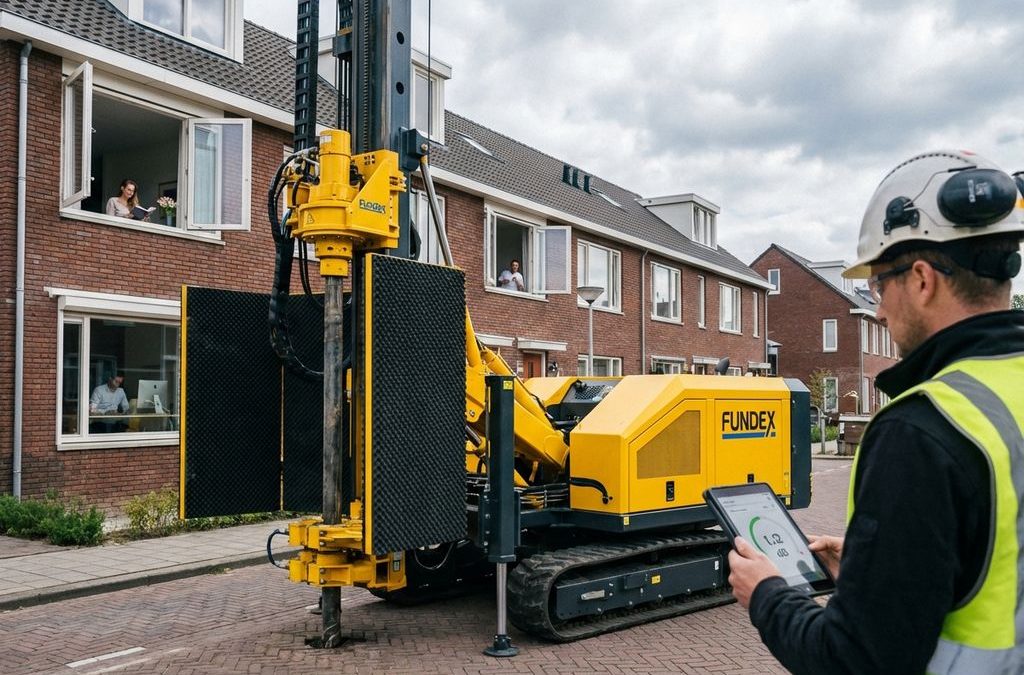
Noise pollution during foundation work can be completely prevented by using modern, vibration-free foundation techniques. Instead of traditional pile driving, which generates heavy vibrations and loud noise, innovative methods use screwing motions to drive piles into the ground. These quiet alternatives offer the same strength and durability as conventional techniques, but without causing any disturbance to the surrounding area.
Why does traditional foundation work cause so much noise pollution?
Traditional pile-driving methods generate intense noise by repeatedly striking a heavy pile driver against piles are driven forcefully into the ground. These striking motions cause vibrations that travel through the ground and sound waves that can be heard for miles. The piling process often generates noise levels of 90 to 110 decibels, comparable to an airplane engine.
The disturbance is caused by the shock waves sent through the ground with each blow of the pile driver. These vibrations can cause damage to nearby buildings, especially older structures with weak foundations. In addition, the repeated blows produce a monotonous, piercing noise that can last for hours.
The problem is exacerbated in urban areas where buildings are closely spaced. Sound waves bounce back and forth between buildings, causing noise levels to rise even further. For nearby residents, this means days of noise pollution during working hours, which can lead to complaints and legal issues.
What vibration-free foundation methods are available?
Modern vibration-free foundation techniques use screwing motions instead of impact force to drive piles the ground. These methods combine axial pressure with torque, allowing piles to be installed piles and quietly, without causing vibrations or loud noise.
Thepile on the principle of “piling without driving.” A steel casing with a detachable drill bit is screwed into the ground to the desired depth, filled with concrete and reinforcing bars, and then the casing is pulled out using an oscillating motion. The only noise comes from the drill’s motor, similar to that of normal construction work.
piles a permanent steel pipe that is installed using the ground-displacement method. This technique is particularly well-suited for soft soil layers, where traditional methods would fail. The grout injection provides additional strength without causing vibrations.
Drilled piles another alternative, in which the soil is drilled out rather than pushed aside. This method is quiet but requires soil removal. For specific applications, there are alsopiles variable diameters andpiles retaining structures.
How do you choose the right low-noise foundation technique for your project?
The selection of a low-noise foundation method depends primarily on the soil conditions and the required bearing capacity. For soil layers with a bearing capacity between 1 and 20 MPa,piles arepiles , whilepiles arepiles for soil layers with a bearing capacity of up to 80 MPa. In very soft soil layers, soil displacement techniques are preferred.
Space constraints play a crucial role in the decision-making process.piles be installed in areas with limited headroom and on small installation sites measuring 2 x 3 meters. For projects requiring an inclined installation, lean angles of up to 4:1 are possible, offering flexibility on complex construction sites.
Environmental factors often determine the final choice. In densely populated urban areas or environmentally sensitive areas, completely vibration-free methods are essential. The distance to adjacent structures varies between 0.5 and 0.9 meters, depending on the technique chosen.
Local regulations regarding noise standards and vibration requirements must be reviewed. Many municipalities enforce strict limits on construction noise, especially in residential areas. Project planning must take these restrictions into account to avoid delays.
What are the benefits of vibration-free foundation work for clients?
Vibration-free foundation work virtually eliminates complaints from nearby residents, allowing projects to proceed without social resistance. Clients avoid legal proceedings, delays caused by objections, and the reputational damage often associated with disruptive construction methods.
This technology makes it possible to work in smaller spaces, as it does not require large pile-driving rigs. The required space ranges from 2 x 3 to 9 x 14 meters, allowing for foundation work even in tight urban environments. This opens up possibilities for projects that would otherwise be unfeasible.
Damage to surrounding buildings is prevented because no vibrations are transmitted through the ground. This saves on costs associated with damage inspections, repairs, and potential compensation payments. This is a crucial advantage, especially for historic buildings or sensitive structures.
Compliance with noise standards is largely ensured automatically. Modern electric piling machines, such as the CD20E, operate emission-free and produce minimal noise. This simplifies permitting procedures and prevents enforcement issues during construction.
Planning flexibility increases because there is no need to take noise-restrictive working hours into account. Projects can be planned more efficiently, without the traditional constraints of noisy construction processes.
For clients looking to prevent noise pollution, vibration-free foundation techniques offer the ideal solution. These methods combine technical excellence with social responsibility. For more information about quiet foundation solutions for your specific project, please contact us for a no-obligation consultation.
Frequently Asked Questions
How long does it take to switch from traditional pile driving to vibration-free methods?
The transition can be completed within 2–4 weeks, depending on the size of the project and the availability of specialized equipment. Planning is crucial because vibration-free machines are less widely available than traditional pile-driving equipment. For optimal results, we recommend contacting us at least 6 weeks before work begins.
Are vibration-free foundation methods more expensive than traditional pile driving?
Direct costs are often 10–20% higher, but this is more than offset by savings on damage inspections, legal proceedings, and delays caused by complaints. In addition, lower insurance costs and faster permitting procedures eliminate many indirect costs. Over the entire project duration, vibration-free methods are often more cost-effective.
What should I do if my municipality doesn't have any experience with vibration-free foundations?
Contact a specialized contractor with experience in the permitting process for vibration-free methods. They can provide technical documentation and reference projects to inform municipal officials. Many municipalities are pleasantly surprised by the benefits and quickly adapt their procedures once they understand the technology.
Can all types of soil be reinforced using vibration-free techniques?
Virtually all soil types are suitable, but the choice of specific technique varies depending on the soil type. Hard layers (rocky subsoil) can be challenging and sometimes require preliminary treatment. A geotechnical investigation is essential to determine the most suitable vibration-free method for your specific location.
How can I verify that my contractor is actually using vibration-free equipment?
Request certification for the equipment being used and ask to see the technical specifications. True vibration-free machines use oscillating or screwing motions without any impact. You can also request references from previous projects and, if necessary, have an independent noise and vibration measurement conducted during the work.
What are the most common mistakes made when installing vibration-free foundations?
The biggest mistake is failing to conduct a thorough soil survey beforehand, which leads to the selection of the wrong technique. In addition, planning often begins too late, resulting in specialized equipment being unavailable. Another common mistake is failing to inform nearby residents about the quiet working method, which means the PR benefits are lost.