
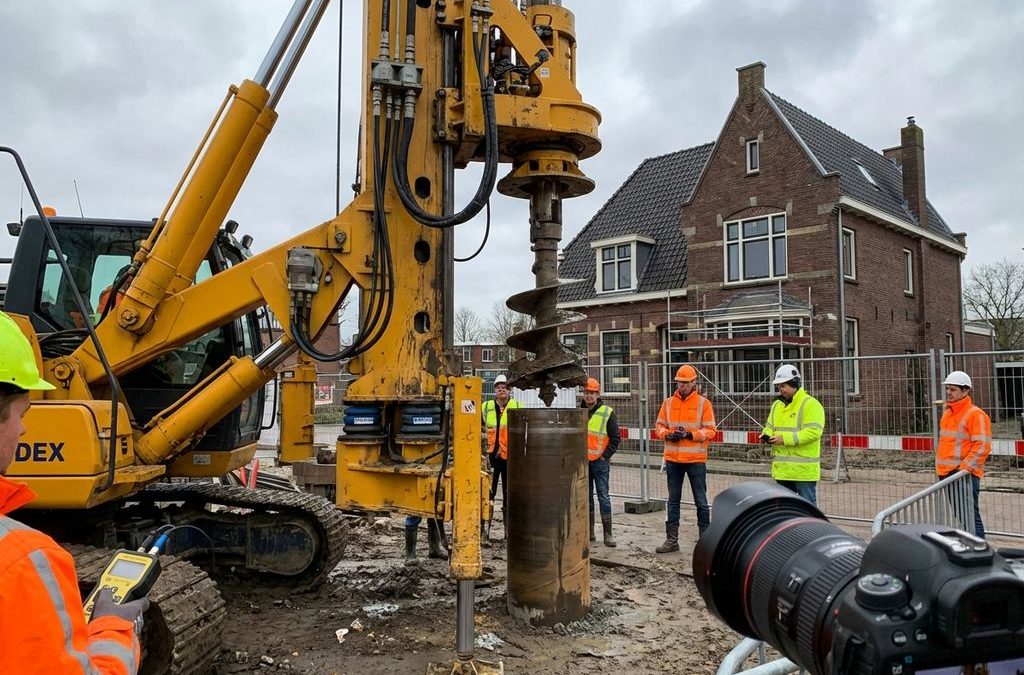
You can prevent vibration damage during foundation work by opting for vibration-free foundation techniques instead of traditional pile driving. These modern methods, such as screw piles and bored piles, eliminate the vibrations caused by driving piles into the ground. This protects surrounding buildings, infrastructure, and residents from damage and disruption.
What are vibrations in foundation work, and what causes them?
Vibrations during pile driving are caused by the mechanical impact force used to drive piles into piles ground. In traditional pile driving, a heavy hammer strikes the pile head repeatedly, with each blow sending shock waves through the ground. These vibrations spread in all directions and can still be felt at a considerable distance.
The physical mechanism behind these vibrations is relatively simple: the kinetic energy of the pile driver is transferred to the pile then to the surrounding soil. This energy transfer causes ground vibrations that propagate as waves through various soil layers. The intensity depends on factors such as the weight of the pile driver, the drop height, the soil type, and the distance from the source.
With conventional pile-driving methods, these vibrations are unavoidable, as the operating principle relies on the use of impact force. Vibratory pile driving, which uses a vibrator, also causes significant vibrations in the ground, albeit with a different frequency pattern than traditional pile driving.
What kind of damage can vibrations cause during foundation work?
Vibrations caused by foundation work can cause various types of damage to buildings, infrastructure, and the surrounding environment. The severity of the damage depends on the intensity of the vibrations, the distance from the source, the soil conditions, and the vulnerability of surrounding structures.
Structural damage to buildings often manifests itself as cracks in walls, ceilings, and foundations. Older buildings and historic structures are particularly susceptible to vibration damage because their construction was not designed to withstand modern construction activities. Vibrations can also widen existing cracks or create new weak spots in the structure.
In addition to causing visible damage, vibrations create significant disruption for residents and occupants of nearby buildings. People find vibrations disruptive and stressful, especially when they persist for long periods. In sensitive environments such as hospitals, schools, and offices, vibrations can disrupt normal operations.
Sensitive equipment in laboratories, hospitals, or manufacturing environments can malfunction or produce unreliable measurements due to vibrations. Vibrations can also cause subsidence or ground shifts, which can indirectly damage nearby foundations and infrastructure, such as pipes and cables.
How does vibration-free foundation construction work, and what techniques are available?
Vibration-free foundation installation involves drivingpiles intopiles ground without using impact force. Instead of hammering, techniques such as screwing, drilling, or pressing are used, allowing the pile to pile reach its position without a sudden transfer of energy that causes vibrations.
Screw piles are driven into the ground using a rotating motion and axial pressure, similar to screwing in a screw. This method is fully soil-displacing and causes no vibrations, as no impact force is used. The soil is pushed aside, so no soil removal is necessary.
Drilled piles constructed by first drilling a hole and then filling it with concrete and reinforcing bars. Although this method requires soil removal, it does not cause vibrations because the drilling process is gradual and does not involve sudden forces.
The “piling without piling” technique combines the advantages of both methods. In this process, a guide pipe is screwed into the ground, filled with concrete and reinforcing bars, and then pulled out using an oscillating motion. This technique is 100% soil-displacing and completely vibration-free, pushing the soil aside rather than driving it out.
Modern electric foundation machines make these techniques even more environmentally friendly by operating without emissions and further reducing noise levels compared to diesel-powered alternatives.
When should you opt for vibration-free foundation techniques?
Vibration-free foundation techniques are essential in situations where vibration damage poses unacceptable risks or causes significant disruption. The choice depends on environmental factors, the sensitivity of nearby structures, and local regulations.
In densely built-up urban areas, vibration-free foundation installation is often the only viable option. The proximity of homes, offices, and other buildings makes the risk of damage and disruption too great for traditional pile-driving methods. Limited available space also makes vibration-free techniques more practical, as they often require more compact machinery.
Historic buildings and monuments almost always require vibration-free foundation techniques due to their fragility and cultural and historical value. These structures are often not designed to withstand modern vibration levels, and repairing any damage is complex and costly.
Sensitive environments such as hospitals, schools, laboratories, and manufacturing facilities with precision equipment cannot operate in the presence of vibrations. In these situations, vibration-free foundations are not only desirable but essential for the continuity of operations.
Vibration-free techniques also offer a solution in environmentally sensitive areas, where noise standards are strict or where the protection of flora and fauna is a priority. The reduced noise level and the absence of vibrations significantly minimize the impact on the surrounding environment.
For projects that require shoring or where work must be carried out in confined spaces, modern vibration-free systems offer greater flexibility than traditional pile-driving rigs. These techniques make it possible to install foundations under difficult conditions without compromising on quality or environmental friendliness.
Choosing vibration-free foundation techniques not only prevents damage and disruption, but also contributes to more sustainable and socially responsible construction practices. For more information about vibration-free foundation solutions for your specific project, please contact us via our quote page.
Frequently Asked Questions
How long does it take to complete vibration-free foundation work compared to traditional pile driving?
Vibration-free foundation techniques are often faster than traditional pile driving because there are no delays due to vibration-sensitive periods and less preparation time is required. For example, screw piles can be installed continuously without interruptions caused by environmental factors. The exact duration depends on the soil conditions and the type pile, but in general, the installation speed is comparable or faster.
Are vibration-free foundation techniques more expensive than conventional pile driving methods?
De initiële kosten van trillingsvrije technieken kunnen hoger zijn, maar de totaalkosten zijn vaak lager door wegvallende schaderisico’s, geen compensatieregelingen voor omwonenden, en snellere uitvoering. Daarnaast vermijdt u kosten voor trillingsbewaking, schouw van nabijgelegen panden, en mogelijke schadeafhandeling. Voor projecten in gevoelige omgevingen is het kostenvoordeel meestal significant.
Can all types of soil be reinforced using vibration-free techniques?
Most soil types are suitable for vibration-free foundation techniques, but the choice of a specific method depends on the soil conditions. Screw piles perform exceptionally well in sandy and clayey soils, while bored piles are piles for harder layers. Pre-drilling may be necessary in very hard soil or rock layers. A geotechnical investigation determines the optimal vibration-free technique for your specific situation.
How do I know if my project requires a vibration-free foundation?
Check the distance to nearby buildings, the presence of historic structures, sensitive equipment, or strict noise regulations in your area. If there are residences within 25 meters, historic landmarks nearby, or if you are working in an urban area, vibration-free foundations are usually required or strongly recommended. Also consult your local municipality for local regulations and restrictions.
What are the main advantages of "piling without piling" compared to bored piles?
De ‘heien zonder heien’-techniek is 100% grondverdringend, waardoor er geen grondafvoer nodig is en geen vervuilde grond hoeft te worden afgevoerd. Dit bespaart kosten en tijd, terwijl de draagkracht door grondverdringing vaak hoger is dan bij geboorde palen. Bovendien is er geen risico op instorting van de boorgaten en kan er gewerkt worden bij hoge grondwaterstanden zonder bemaling.
Can vibration-free foundation techniques also be used for heavy structures?
Ja, moderne trillingsvrije technieken kunnen zeer hoge draagkrachten realiseren. Schroefpalen en ‘heien zonder heien’ kunnen draagkrachten tot 1000 kN of meer bereiken, afhankelijk van de paaldiameter en grondgesteldheid. Voor extra zware constructies kunnen meerdere palen per funderingspunt worden toegepast of kan gekozen worden voor palen met grotere diameters. De draagkracht wordt altijd berekend op basis van grondonderzoek en constructie-eisen.