
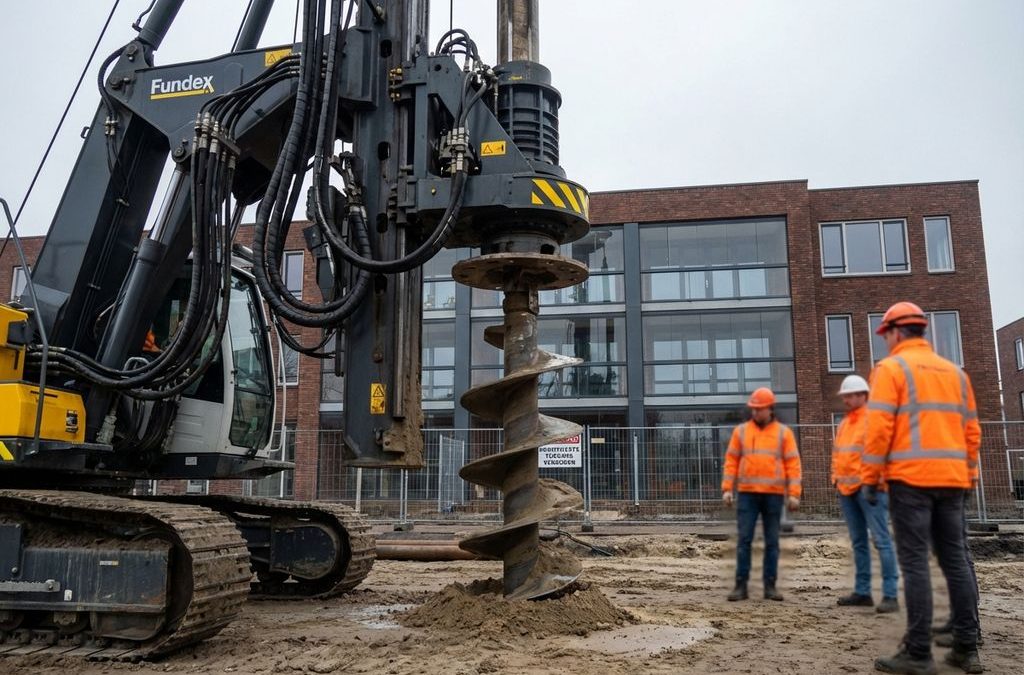
Vibration-free foundation installation is a modern foundation technique in which piles are screwed piles the ground rather than driven, thereby eliminating vibrations and noise pollution. This method prevents damage to surrounding buildings and allows for construction in densely built-up urban areas. The principle of “piling without piling” offers a sustainable alternative to traditional piling methods.
What is vibration-free foundation construction, and how does it work?
Vibration-free foundation installation is a soil-displacement foundation technique in which piles are driven into the ground piles screws, without any impact or vibration. Unlike traditional pile driving, the pile is, pile it were, screwed into the ground, causing the soil to be displaced laterally without any relaxation or reduction in cone resistance.
The operating principle is based on a controlled rotational motion in which the pile is pile rotated into the ground. This displaces and compacts the soil, creating a stable foundation without the adverse effects of vibrations. This method uses special drill bits and hollow pipes to ensure optimal soil displacement.
The technical aspects that eliminate vibrations include the use of rotational movements instead of impact force. The only noise produced comes from the drill’s motor, which represents a significant reduction compared to traditional pile-driving machines. This approach makes it possible to install foundations on relatively small areas without disturbing the surrounding environment.
Why does traditional pile driving cause problems in urban areas?
Traditional pile driving causes significant vibrations and noise pollution that can be harmful to surrounding buildings and residents. The impact force required to drive piles the ground creates vibrations that travel through the soil to nearby structures, which can cause cracks in walls and foundations.
In densely populated urban areas, noise pollution is a major problem for residents and businesses. The constant pounding and vibrations can disrupt work and impair quality of life. Furthermore, the vibrations can damage historic buildings and fragile structures, potentially resulting in costly repairs.
The limitations of working in confined spaces often make traditional pile driving unsuitable for inner-city projects. The required workspace and the impact on the surrounding area limit flexibility and significantly increase project costs. This has led to the development of alternative, vibration-free methods.
What are the benefits of vibration-free foundation work for construction projects?
Vibration-free foundation installation reduces noise pollution and protects surrounding buildings, allowing projects to be carried out in sensitive environments without the risk of damage. This method enables work to be performed in densely built-up areas where traditional pile driving would not be acceptable due to its impact on the surrounding area.
The ability to work in confined spaces significantly increases flexibility. Projects can be carried out with minimal disruption to daily life and business operations in the surrounding area. This leads to better planning and shorter completion times.
In addition, vibration-free foundation installation offers high load-bearing capacity and is ideally suited for use as both compression and tension piles. No soil removal is required, as the soil is displaced laterally, saving both time and money. The increased flexibility in project planning makes it possible to carry out complex construction projects without the limitations of traditional foundation methods.
How does vibration-free foundation construction contribute to sustainable building?
Vibration-free foundation work contributes to sustainable construction through the use of zero-emission electric machinery and a reduced environmental impact. Modern, electric-powered foundation machines produce no direct emissions, resulting in a significantly lower environmental impact compared to diesel-powered alternatives.
The quieter operation of electric pile-driving machines is particularly beneficial in environmentally sensitive areas, where noise pollution is a major concern. The reduced noise level contributes to a better living environment around construction sites and minimizes disruption to local wildlife.
Innovative foundation methods comply with increasingly stringent emissions regulations and are suitable for areas where the use of diesel-powered equipment is restricted. This development aligns with the ESG (Environmental, Social, Governance) guidelines for 2030, 2040, and 2050, enabling construction projects to contribute to green building certifications and sustainability goals.
Vibration-free foundation construction represents a significant step forward in the construction industry, combining technological innovation with respect for the environment. For construction projects that must meet modern sustainability and quality standards, this method offers the ideal balance between technical performance and social responsibility. Contact us for more information about vibration-free foundation solutions for your project.
Frequently Asked Questions
How long does it take to install a vibration-free foundation compared to traditional pile driving?
Vibration-free foundation installation is often faster than traditional pile driving because no preparation time is required for vibration-reduction measures and there is less downtime due to noise restrictions. The exact duration depends on soil conditions and project scope, but on average, 20–30% of the time can be saved thanks to the more efficient method and reduced disruptions.
In what types of soil is vibration-free foundation construction most effective?
Vibration-free foundation systems work exceptionally well in sandy and clayey soils where the ground can be easily displaced. In very hard layers, such as rock formations or very dense sand layers, the method may have limitations. A preliminary soil investigation is essential to determine suitability and select the appropriate drill bits.
What is the cost of vibration-free foundation installation compared to traditional methods?
Although the direct construction costs of vibration-free foundation work are comparable to those of traditional pile driving, the total project costs are often lower due to the elimination of costs associated with vibration monitoring, damage prevention, and compensation for disruption. In addition, projects can be completed more quickly, which results in indirect cost savings.
How deep can piles driven using vibration-free foundation techniques?
Using modern vibration-free foundation techniques, piles can be driven piles depths piles 25–30 meters, depending on soil conditions and the type of installation. For very deep foundations, special extension pieces and more powerful rotary units can be used to reach the desired depth.
What permits are required for vibration-free foundation work in urban areas?
Vibration-free foundations generally require the same building permits as traditional foundations, but there are often fewer restrictions regarding working hours and noise standards. In some municipalities, simplified procedures may apply due to the reduced disturbance. It is advisable to contact the local municipality in advance to inquire about specific regulations.
Can vibration-free foundation work be used in renovation projects for existing buildings?
Yes, vibration-free foundation installation is particularly well-suited for renovation projects because there is no risk of damage to existing structures. The method can even be used in basements or confined spaces where traditional pile driving would be impossible. This makes it ideal for foundation reinforcement and extensions of historic buildings.