
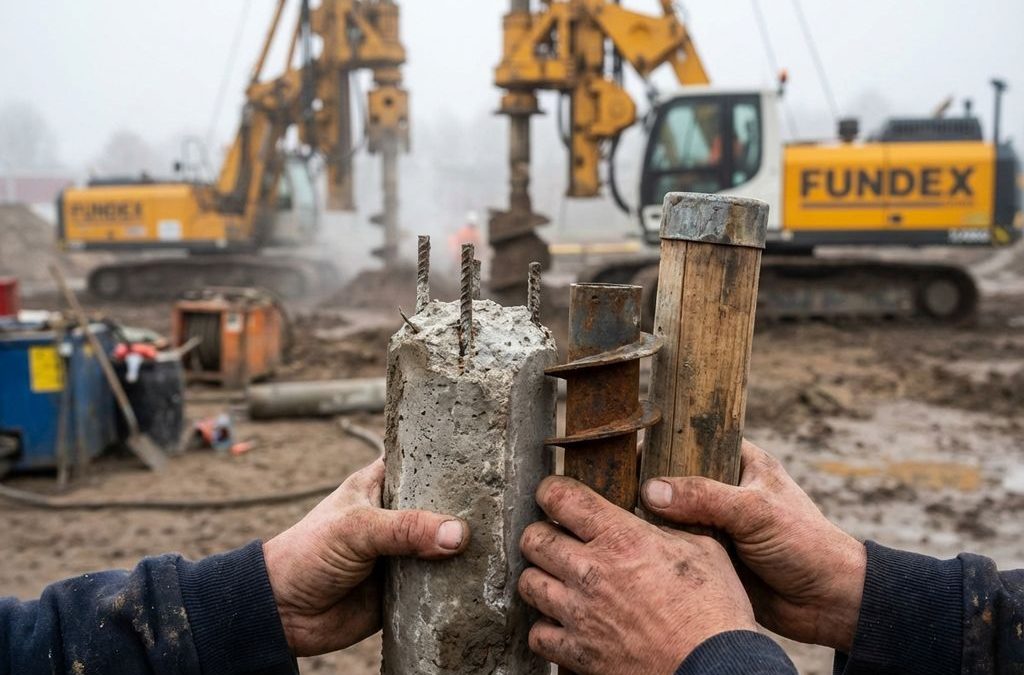
The choice of the right foundation pile depends on various factors, such as soil type, bearing capacity, load, and environmental conditions. Concrete piles offer durability and high bearing capacity, while steel piles provide piles in difficult soil conditions. Vibration-free methods are essential for sensitive construction projects, and the correct dimensions are determined based on soil investigations and load calculations.
What factors determine the choice of a foundation pile?
The choice of a foundation pile is primarily determined by soil type, bearing capacity requirements, and project-specific conditions. Soil testing forms the basis for this decision, supplemented by structural requirements and environmental constraints, such as nearby buildings or noise restrictions.
Soil conditions play a crucial role in the selection of piles. In soft soil layers, displacement piles are piles the best option, as they displace the soil laterally without causing settlement. In erratic soil layers with varying hardness, different techniques may be necessary to penetrate hard layers.
Environmental factors often determine which installation method is feasible. In densely built-up areas or near historic buildings, vibration-free foundation work is essential to prevent damage to adjacent structures. Noise restrictions can also influence the choice, with quiet installation methods being preferred.
The loads that the pile bear—both compressive and tensile loads—determine the required load-bearing capacity and, consequently, the type of pile. Some piles specifically designed to withstand both compressive and tensile loads, while others are primarily used for compressive loads.
What are the main differences between concrete piles and steel piles?
Concrete piles offer high durability and load-bearing capacity at a relatively low cost, while steel piles offer piles during installation and are suitable for specific applications, such as permanent pipe structures. The choice depends on project requirements, soil conditions, and the desired service life.
Concrete piles are cast on site and offer excellent compressive strength. They can be reinforced along their entire length for optimal quality and are suitable for all concrete strength classes. A key advantage is that the pile length is determined from the pile tip to ground level, allowing for customization.
Steel piles, such as thepile, consist of permanent steel tubes that remain in the ground as part of the structure. These piles available with tube diameters ranging from 168 mm to 762 mm, with corresponding drill bit diameters ranging from 310 mm to 950 mm. They are particularly suitable for situations with limited space and can be installed up to approximately 30 meters in length.
Installation methods differ significantly between the two types. Concrete piles are often driven into the ground using guide tubes, which are removed after the concrete is poured. Steel piles installed with the casing in place, and the casing remains a permanent part of the foundation structure.
When should you choose vibration-free foundation methods?
Vibration-free foundation methods are essential for sensitive construction projects, historic buildings, and densely built-up areas where damage to adjacent structures must be prevented. These methods minimize vibrations and noise pollution, making them ideal for urban projects with strict environmental restrictions.
Thepile a vibration-free, soil-displacing concrete pile manufactured using a steel casing that is installed by screwing. The screwing installation process generates no vibrations, while the soil is displaced 100%, without causing soil relaxation or a reduction in cone resistance.
The installation process involves applying axial pressure and torque to the casing with a detachable drill bit. Once the desired depth is reached, the reinforcement is installed, the casing is filled with concrete, and then it is pulled out in an oscillating motion, leaving the drill bit behind. This process produces only the sound of the drill.
For very heavy soil conditions, grout injection can be used, involving the installation of precast elements and the use of grout to provide additional strength. This method allows for installation in challenging soil conditions without causing vibrations.
How do you determine the correct pile length and diameter for your project?
The correct pile dimensions are determined by soil investigations, load calculations, and bearing capacity requirements. The pile length depends on the depth of the load-bearing soil layers, while the diameter is determined by the required bearing capacity and the available space for installation.
Standardpiles shaft diameters of 380 mm, 460 mm, and 540 mm, with corresponding drill bits of 450 mm, 560 mm, and 660 mm. The pile length can be up to approximately 35 to 40 meters, with the pile to ground level. Other dimensions can be used for specific projects.
For variable loads, apile —which is thicker at the top than at the bottom—can bepile . This provides better resistance to bending moments and lateral forces while reducing concrete consumption. The thicker top also allows for faster drilling due to the smaller diameter of the bottom.
For projects involving extreme loads, Superpiles enlarged bases can be used. Base diameters can be made up to 50 cm larger than the pipe diameters, ensuring high load-bearing capacity even in soft soil layers. The load-bearing capacity is calculated in accordance with EC, NEN, and CUR standards to ensure optimal safety.
Choosing the right foundation pile requires careful consideration of all project factors. From soil conditions to environmental restrictions, every aspect influences the optimal choice. Vibration-free methods often offer the best solution for urban projects, while the correct dimensions are crucial for safety and cost-efficiency. Please contact us for advice on the most suitable foundation solution for your specific project.
Frequently Asked Questions
How long does the installation process for foundation piles take?
The installation time depends on the type of pile and the soil conditions. On average, piles vibration-freepiles piles piles be installed piles day, depending on the depth and soil resistance. Steel piles often piles more quickly, while complex soil layers require more time.
What is the cost of vibration-free foundation construction compared to traditional methods?
Trillingsvrije methoden zijn doorgaans 10-20% duurder dan traditionele trillingsfundering, maar besparen vaak kosten door het vermijden van schaderisico’s aan belendingen. De meerkosten worden vaak gecompenseerd door kortere projecttijden en minder omgevingsbeperkingen.
Can I install foundation piles without a soil survey?
Soil investigation is required by law and essential for safe foundations. Without soil testing, it is impossible to determine the correct pile length, bearing capacity, and installation method. This can lead to foundation failure or unnecessary additional costs due to over-engineering.
How do I know if my soil is suitable for soil-displacement piles?
Displacement piles ideal for soft to moderately firm soil layers without hard obstacles. They are generally suitable for sandy soils with densities less than 15 MPa and clay soils. Rock layers or rubble often require other techniques, such as bored piles.
What happens if unexpected soil layers are encountered during installation?
If unexpectedly hard layers are encountered, the installation method can be adjusted, for example by switching to pre-drilling or grout injection. The pile supplier will adjust the installation plan and calculate any additional costs. That is why an experienced contractor is essential.
What permits are required to install foundation piles?
A building permit is usually required for foundation piles. In urban areas, a vibration or noise exemption may be necessary. Additional requirements often apply near historic landmarks or in protected areas. Always consult your local municipality for specific permit requirements.