
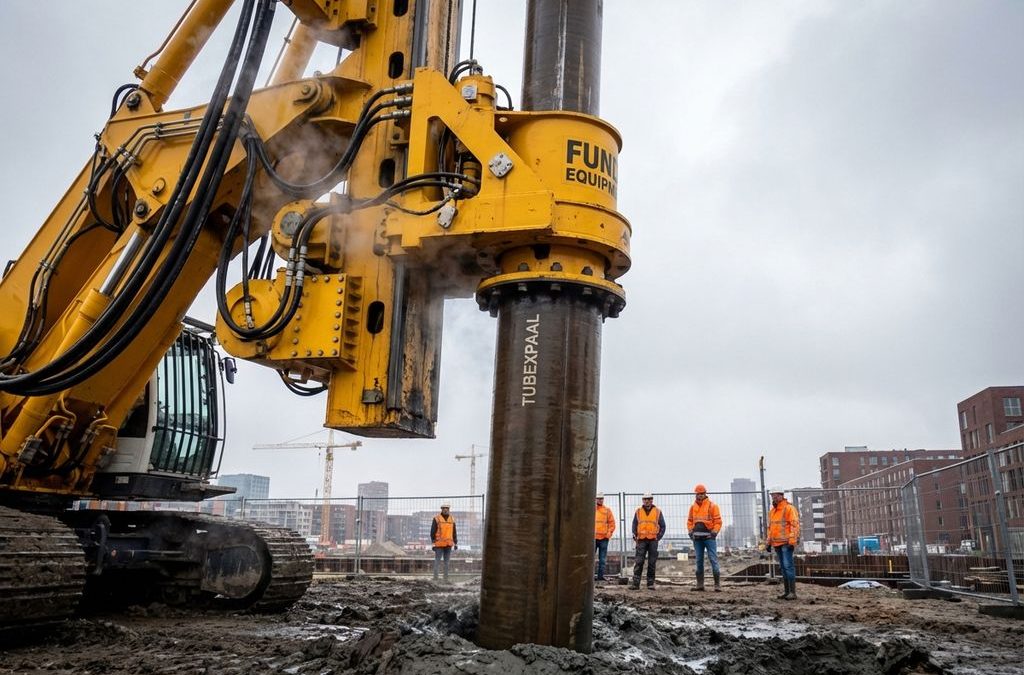
A tubex pile the best choice when you want vibration-free foundations in soft to very heavy soil layers, especially in confined spaces or near vulnerable buildings. This soil-displacing concrete pile with permanent steel pipe offers excellent performance in soil layers from 1 to 80 MPa and is ideal for projects that need to absorb both high compressive and tensile forces without vibrations or soil subsidence.
What is a tubex pile how does this foundation method work?
A tubex pile a vibration-free, soil-displacing concrete pile with a permanent steel tube that is screwed into the ground to the required depth. The steel tube has a welded drill tip and is twisted into the ground using axial pressure and torque, displacing the soil without causing vibrations.
The installation process consists of two phases. In the first phase, the steel pipe with welded drill tip is placed at ground level and screwed down to the desired depth. Once the pile tip level has been reached, the foundation machine can move on to the next location. In the second phase, the pipe is cut to the exact height, reinforced, and filled with concrete.
What makes this technique unique is that the permanent steel pipe remains part of the structure, unlike other methods where the pipe is pulled out. This feature makes the tubex pile soil displacement, without soil relaxation or reduction of cone resistance.
In which soil conditions is a tubex pile best choice?
Tubepiles perform optimally in soil layers with cone values between 1 and 20 MPa, with very soft soil layers being the most suitable application area. In such soft soils, deformation of the pile shaft cannot occur due to the permanent steel tube.
For very heavy soil layers up to approximately 80 MPa, there is the option of Tubex piles with grout injection. This variant creates a grout shell in sand layers with the same diameter as the drill tip diameter, which significantly increases the load-bearing capacity. The grout injection also makes it possible to piles obstacles such as masonry, poor-quality concrete, and existing wooden piles .
Problematic soils where other foundation methods fail are often ideal for Tubex piles. The technique works well in unpredictable soil layers and offers the possibility of pushing through if a sufficiently load-bearing layer has not yet been reached. In cases of doubt, the pile tip level can be guaranteed.
When should you choose a tubex pile other foundation methods?
Choose a tubex pile vibration-free foundation is essential and you are dealing with limited space or height. This method differs from traditional pile driving methods due to the complete absence of vibrations and the ability to work in confined spaces.
Compared to Funde piles, with Tubexpalen piles the steel pipe remains permanently in the ground and the drill tip is welded on rather than loose. This makes Tubexpalen piles more suitable for situations in which large tensile and compressive forces must be absorbed and in which moments and deformations must be limited.
This technique is superior to vibrating methods when nearby buildings are sensitive to vibrations. Tubepiles can be used as temporary foundation piles and can be installed at angles of up to 4:1 forward, 1:1 backward, and up to 3:1 sideways. The required working space varies from 2×3 to 9×14 meters, allowing for flexibility in tight construction sites.
What advantages does a tubex pile offer tubex pile your construction project?
The main advantage of tubex piles is that they provide vibration-free foundations without causing any nuisance to the surrounding area, making them ideal for projects near sensitive buildings or in urban areas. The method is 100% soil displacement, without soil removal, because the soil is pushed aside.
Tubex piles are ideal for confined construction sites due to their compact installation space and the ability to work in areas with limited height. The distance to adjacent structures can be limited to 0.5–0.9 meters perpendicular to the adjacent structure, depending on the foundation machine used.
From an economic perspective, Tubex piles offer advantages due to the rapid installation method and the absence of soil removal. In principle, the piles be installed to an unlimited length of up to approximately 30 meters, with the pile head being installed at ground level or below. The permanent steel pipe ensures durability and high load-bearing capacities, while different pipe diameters from 168 mm to 762 mm allow for customization.
Would you like to know whether Tubex piles are the right choice for your specific project? Contact us via our quotation page for an expert analysis of your foundation issue and tailored advice.
Frequently Asked Questions
How much does a tubex pile cost tubex pile per linear meter?
The cost of a tubex pile depending on factors such as pipe diameter, soil conditions, project size, and site accessibility. For an accurate cost calculation, it is important to have the specific project conditions assessed by a specialist. Contact us for a free, customized quote.
How long does it take to install Tubex piles compared to other foundation methods?
Tubepiles can be installed relatively quickly thanks to the efficient two-phase method. The installation speed depends on the soil conditions, pile length, and diameter, but in general, the method is faster than traditional pile driving methods due to the lack of preparatory groundwork and direct installation.
What happens if tubex pile obstacle is encountered during the installation of a tubex pile ?
When encountering obstacles such as old foundations, masonry, or existing wooden piles , Tubex piles with grout injection piles be used. This variant can drill through most obstacles. If necessary, the pile tip level can be adjusted or pushed through until a more suitable load-bearing layer is reached.
Can Tubex piles be used for temporary structures?
Yes, Tubex piles are ideal for use as temporary foundation piles for temporary building structures, cranes, or support structures, for example. After use piles the piles can be cut off below ground level, leaving the steel pipe in the ground without any adverse effects on future construction.
How is the quality and load-bearing capacity of an installed tubex pile ?
Quality is controlled by monitoring installation parameters such as torque, axial pressure, and penetration speed during installation. After installation, test loads can be carried out to verify the actual load-bearing capacity. The permanent steel pipe also allows for internal inspection and quality control of the concrete.
What are the most important considerations when designing a foundation with Tubex piles?
Important design factors include correctly determining the pile length based on soil investigations, selecting the appropriate pipe diameter for the loads, and determining the required reinforcement. The limited working space, accessibility for the foundation machine, and any restrictions due to nearby buildings or pipes must also be taken into account.