
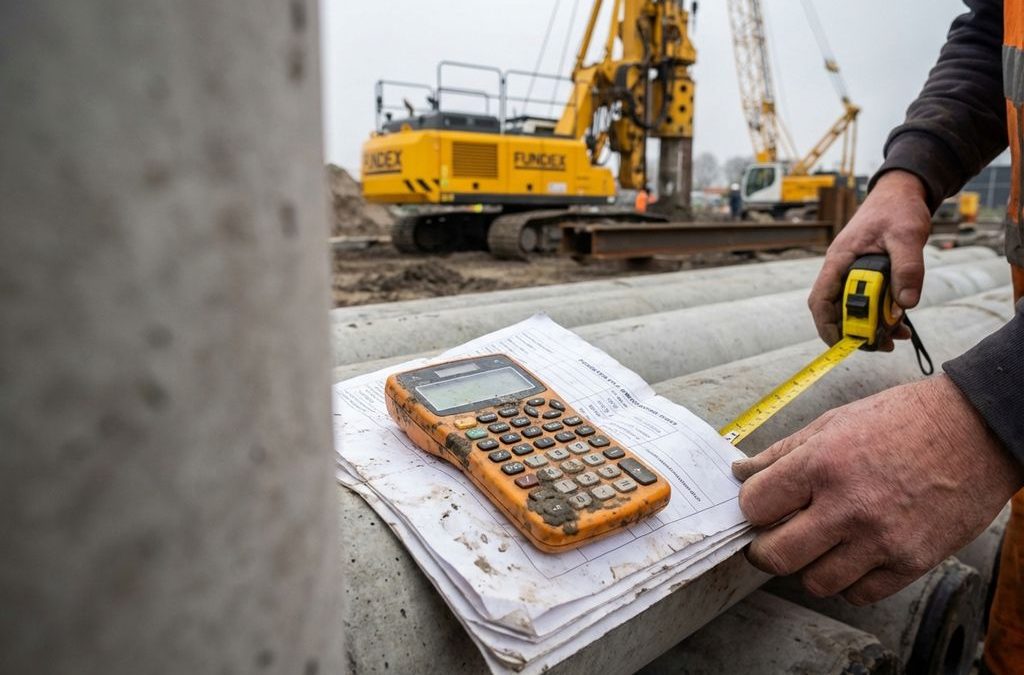
The price of foundation piles is determined by several factors that together make up the total project cost. Pile type, soil conditions, and project specifications are the main cost drivers. Modern vibration-free techniques may initially be more expensive than traditional pile driving, but they often result in cost savings due to faster execution and less disruption. In addition to the base pile price, you must account for additional costs, such as soil testing, permits, and equipment transport.
What factors determine the base price of foundation piles?
The pile type and technical specifications form the basis for pricing foundation work.piles,piles composite piles each have different cost prices due to their unique production processes and material requirements. The shaft diameter plays an important role, with standard sizes ranging from ø380 mm to ø540 mm having different price levels.
Pile length directly affects material costs and labor intensity.piles be installed to a depth of approximately 35 to 40 meters, whilepiles permanent steel casings reach a maximum depth of around 30 meters. Longer piles more concrete, more extensive reinforcement, and a longer installation time.
Material specifications, such as concrete strength class and reinforcement type, also determine the cost. piles are reinforced along their entire length for quality reasons are more expensive than piles only head reinforcement. Forpiles , the cost of the permanent steel tubepiles alsopiles ; this varies from ø168 mm to ø762 mm, along with the corresponding drill bits.
How do soil conditions affect the cost of your foundation project?
Soil conditions have a direct impact on the choice of foundation technique and equipment, which significantly affects project costs. Standardpiles canpiles used in soil layers with a strength of 1 to 20 MPa, while very soft layers require systems with permanent casing, such aspiles.
Grout injection is necessary in cases of very heavy soil conditions, such as with Fundexpiles Tubexpiles, which entails additional material and labor costs. The bearing capacity of the soil also determines the required pile diameter and length, with weaker soils piles longer or thicker piles .
The accessibility of the construction site influences the choice of foundation machine. Confined spaces require more compact rigs a footprint of 2 x 3 meters, while open areas allow for larger machines with a footprint of 7 x 12 meters. The distance to adjacent structures is also a factor, with piles typically installed piles approximately 0.9 meters perpendicular to the adjacent structure.
What is the price difference between traditional pile driving and vibration-free foundation installation?
Vibration-free piling often involves higher initial costs per pile, but offers significant savings through faster project completion and less disruption. Traditional piling methods often require extensive vibration-reduction measures and can pose a risk of damage to surrounding buildings.
The added value of vibration-free techniques, such as Fundex®, becomes clear in urban environments where disturbances must be minimized. The “piling without piling” principle eliminates the costs associated with vibration and noise monitoring, potential compensation claims, and delays caused by complaints.
In the long term, modern technologies, such as thepile, offer economic benefits by reducing the amount of concrete required and enabling faster drilling thanks to the smaller diameter at the bottom. The thicker top section provides better resistance to bending moments, allowing for material savings without compromising quality.
What additional costs should you factor in for foundation work?
In addition to the base price, there are several often-overlooked cost items that can significantly impact the total budget. Soil testing is essential for selecting the right engineering solution and costs between a few thousand and tens of thousands of euros, depending on the project’s size and complexity.
Permit fees and inspections are a standard part of every foundation project. Static tests for compressive and tensile strength, ultrasonic integrity tests, and dynamic tests are necessary for quality assurance, but they require additional time and money.
Transporting heavy equipment can involve significant costs, especially at remote locations. Machines range in weight from 13 to 120 tons and sometimes require specialized transport. For projects in urban areas, additional arrangements may be needed for traffic control or temporary infrastructure.
An accurate cost estimate therefore requires a holistic approach that takes all aspects into account. A customized approach is essential for a detailed quote that covers all cost items. Every foundation solution is unique and requires specialized knowledge to determine the most cost-effective approach.
Frequently Asked Questions
What is the best way to estimate the cost of my foundation project before requesting a quote?
Start by determining your project specifications: number piles, estimated depth, and desired bearing capacity. Request a soil survey to assess the soil conditions, as this will largely determine the choice of technique. Also assess the accessibility of your construction site and any potential limitations. With this basic information, you can get a realistic idea of the costs before requesting professional quotes.
When is it more cost-effective to opt for more expensive vibration-free techniques instead of traditional pile driving?
Vibration-free techniques are particularly advantageous in urban areas with nearby buildings, when working to tight schedules, and when it is necessary to minimize disruption. Although the cost per pile is higher, you save on monitoring, potential damage costs, and project delays. For projects involving more than 50 piles residential areas, the total costs are often lower than those of traditional pile driving.
What happens to the costs if unexpected soil conditions are encountered during the foundation work?
Unexpected soil conditions can lead to additional work, such as deeper piles, stronger reinforcement, or a different foundation technique. A thorough preliminary soil investigation significantly minimizes this risk. Discuss with your contractor in advance how such situations will be handled, and set aside a contingency budget of 10–15% for unforeseen circumstances.
How long does an average foundation project take, and how does this affect the total cost?
An average foundation project for a home takes 2–5 business days, depending on the number piles the chosen technique. Modern vibration-free techniques are often faster than traditional pile driving. A shorter project duration means lower equipment costs, less disruption, and a quicker resumption of construction. For complex projects, the preparation phase (permits, surveys) can take 4–8 weeks.
Can I save money by handling parts of the foundation project myself?
You can organize the soil investigation yourself, which can help you save some money. You can also handle permit applications on your own if you have the necessary expertise. However, the actual foundation work requires specialized knowledge and certification, so it must always be carried out by professionals. Focus on thorough preparation and comparing quotes to get the best value for your money.
What kind of warranty do I get on foundation work, and what does this mean for long-term costs?
Professional foundation contractors typically offer a 10- to 20-year warranty on their work, depending on the techniques and materials used. Modern techniques such as Fundex® and Tubex® have a proven lifespan of 50+ years. Always choose certified contractors with comprehensive warranty terms, as this prevents costly repairs and provides peace of mind regarding your long-term investment.