
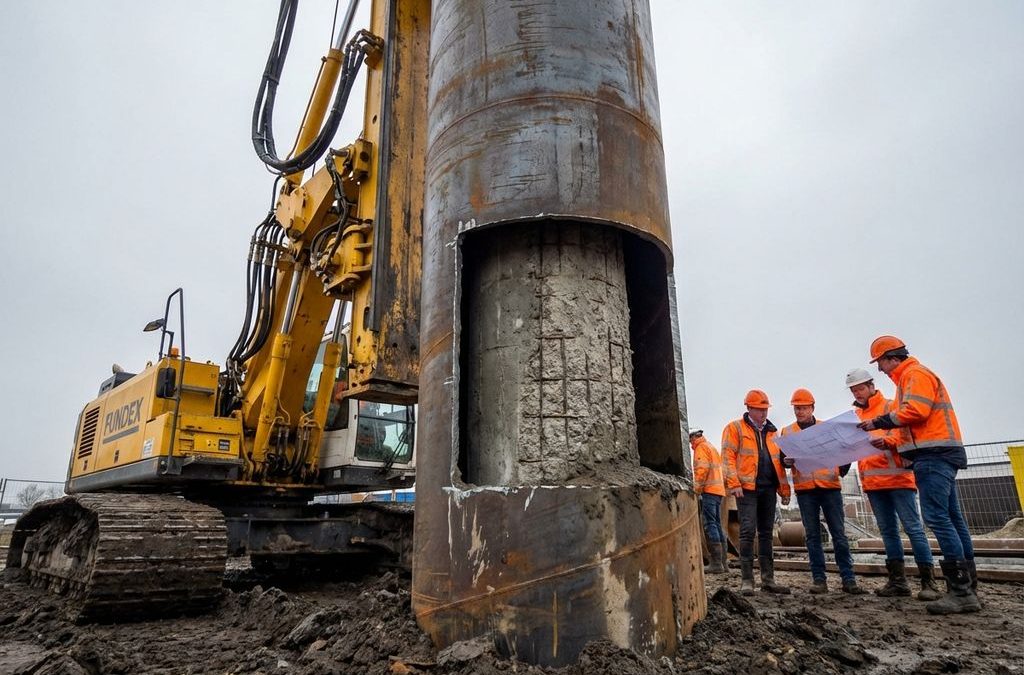
A tubex pile is a vibration-free, soil-displacing concrete pile with a permanent steel pipe that is screwed into place at depth. This innovative foundation method combines the advantages of traditional foundations with modern technology, whereby the steel pipe remains permanently in the ground after installation as part of the structure. Tubex piles offer an excellent solution for projects where vibration and noise pollution must be kept to a minimum.
What tubex pile is a tubex pile and how does this foundation method work?
A tubex pile a ground-displacing concrete pile that is installed using a permanent steel pipe and a welded drill tip. This foundation method differs from traditional techniques in that the steel pipe remains permanently in the ground and forms part of the final structure.
The operating principle consists of two distinct phases. During the first phase, the steel pipe with welded drill tip is placed at ground level and then screwed into place at depth using axial pressure and torque. Once the desired pile tip level has been reached, the rig can rig moved to the next location. In the second phase, the steel pipe is cut to the exact height, the reinforcement is inserted into the pipe, and the pipe is filled with concrete.
The tubex pile available in various pipe diameters, ranging from 168 mm to 762 mm, with corresponding drill bits from 310 mm to 950 mm. The maximum length is approximately 30 meters, whereby the pile head can be installed at ground level or recessed.
Why are more and more construction projects choosing Tubex piles?
Tubepiles are becoming increasingly popular due to their unique combination of vibration-free foundation and high load-bearing capacity. This method is 100% soil displacement, without soil relaxation or reduction of cone resistance, resulting in optimal stability and load-bearing capacity.
The main advantages make Tubex piles particularly suitable for modern urban construction projects. They are ideal for absorbing large compressive and tensile forces and moments and for limiting deformations. In addition, they can be used in areas with limited height or space, with rake angles of up to 4:1 forward, 1:1 backward, and up to 3:1 sideways.
The tubex pile offers tubex pile advantages for projects in very soft soil layers, as deformation of the pile shaft cannot occur. The method can also be used as a temporary foundation pile and can be implemented in soil layers ranging from 1 to 20 MPa. In very heavy layers, grout injection can be used, enabling cone values of up to approximately 80 MPa.
How does a tubex pile differ tubex pile other foundation methods?
The main difference between Tubex piles and other foundation methods lies in the permanent steel pipe and the vibration-free installation method. While traditional piles are driven into the ground with vibrations and noise pollution, Tubex piles are screwed into place at depth.
Compared to the Fundex pile, where the steel auxiliary tube is withdrawn after concreting, with the tubex pile steel tube remains permanently in the ground. This provides extra stability and makes the pile for both compressive and tensile forces. The drill tip is welded to the tube, rather than being separate as with other systems.
Drilled piles often piles soil removal and can cause problems in soft soil layers. Tubex piles, on the other hand, displace the soil laterally, eliminating the need for soil removal and preserving the original soil structure. For projects with limited access, the tubex pile offers tubex pile due to its compact installation footprint of 2×3 to 9×14 meters.
In very difficult soil conditions, the tubex pile can tubex pile combined with grout injection, allowing piles penetrate obstacles such as masonry, deteriorated concrete, and existing wooden piles —something that is often not possible with traditional methods.
For which construction projects are Tubex piles most suitable?
Tubepiles are ideal for urban construction projects where vibration and noise pollution must be kept to a minimum. The vibration-free installation method makes them ideal for projects near sensitive buildings, historic buildings, or in densely built-up areas.
Renovation projects are an important area of application, especially when foundations need to be laid close to existing structures. With a minimum distance of approximately 0.5 to 0.9 meters perpendicular to adjacent structures, Tubex piles can be installed without damaging surrounding buildings. In the case of recessed corners, this distance can be increased for optimal accessibility.
Projects with limited accessibility benefit from the flexibility of Tubex piles. They can be used in areas with limited height and can be installed using various rigs, from the compact F10 to the large F3500. The weight of the rigs from 13 to 120 tons, ensuring that a suitable solution is available for every situation.
For construction projects in very soft soil layers, such as peat areas or clay layers, Tubex piles offer a reliable solution because the pile shaft cannot deform. In combination with grout injection, they can also be used in very heavy soil layers, allowing a wide range of soil conditions to be addressed.
Tubepiles represent an advanced foundation solution that combines the advantages of modern technology with proven reliability. They are an excellent choice for projects where quality, sustainability, and minimal environmental impact are essential. If you have any questions about the applicability of Tubepiles for your specific project, please contact us for a no-obligation quote.
Frequently Asked Questions
How long does it take to install Tubex posts, and what are the main steps in the process?
The installation time depends on the pile length and soil conditions, but on average, 15–25 piles can be installed piles day. The process consists of two main phases: first, screwing the steel pipe to the desired depth (approximately 10–15 minutes per pile), followed by burning off the excess, placing reinforcement, and pouring concrete (another 10–15 minutes). This efficient method allows projects to be completed quickly.
What are the costs of Tubex piles compared to traditional foundation methods?
Although Tubex piles may initially be slightly more expensive than traditional piles, the lower total costs compensate for this difference. There are no costs for vibration measurements, damage prevention to surrounding buildings, or soil removal. In addition, the rapid installation ensures shorter construction times and lower overhead costs, often making the total project more cost-effective.
Can Tubex piles be used in groundwater or at high groundwater levels?
Yes, Tubex piles are ideal for use in groundwater. The permanent steel pipe protects the concrete against aggressive groundwater influences and prevents leaching. At high groundwater levels, installation can continue without special drainage, because the process is completely soil-displacing and does not require an open borehole.
How is the quality and load-bearing capacity of Tubex piles checked during installation?
During installation, continuous measurements are taken of torque, axial pressure, and penetration speed. These parameters are recorded in real time and compared with pre-calculated values. After installation, test loads can be applied to verify the actual load-bearing capacity. The permanent steel pipe also allows for visual inspection of the pile integrity.
What happens if obstacles such as old foundations or debris are encountered during drilling?
When combined with grout injection, Tubex piles can piles obstacles such as masonry, deteriorated concrete, and old wooden piles . For particularly stubborn obstacles, the drill bit can be modified or a pilot hole can be drilled locally. This makes Tubex piles particularly suitable for renovation projects where existing foundation remnants may be encountered.
Is it possible to remove or modify Tubex posts later on for future construction plans?
Because the steel pipe is a permanent part of the structure, Tubex piles are not intended for temporary use like some other pile systems. However, special designs can be used for temporary foundations. In future renovations, existing Tubex piles can often be integrated into the new design due to their high load-bearing capacity and flexibility.