
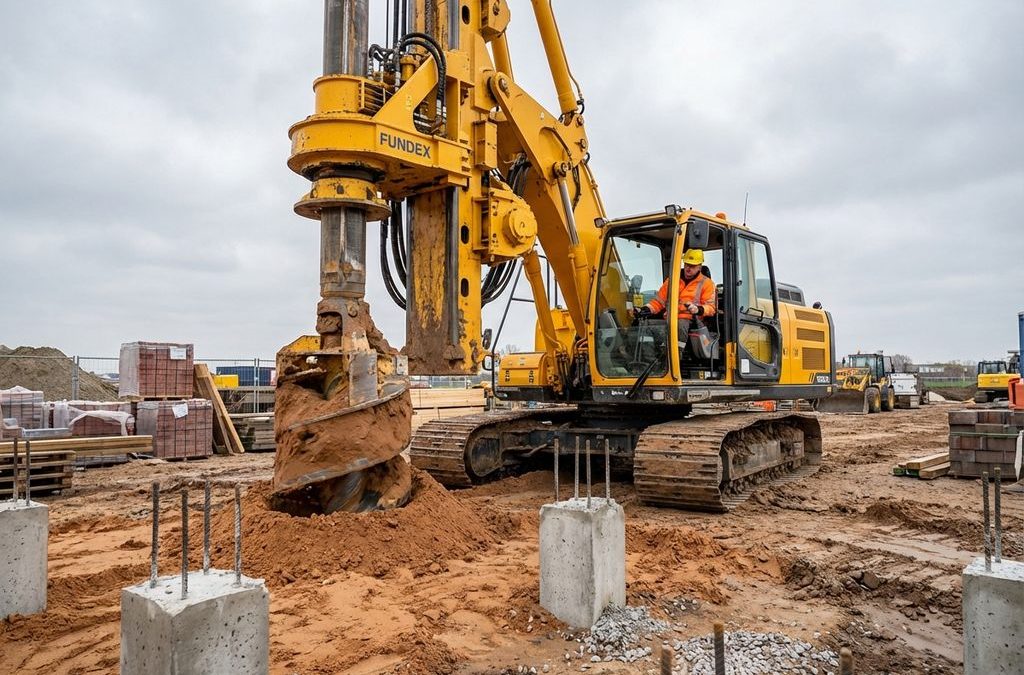
Foundation work is the process of creating a solid base for buildings and structures by transferring the load of the structure to load-bearing soil layers. This fundamental part of any construction project ensures that structures remain stable and safe for use. There are various foundation methods, from traditional piles to modern vibration-free techniques.
What is foundation work and why is it so important for every construction project?
Foundation work involves creating a stable connection between a structure and the ground. The aim is to safely transfer all forces and loads from the building to load-bearing soil layers, thereby preventing settlement, subsidence, or collapse.
A solid foundation literally forms the basis for the safety and durability of any structure. Without adequate foundations, buildings can become crooked, develop cracks or, in the worst case, collapse. This applies to all types of structures, from homes to high-rise buildings and from bridges to industrial complexes.
The choice of the right foundation method depends on various factors: the soil conditions at the site, the load on the structure, the presence of groundwater, and environmental factors such as vibration-sensitive buildings in the vicinity. A good foundation must not only be strong enough to bear the weight, but also resistant to horizontal forces such as wind and seismic activity.
What different foundation methods are there?
There are various foundation methods, each with its own area of application. The main categories are shallow foundations, deep foundations, and special techniques for complex situations.
Shallow foundations are used when load-bearing soil is located at a shallow depth. These include foundation slabs, strip foundations, and point foundations. These methods are cost-effective but only suitable in good soil conditions.
Deep foundations are necessary when load-bearing layers are located deeper. Important techniques include:
- Piles: traditional method in which prefab concrete piles or steel tubular piles are driven into the ground
- Drilled piles: concrete piles poured on site and installed by means of drilling
- Combination piles: combination of prefabricated elements with grout injection for extra strength
- Vibration-free methods: modern techniques in which piles screwed in rather than driven
Special techniques, such as energy piles, combine structural support with sustainable energy generation through geothermal heat exchange via piping embedded in the reinforcement.
How does vibration-free foundation work and what are the advantages?
Vibration-free foundation installation is an innovative technique in which piles are, piles it were, screwed into the ground rather than driven into it. This method eliminates vibrations and noise pollution during the foundation installation process.
The principle of "piling without piling" works by means of controlled rotation and pressure. Special drill bits and pile systems ensure that the pile penetrates the ground without shock loads. This process can be carried out with both conventional machines and fully electric units for emission-free working.
The advantages of vibration-free foundation techniques are considerable:
- No vibration nuisance for surrounding buildings and residents
- Minimal noise pollution, ideal for inner-city projects
- Ability to work in confined spaces
- No risk of damage to adjacent structures
- Better workability in sensitive environments such as hospitals or laboratories
These methods are particularly valuable in urban areas where traditional pile driving would cause problems. The technique makes it possible to carry out foundation work without the surrounding area being affected by the construction work.
When do you need deep foundations for your construction project?
Deep foundations are required when the upper soil layers do not provide sufficient bearing capacity to support the structure. This occurs in cases of poor soil conditions, high loads, or specific location requirements.
Important indicators for deep foundations are weak topsoil, such as peat, clay, or sand with low bearing capacity, high loads from the structure, such as in high-rise buildings or heavy industrial constructions, and the presence of groundwater that could affect shallow foundations.
The choice is determined by a geotechnical survey that maps the soil structure and bearing capacity. Soil layers with a bearing capacity below 120 kPa usually require deep foundation techniques. For very heavy loads, soil layers with a strength of up to 80 MPa may be required, which can only be achieved with specialized techniques.
Specific situations that require deep foundations include construction sites near water where groundwater issues are a concern, areas with poor soil conditions such as former peatlands, and projects with strict vibration requirements where conventional methods are not suitable. In urban environments with limited space, compact, vibration-free systems are often the only viable option.
Professional advice is essential for an accurate assessment of your foundation needs. Experienced foundation specialists can determine the best approach based on soil testing, load calculations, and environmental factors, ensuring your project is built on a solid foundation. Request a quote for your foundation project here.
Frequently Asked Questions
How long does the foundation process take for an average house?
The duration of the foundation process depends on the chosen method and scope of the project. For an average residential home, traditional pile driving takes 1-2 days, while vibration-free techniques can take 2-3 days due to the more precise execution. Bored piles usually take 3-5 days, including the curing time of the concrete.
What are the costs of vibration-free foundations compared to traditional piles?
Trillingsvrije funderingsmethoden zijn doorgaans 15-25% duurder dan traditionele heipalen vanwege de gespecialiseerde apparatuur en langere uitvoeringstijd. Deze meerkosten worden echter vaak gecompenseerd door lagere schaderisico’s aan omliggende bebouwing en het vermijden van overlastclaims van buren.
Can I decide for myself which foundation method is best for my project?
No, choosing a foundation method always requires professional advice based on geotechnical soil testing. A geotechnical consultant analyzes the soil conditions, loads, and environmental factors to determine the optimal and safest foundation solution. Making your own assessment can lead to costly mistakes or safety issues.
What happens if, during the foundation work, it turns out that the soil is different than expected?
If the actual ground conditions differ from those identified in the preliminary investigation, the foundation method must be adjusted. This may mean that deeper piles are piles , a different piling technique must be used, or additional reinforcement measures must be taken. Experienced foundation contractors can adapt quickly and propose alternative solutions.
How do I know if my foundation is still in good condition after many years?
Signs of foundation problems include cracks in walls, doors that no longer close properly, or visible subsidence. For older buildings, periodic inspection by a structural engineer is recommended. If in doubt, a foundation survey can provide a definitive answer about the current condition and any need for maintenance or reinforcement.
Is it possible to reinforce the foundations retrospectively?
Yes, existing foundations can be reinforced through underpinning, grouting techniques, or the installation of additional piles. These projects are more complex than building new foundations and require specialized techniques. The costs are generally higher than for new construction, but it is often more cost-effective than demolition and reconstruction.