
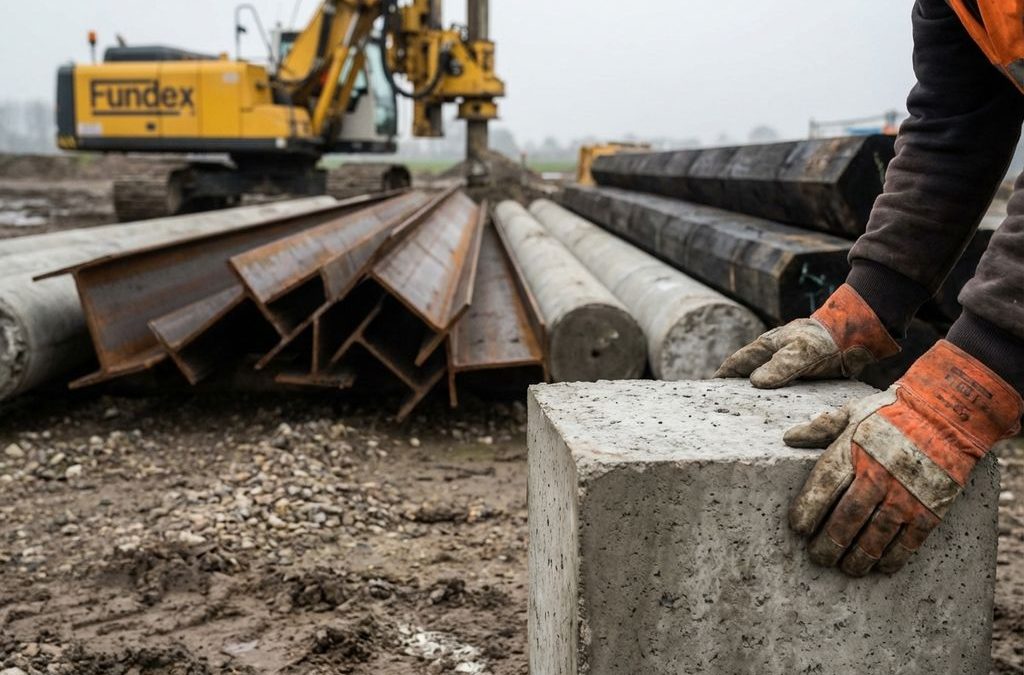
When choosing the right foundation solution for your construction project, different types of piles each play a unique role. Driven piles, bored piles screw piles are the three main categories, each with specific characteristics suited to different soil conditions and project requirements. Modern, vibration-free techniques also offer innovative alternatives to traditional pile driving methods, enabling effective foundation work even in urban environments.
What are the main categories of foundation piles?
The three main categories of foundation piles are driven piles, bored piles screw piles. Driven piles driven into the ground with force, bored piles inserted into pre-drilled holes, and screw piles rotated into the ground. Each category offers specific advantages, depending on soil conditions, environmental requirements, and project specifications.
Driven piles on impact force to drive the pile various soil layers. This method is effective in firm soil layers, but causes vibrations and noise pollution. The piles the soil, thereby creating a strong bond with the ground, which results in high bearing capacities.
Drilled piles installed by first drilling a hole and then pile the pile . This method causes less vibration but often requires soil removal. The drilling process can be adapted to various soil conditions, ranging from soft clay layers to hard rock formations.
Screw piles rotation with axial pressure to drive the pile the ground. This technique displaces the soil without the extreme vibrations associated with traditional pile driving. The result is a stable foundation with minimal impact on the surrounding area, making it ideal for projects in built-up areas.
How do vibration-free pile types such as Funde piles work?
Vibration-free pile types such as Funde piles work according to the principle of 'piling without piling', whereby rotation and axial pressure are used instead of impact force. The ground displacement drill is screwed into the ground and creates space for the pile through displacement. This method eliminates vibrations and significantly reduces noise pollution.
The technical process begins with a soil displacement drill that enters the ground together with a steel auxiliary pipe. The rotating movement displaces the soil rather than knocking it away. The auxiliary pipe remains in place while the drill continues to descend, after which reinforcement is placed and concrete is poured.
This technique offers major advantages in urban environments where vibrations can cause damage to existing buildings. Funde piles can be used in soil layers of approximately 1 to 20 MPa and can be installed at limited distances from adjacent structures (approximately 0.9 meters at right angles). The maximum pile length is approximately 35 to 40 meters.
Compared to traditional pile driving, this method produces virtually no vibrations, less noise, and can be carried out in smaller work areas. This makes it possible to lay foundations in densely built-up areas without causing nuisance to local residents or posing a risk to existing structures.
What is the difference between combination posts and standard concrete posts?
Combi piles combine a permanent steel pipe with grout injection, while standard concrete piles consist entirely of concrete. Combi piles retain the steel auxiliary pipe as part of the construction and are supplemented with a grout shell for extra stability. This combination results in higher load-bearing capacities and better performance in soft soil layers.
With standard concrete piles, the steel casing is removed during casting, pile a solid concrete pile . The concrete must bear all structural loads and provide the ground connection. These piles suitable for normal soil conditions, but may have limitations in very soft or unstable layers.
Combi piles offer specific advantages due to the permanent steel tube. The steel-concrete combination increases the load-bearing capacity and improves resistance to lateral forces. The grout injection ensures an improved connection with the surrounding soil and can improve the soil around the pile.
The choice between the two types depends on soil conditions and load requirements. Combination piles are ideal for very soft soil layers where pile shaft deformation must be prevented, while standard concrete piles are sufficient for stable soil conditions with normal loads. Combination piles generally have higher initial costs, but can be more economical in challenging soil conditions.
Which type of pile is best suited to your construction project?
The choice of the right pile type depends on soil conditions, environmental requirements, project size, and sustainability objectives. Soil investigation forms the basis for this decision, supplemented by factors such as the vibration sensitivity of surrounding buildings, the available working space, and any noise restrictions. A thorough analysis of these aspects leads to the optimal foundation solution.
For projects in urban environments with vibration-sensitive buildings, vibration-free solutions such as Funde piles or Tubex piles are preferred. These can be installed without damaging existing structures and comply with strict noise standards. In very soft soil layers (below 1 MPa), combination piles or systems with permanent casing are more suitable.
The size of the project also influences the choice. Large projects can benefit from efficient standard piles, while complex projects with limited space require special solutions. Bracing angles of up to 4:1 forward are possible with certain pile types, offering flexibility in challenging locations.
Sustainability considerations are becoming increasingly important. Electrically powered machines reduce emissions during operation, while efficient pile designs limit material consumption. The service life and maintenance requirements of different pile types must be weighed against the initial investment costs.
Professional advice is essential for making the best choice. Experienced foundation specialists can evaluate all factors and propose the most suitable solution. Contact us for a thorough analysis of your specific project requirements and appropriate foundation advice.
Frequently Asked Questions
How long does it take to piles vibration-free piles compared to traditional pile-driving methods?
Vibration-free piles Fundexpiles, can be installed more quickly than using traditional driving methods, at an average rate of 15–25 meters per day, depending on soil conditions. The elimination of vibration breaks and noise restrictions ensures a more efficient workflow. In addition, less preparation time is required because no special vibration protection needs to be installed.
What is the cost of vibration-free foundation techniques compared to standard piles?
Although vibration-free techniques may initially be 10-20% more expensive, they often result in cost savings due to faster execution, fewer nuisance compensation payments, and no risk of damage to surrounding buildings. In urban environments, the total project costs are often lower due to the elimination of monitoring, vibration protection, and potential damage claims.
Can I reinforce existing foundations using modern pile techniques?
Yes, existing foundations can be reinforced with micropiles or support piles installed using vibration-free techniques. This method is ideal for renovation projects, foundation repairs, or subsidence problems. The work can often be carried out without residents having to leave the building.
What soil investigations are necessary before I can choose a pile type?
A geotechnical investigation with at least drilling down to the load-bearing layer is essential, supplemented with CPT sounding to determine load-bearing capacity. For vibration-free techniques, additional information is needed about soil composition and any obstacles. An environmental soil investigation may also be required depending on the location and zoning plan.
How do I deal with unexpected obstacles in the ground during piles driving?
Alternative techniques can be used to overcome obstacles, such as pre-drilling or using special drill bits for hard layers. Experienced contractors usually have backup solutions available and can make adjustments on site. It is important to include obstacle expectations in the contract and work plan in advance.
What are the maintenance requirements for different types of piles after installation?
Concrete piles and composite piles require minimal maintenance during their 50-100 year lifespan. Periodic inspection of visible pile heads is recommended, especially in aggressive soil conditions. Steel components in composite piles have good corrosion resistance due to the grout coating, but monitoring their condition after 25-30 years is advisable.
How can I ensure that my foundation project meets modern sustainability requirements?
Opt for electrically powered pile drivers to reduce CO2 emissions and consider recycled materials where possible. Optimize pile design to minimize material consumption and choose techniques with a long service life. Many modern foundation specialists offer sustainability certification and can advise on circular construction principles.