
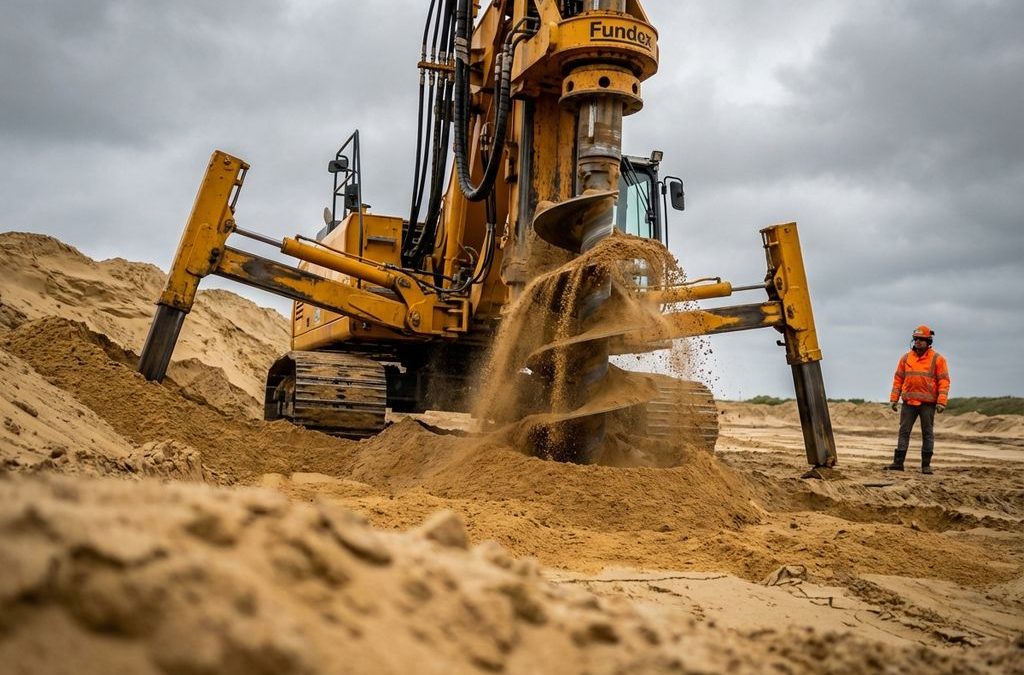
Foundation work in sandy soil presents unique challenges due to the specific properties of this soil type. Sandy soil has a relatively low bearing capacity, is sensitive to changes in water levels, and can cause instability if not properly supported. These properties often render traditional foundation methods inadequate and require specialized techniques to create stable and durable foundations.
Why is building on sandy soil so challenging?
Sandy soil poses a challenge for foundation work due to the low cohesion between sand grains and the limited bearing capacity of this soil type. Sandy soil typically has a bearing capacity between 1 and 5 MPa, which is significantly lower than that of clay or compacted soil layers, for example.
The granular structure of sand causes the soil to shift easily under load. This occurs especially when the soil becomes saturated with water, which reduces friction between the sand grains. Changes in water levels can therefore directly affect the stability of foundations in sandy soil.
Traditional pile driving causes vibrations that can further disrupt the sand structure. These vibrations can lead to compaction of the surrounding soil, causing existing foundations in the vicinity to settle. In urban areas with a high density of existing buildings, these vibrations are often unacceptable.
The permeability of sandy soil also means that water can flow easily through the ground. This can result in foundation piles being subject to washout or erosion, especially in areas with fluctuating groundwater levels.
What problems can arise if the foundation is improperly constructed in sandy soil?
Inadequate foundations in sandy soil lead to uneven settlement, causing different parts of a building to sink at different rates. This results in cracks in walls, doors that no longer close properly, and structural damage that is costly to repair.
Differential settlement is a common problem in which foundation elements settle unevenly. This occurs when the bearing capacity of the sandy soil is not uniform or when the load is not distributed evenly. The result is cracks that develop from small hairline cracks into serious structural fractures.
Lateral instability can occur when foundation piles do not provide sufficient resistance to horizontal forces. In sandy soil, where lateral support is limited, piles may piles or shift under the influence of wind, soil pressure, or uneven loading.
Erosion around foundation elements is a creeping problem that can develop over many years. Flowing groundwater washes away sand particles around the foundation, creating voids that further undermine its stability. This process often becomes visible only after significant damage has already occurred.
How do you determine the bearing capacity of sandy soil for foundations?
The bearing capacity of sandy soil is determined through soil testing using cone penetration testing, in which a cone is pressed into the ground to measure resistance. This cone resistance provides direct information about the density and bearing capacity of the sand layers at various depths.
Soil investigations are conducted in accordance with the Dutch standard NEN-EN-ISO 22476-1 and provide a continuous profile of soil strength. In sandy soil, cone resistance values between 1 and 20 MPa are typical, with higher values indicating denser and more load-bearing layers.
Borehole testing complements soil testing by collecting samples for laboratory analysis. This process determines the grain size distribution, density, and permeability. This data is essential for calculating settlements and designing appropriate foundation solutions.
Groundwater level measurements are crucial because the water level directly affects the effective stress in sandy soil. Fluctuations in the groundwater level can significantly affect the bearing capacity and must be taken into account in foundation calculations.
Interpreting this data requires expertise to select the appropriate foundation method. Very soft sand layers (below 1 MPa) require special techniques, whereas layers with moderate bearing capacity (5–15 MPa) allow for more standard solutions.
Which modern foundation techniques work best in sandy soil?
Vibration-free foundation techniques are best suited for sandy soil because they do not disturb the soil structure. Screw piles are screwed into the ground rather than driven, thereby avoiding vibrations and leaving the surrounding soil intact.
For very soft sand layers, systems with permanent casings are ideal, as they prevent deformation of the pile shaft. These techniques are particularly suitable for soil layers with a bearing capacity between 1 and 20 MPa and can be used in confined spaces.
In the case of heavy sand layers, grout injection techniques can be used to further increase the bearing capacity. Grout is injected under pressure into the surrounding soil, creating a stronger bond between the pile the ground.
Modern foundation drilling machines can drill at angles of up to 4:1 forward, offering flexibility in hard-to-reach locations. These machines require a small footprint and can operate at distances of approximately 0.9 meters from adjacent structures.
Sustainable electric foundation-driving machines are being used more and more often because they produce zero emissions and cause less noise pollution. This is particularly important in urban areas where nearby residents may be bothered by traditional diesel-powered machines.
Choosing the right foundation technique for sandy soil requires a thorough understanding of both the soil conditions and the available techniques. Professional advice is essential to avoid costly mistakes and ensure a durable solution. For more information about suitable foundation solutions, please contact us via our quote page.
Frequently Asked Questions
How long does it take to complete a soil survey before I can start laying the foundation in sandy soil?
A standard soil investigation involving soil probing and drilling typically takes 1–3 days, depending on the size of the project. Laboratory analysis of soil samples also takes 1–2 weeks. Therefore, you should allow at least 3 weeks for the entire investigation and reporting process before you can begin foundation work.
What is the cost of vibration-free foundation techniques compared to traditional pile driving?
Vibration-free techniques, such as bored piles generally 10–20% more expensive to purchase, but often save money on damage prevention and permits. In urban areas where vibration damage to surrounding buildings must be prevented, total project costs are often lower due to the elimination of monitoring and potential compensation claims.
Can I determine on my own whether my sandy soil is suitable for a foundation, or do I always need an expert?
Voor kleinere projecten kunt u indicaties krijgen door te kijken naar bestaande bebouwing in de buurt en lokale bouwhistorie. Voor alle serieuze funderingsprojecten is echter professioneel grondonderzoek verplicht volgens de bouwregelgeving. Een geotechnisch adviseur kan de risico’s juist inschatten en de meest economische oplossing bepalen.
How can I prevent my foundation in sandy soil from being affected by seasonal changes in the water table?
Design your foundation based on the lowest expected groundwater level and allow for safety margins. Install drainage around the foundation where necessary and consider using water-resistant materials. Properly sealing basements and crawl spaces prevents fluctuating water levels from affecting the stability of the structure.
What signs indicate that my existing foundation in sandy soil is having problems?
Watch for cracks in walls that are spreading, doors and windows that stick, uneven floors, and gaps between different materials. Water seepage in basements or crawl spaces can also indicate foundation problems. If you notice any of these signs, an immediate inspection by a specialist is necessary to prevent further damage.
Is it possible to reinforce existing foundations in sandy soil without major renovations?
Yes, there are various techniques, such as micropiles, grout injection, or support piles, that can be implemented with minimal disruption. These methods can often be carried out from inside buildings. The choice depends on the specific situation and requires a customized solution from a foundation specialist.
How long does a modern foundation last in sandy soil, and what maintenance is required?
A properly constructed foundation in sandy soil typically lasts 50 to 100 years, depending on the materials and techniques used. Regular inspection of drainage systems and monitoring for any settlement are recommended. For concrete foundations, it is important to check for corrosion of the reinforcing bars, especially in areas with aggressive groundwater.