
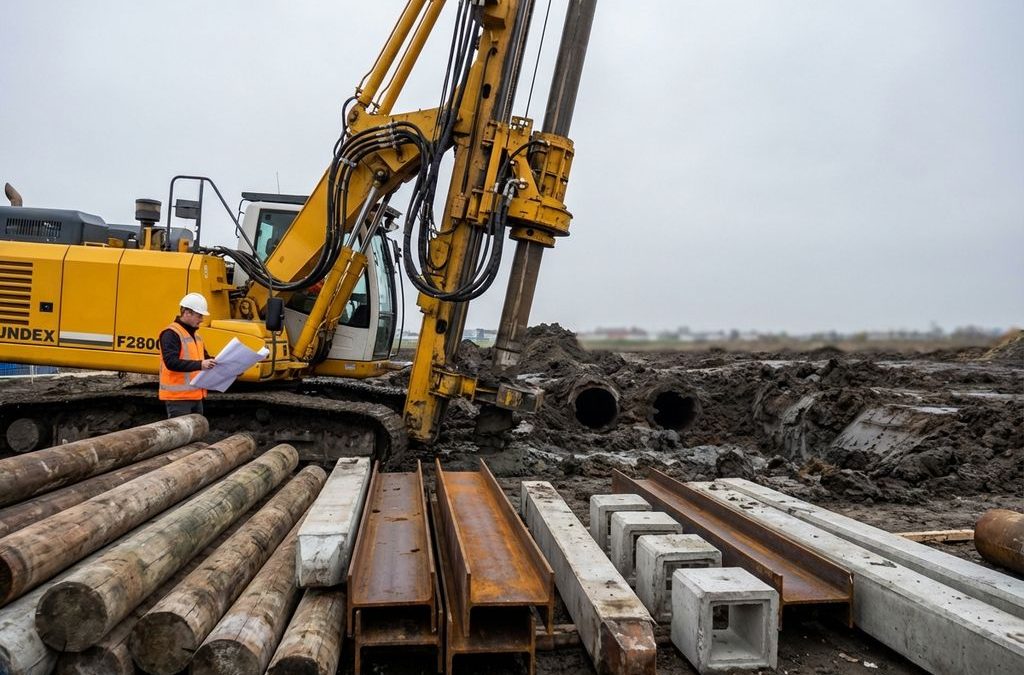
Foundation work is the process of installing stable support structures in the ground to support buildings and infrastructure. There are various methods, ranging from traditional pile driving to modern vibration-free techniques. The choice depends on soil conditions, environmental factors, and project-specific requirements. This guide answers the most frequently asked questions about available foundation methods and their applications.
What is the difference between traditional pile driving and modern foundation methods?
Traditional pile driving uses vibrations and impact force to drive piles the ground, while modern methods, such as vibration-free pile driving, involve piles into the ground. The main difference lies in the impact on the surrounding area and the suitability of these methods for urban areas.
Traditional pile driving techniques, such as Vibrex and Superpiles on vibrations that travel through the ground. These methods are effective in a variety of soil conditions, but can cause disturbances for nearby residents and damage to nearby buildings. The vibrations can also affect historic buildings and sensitive infrastructure.
Modern vibration-free methods, on the other hand, piles using axial pressure and torque. This principle of “piling without hammering” ensures that the surrounding area is not affected by vibrations. As a result, these techniques can be used on relatively small sites and in densely built-up areas.
The benefits of modern methods are clearly evident in urban projects. Work can be carried out closer to existing buildings, often just 0.5 to 0.9 meters from adjacent structures. This makes complex construction projects in inner-city areas possible without disrupting the surrounding area.
What foundation methods are available for different projects?
There is a wide range of foundation techniques available, ranging frompiles composite piles topiles bored pipe piles. Each method has specific characteristics that make it suitable for certain soil conditions and project requirements.
Vibration-free techniques encompass a variety of specialized methods.piles be used in soil layers with a bearing capacity of approximately 1 to 20 MPa and reach depths of up to 40 meters.piles arepiles for very soft soil layers, where a permanent steel tube provides stability and is suitable for soil layers with a bearing capacity of up to 80 MPa when combined with grout injection.
piles economic benefits and have greater resistance to lateral forces. Twin-tube pile walls are suitable for specific structural applications. For projects with extreme soil conditions, there are combination piles that combine the advantages of different techniques.
Special applications include Fundex tension anchors for tensile loads and drilled multi-shafts for various purposes such as parking, water treatment, and foundations. There are also innovative solutions such as Fundex Energy Piles, which use significantly less energy for cooling and heating than traditional systems.
The choice of method depends on factors such as soil strength, spatial constraints, and specific load requirements. In the case of very soft soils, systems with permanent casing are often chosen, while very hard soils require systems with grout injection.
How does vibration-free foundation work, and why is it important?
Vibration-free foundation installation operates on the principle of “piling without piling,” in which piles are driven into the ground piles axial pressure and torque. This eliminates vibrations and makes it possible to work in sensitive environments.
The process consists of seven steps: a steel casing with a detachable drill bit is installed, driven to the desired depth, and filled with reinforcing bars and concrete, after which the casing is pulled out in an oscillating motion while the drill bit remains in place. This method ensures a stable pile disturbing the surrounding soil.
The benefits for local residents are significant. No vibrations mean no damage to nearby buildings, less noise pollution, and the ability to work in densely built-up areas. This is particularly valuable in historic city centers where historic buildings require protection.
For sensitive infrastructure such as hospitals, laboratories, or precision manufacturing facilities, vibration-free foundations are often the only acceptable option. This method prevents disruption to sensitive equipment and processes that cannot tolerate vibrations.
There are numerous practical applications in urban environments. Projects can be carried out in confined spaces, using rigs require footprints ranging from 2 x 3 to 9 x 14 meters. Bracing ratios of up to 4:1 forward, 1:1 backward, and 3:1 sideways make it possible to work in tight spaces.
What factors determine the choice of a specific foundation method?
The choice of foundation method is determined by soil investigations, bearing capacity requirements, environmental factors, and budget considerations. A thorough analysis of these factors leads to the optimal foundation solution for each project.
Soil investigation forms the basis for any foundation decision. The strength of the soil determines which techniques are feasible: soils with strengths ranging from 1 to 20 MPa are suitable for standardpiles, very soft layers require systems with permanent casing, and very hard layers necessitate grout injection.
Environmental factors play a crucial role in urban areas. The proximity of existing structures, the available workspace, and noise restrictions determine whether vibration-free methods are necessary. Adjacent structures less than one meter away often make traditional pile driving impossible.
Load-bearing capacity requirements and load conditions influence the choice between different pile types. Projects involving high compressive and tensile forces or moments require more robust solutions, such aspiles their superior resistance to deformation.
Budget considerations include not only the direct costs of the foundation method, but also indirect factors such as project delays due to environmental restrictions, damage claims resulting from vibrations, or additional costs for noise mitigation measures. Modern vibration-free methods may have higher initial costs, but they often result in savings on the total project costs.
Practical considerations, such as the accessibility of the construction site and the available height and space, determine which foundation systems can be used. Compact sites require specialized equipment designed for confined spaces, which further influences the choice of method.
Choosing the right foundation method requires expertise and experience to weigh all the factors. Professional advice helps in finding the optimal balance between technical suitability, environmental impact, and cost-effectiveness. For specific project advice and quotes, it is advisable to contact specialized foundation experts who can assess local conditions and project requirements.
Frequently Asked Questions
How long does it take to install vibration-free foundation piles compared to traditional methods?
Vibration-free foundation methods are generally faster than traditional methods because no preparation time is required for vibration-reduction measures. An averagepile be installed in 15–30 minutes, depending on the depth and soil conditions. The elimination of waiting times due to environmental restrictions and the absence of damage assessments significantly speeds up the overall project timeline.
What is the cost of vibration-free foundation installation compared to traditional pile driving?
Although vibration-free methods may incur 10–20% higher direct costs, total project costs are often lower due to savings on damage claims, noise mitigation measures, and project delays. In urban areas where traditional pile driving is limited or impossible, vibration-free methods often offer the only economically viable solution. Project-specific advice is necessary for an accurate cost comparison.
Can vibration-free foundation piles be used in all types of soil?
Non-vibrating methods are suitable for most soil conditions, but the specific technique varies depending on the soil type. For very soft soils (below 1 MPa),piles permanent casing are ideal, while hard layers above 20 MPa require grout injection. Rocky subsoil can impose limitations and may require pre-treatment or modified techniques.
How is the quality of vibration-free foundation piles checked during installation?
Quality control is performed through real-time monitoring of parameters such as torque, axial pressure, and penetration rate during installation. This data is digitally recorded and compared with predetermined values. After installation, integrity checks such as PIT (Pile Integrity Testing) can be performed to verify pile quality.
What happens if unexpected obstacles are encountered during drilling?
If obstacles such as old foundation remains, cables, or pipes are encountered, the drilling process may be adjusted or temporarily halted. Modern vibration-free systems are often capable of carefully navigating around obstacles, or, if necessary, special drilling techniques can be employed. In complex situations, the obstacle is first located and safely removed before drilling resumes.
How small can the work area be for vibration-free foundation work?
The minimum workspace varies depending on the type rig, but compact systems can operate in areas as small as 2 x 3 meters. A 2.5-meter-wide doorway is usually sufficient for access. Specializedrigs even be used in basements or very confined spaces, where height restrictions as low as 2.5 meters are possible with modified mast configurations.