
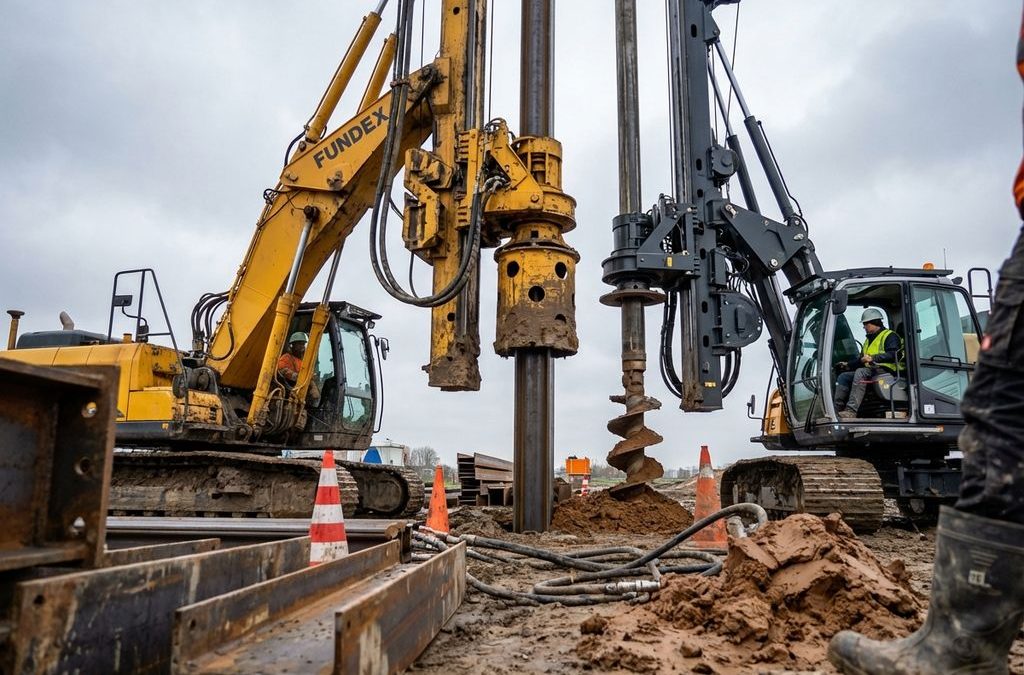
For foundation work, you can choose between traditional pile driving and modern drilling techniques. Pile driving drives piles into the ground piles impact force, while drilling techniques install piles or boring. Drilling techniques are vibration-free and low-noise, making them more suitable for urban environments. Pile driving often provides greater load-bearing capacity in certain soil types, but causes vibrations and noise pollution.
What is the difference between pile driving and drilling in foundation work?
Piling and drilling are two fundamentally different methods for installing foundation piles in the ground. In traditional piling, a precast concrete pile or steel casing is driven into the ground using impact force. The pile driver strikes the pile repeatedly pile it reaches the desired depth.
Drilling techniques, on the other hand, work by displacing soil through rotation. The pile driven into the ground by screwing or drilling, using axial pressure and torque. In soil-displacing drilling techniques, the soil is pushed aside without being brought to the surface, eliminating the need for soil removal.
The materials used also vary considerably. Driven piles often fully prefabricated, whereas bored piles are formed piles site. With boring techniques, the space is first created, then the reinforcement is placed, and finally concrete is poured as the guide tube is withdrawn.
What are the environmental drawbacks of traditional pile driving?
Traditional pile driving causes significant vibration and noise pollution due to the repeated striking of the pile driver. These vibrations can cause damage to nearby buildings, especially older structures with weak foundations. This poses a major problem in urban areas.
The working space during pile driving is limited by the height of the pile-driving rigs and the reach of the crane. This makes pile driving unsuitable for locations with limited space or low overhead obstacles, such as bridges and canopies. In addition, vibrations can cause settlement in adjacent buildings.
The noise levels generated by pile driving often exceed municipal standards, which means that work is restricted to specific times. This affects scheduling and can cause project delays. As a result, pile driving is often not permitted in densely populated areas.
What are the advantages of drilling over pile driving?
Vibration-free operation is the main advantage of drilling techniques. Soil-displacement drilling methods drive piles into the ground piles vibrations or impact, preventing damage to adjacent properties. The only noise comes from the drill’s engine.
Drilling techniques offer greater flexibility in confined spaces. The work platform is more compact, and the required working height is lower than with pile driving. This makes drilling suitable for renovation projects and sites with space constraints.
With soil-displacement drilling techniques, the soil does not settle, so the original cone resistance is maintained. This results in a high bearing capacity. Furthermore, no soil removal is required because the soil is displaced laterally, which results in cost savings.
Modern drilling techniques can piles obstacles such as masonry, poor-quality concrete, and existing wooden piles , which is a major advantage in renovation projects.
When should you choose pile driving, and when should you choose drilling?
The choice between pile driving and drilling depends on project conditions and environmental factors. Pile driving is suitable for large open areas without vibration-sensitive structures in the vicinity. It can be advantageous in sandy soils and when very high bearing capacity requirements are needed.
Drilling is the preferred method in urban areas, for renovation projects, and near structures that are sensitive to vibrations. When working space is limited, there are low obstacles, or strict noise standards apply, drilling techniques are often the only option.
Soil conditions play an important role. In uneven soil layers where pile driving may be necessary, certain drilling techniques, such as the Vibrex method, offer good alternatives. In soft soil conditions, where pile shaft deformation must be prevented, specialized drilling techniques are ideal.
Timeframes and costs vary depending on the method. Piling can be faster when installing large numbers piles open areas, but drilling techniques compensate for this by eliminating the need to remove soil and imposing fewer planning restrictions due to noise pollution.
For advice on the most suitable foundation method for your specific project, please contact our specialists via the quote page.
Frequently Asked Questions
How long does it take to switch from pile driving to drilling techniques during an ongoing project?
Switching methods during a project is complex and time-consuming. You will need different machinery, materials, and often modified work plans. Therefore, plan the appropriate method in advance in consultation with your foundation specialist to avoid costly delays.
What is the typical cost ratio between pile driving and drilling per linear meter of pile?
Piling is often less expensive in terms of material costs, but drilling saves on soil removal, vibration damage claims, and involves fewer planning restrictions. The total project costs depend on the location, soil type, and environmental factors. Always request a comparative cost analysis.
Can drilling techniques achieve the same load-bearing capacity as driven piles?
Yes, modern ground-displacing drilling techniques can achieve comparable or even higher bearing capacities. The cone resistance is maintained because the soil is not disturbed. However, in certain soil conditions, pile driving may still offer superior bearing capacity.
How do you measure vibrations during pile driving, and what are the permissible limits?
Vibrations are measured using seismographs that record vibration speeds. Dutch standards typically specify 5 mm/s for residential buildings and 2.5 mm/s for historic buildings. Have a vibration assessment conducted in advance and monitor the situation continuously during the work.
What preparations are needed before you start drilling in urban areas?
Conduct a comprehensive KLIC survey for cables and utility lines, investigate the soil composition, inspect the existing foundations of surrounding buildings, and arrange for a structural survey if necessary. Also plan the delivery and removal routes for equipment and materials.
What happens if you encounter unexpected obstacles while drilling?
Modern drills can penetrate many obstacles, such as old foundation debris, masonry, and concrete. For very hard obstacles, a modified drilling technique or preparatory work may be necessary. Always stop work and consult your specialist if you encounter unknown obstacles.
Is it possible to combine both techniques within a single foundation project?
Yes, hybrid approaches are possible, such as using pile driving in open areas and drilling in confined or vibration-sensitive zones. However, this requires careful planning of work sequences, material flows, and quality assurance across the different methods.