
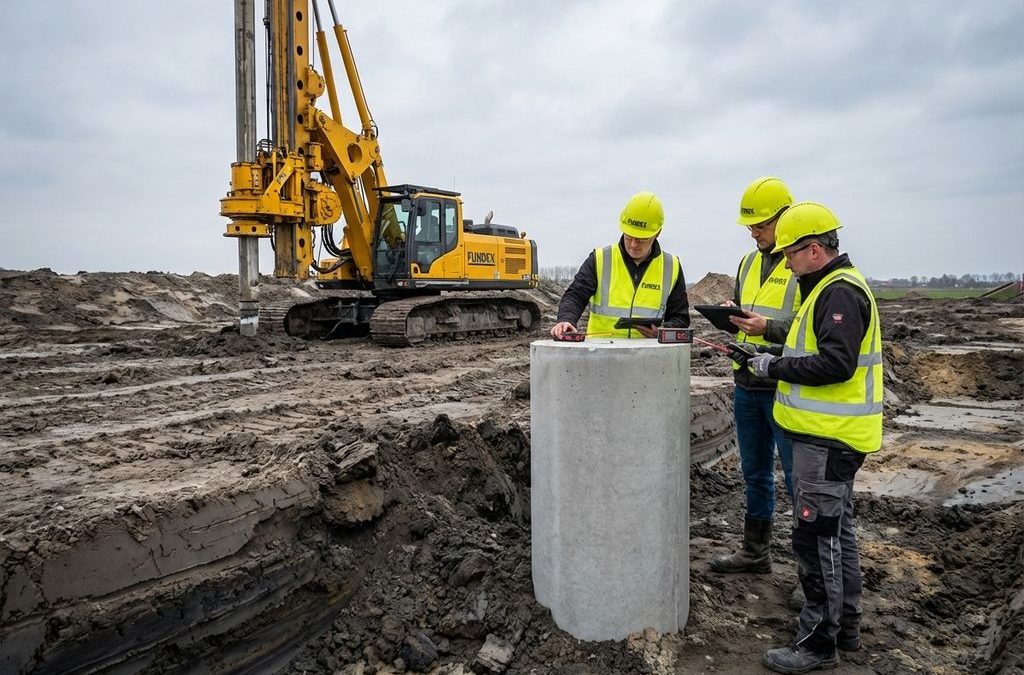
The Fundex pile offers unique advantages thanks to its patented “piling without driving” technology, in which piles are screwed into the ground piles . This ensures minimal disruption in urban areas, higher bearing capacity through soil displacement, and flexibility in confined spaces. The method combines efficiency with sustainability and can be applied in various soil conditions ranging from 1 to 20 MPa.
What is a Fundex pile and how does it differ from traditional foundation methods?
A Fundex pile is a vibration-free concrete pile manufactured using a steel guide tube that is screwed into place. Unlike traditional pile driving, in which piles are driven piles into the ground, the Fundex pile is, as it were, screwed into the ground using axial pressure and torque.
This method differs fundamentally from conventional methods. Traditional pile driving generates vibrations and noise pollution because piles are driven into the ground piles great force. The Fundex pile, on the other hand, is lowered to the desired depth in a controlled manner without any hammering. The steel casing with a loose drill bit is installed using a screwing motion, after which the precast element is inserted and the casing is filled with concrete.
Standard dimensions vary from ⌀380 mm to ⌀540 mm shaft diameter, with lengths up to approximately 35 to 40 meters. The pile completely filled to ground level and fitted with prefabricated reinforcement cages along its entire length for optimum quality.
Why is vibration-free foundation so important for construction projects?
Vibration-free foundation construction prevents damage to surrounding buildings and eliminates noise pollution for residents. Traditional pile driving methods cause vibrations that can damage the foundations and structures of nearby buildings, especially in densely built-up urban environments.
The impact of vibrations extends beyond structural damage. Residents experience considerable nuisance from the constant noise and vibrations during traditional foundation work. This leads to complaints, potential damage claims, and project delays due to limited working hours.
Regulations concerning noise pollution are becoming increasingly stringent, with specific standards for construction activities in residential areas. Municipalities often impose strict noise restrictions and may limit working hours to certain times of the day. Vibration-free techniques make it possible to work longer hours and complete projects faster.
In sensitive environments, such as hospitals, schools, or historic buildings, vibration-free foundations are often the only acceptable solution. The technology makes construction possible in locations where traditional methods are not an option.
What technical advantages does the Fundex pile offer for different soil types?
Fundexpiles perform exceptionally well in soils with strengths ranging from 1 to 20 MPa, and their soil-displacement properties provide a higher bearing capacity than bored piles. The screw-in installation process displaces the soil around the pile, resulting in improved friction properties and a higher bearing capacity.
For very soft soil layers, Funde piles can be combined with permanent casing systems, while grout injection is possible for very hard layers. This flexibility makes the system suitable for various geological conditions without compromising on quality.
The system can accommodate rake angles of up to 4:1 forward and 2:1 backward, which offers particular advantages in sloping constructions or where space restrictions require diagonal installation. This possibility opens up applications that are difficult to achieve with traditional methods.
Fundex piles can withstand both compressive and tensile loads and are suitable for a wide range of construction projects, from residential building to infrastructure works. The piles be installed as close as 0.9 meters from adjacent structures, making it possible to work in confined spaces.
How sustainable and cost-effective are Funde piles compared to other foundation solutions?
Funding piles offer significant sustainability benefits through the use of fully electric machines, such as the CD20E and F4800E, which can operate emission-free. The entire machine park runs on HVO100 fuel, reducing localCO2 emissions by 90% compared to traditional diesel.
Cost-effectiveness is achieved through faster installation and compact workspaces. Fundepiles require installation sites measuring just 7 × 12 meters, whereas traditional pile driving methods often require more space. This saves costs for site preparation and logistics.
Time savings are achieved because no vibration reduction measures are required and working hours are not restricted by noise standards. Projects can continue without interruptions for complaint handling or damage inspections to surrounding buildings.
The service life of Funde piles is comparable to that of traditional foundations, but the installation quality is often higher due to controlled placement and full reinforcement. Material efficiency is achieved through optimal use of concrete and steel, without waste due to vibration damage.
For projects where sustainability is an important selection criterion, Fundexpalen offer a competitive advantage. The combination of emission reduction, noise reduction, and efficient use of space makes it a cost-effective solution for modern construction projects that comply with future ESG guidelines.
Frequently Asked Questions
How long does it take to install Funde piles compared to traditional pile driving methods?
Fundex piles can be installed considerably faster because there are no waiting times for vibration-reducing measures and working hours are not restricted by noise standards. On average, a Fundex pile can be installed within 30-60 minutes, depending on the depth and soil conditions. Projects can also continue for longer each day without nuisance restrictions.
What are the most important considerations when choosing between different pole sizes (⌀380mm to ⌀540mm)?
The choice depends on the required load-bearing capacity, soil conditions, and space constraints. Smaller diameters (⌀380 mm) are suitable for lighter loads and confined spaces, while larger diameters (⌀540 mm) can provide higher load-bearing capacities for heavier structures. A geotechnical investigation and load-bearing capacity calculation will determine the optimal size for your specific project.
Can Fundexpalen be used in combination with existing foundations in renovation projects?
Yes, Fundexpalen piles are ideal for renovation and reinforcement projects. Thanks to their vibration-free installation, they can be safely placed next to existing foundations without causing damage. They can be used to support new extensions, reinforce existing structures, or repair foundations in historic buildings.
What preparatory work is required before Fundexpalen can be installed?
Minimal site preparation is required: a flat 7×12 meter area for the machine and access for material delivery. Cables and pipes must be located and marked. A geotechnical soil investigation is essential for determining the pile length and diameter. Permits are usually easier to obtain due to the low-noise working method.
How is the quality of Fundexpalen checked during and after installation?
During installation, continuous measurements of torque, axial force, and penetration speed are taken to monitor the bearing capacity. Each element is fully reinforced and backfilled to ground level for optimal quality. After installation, test loads can be carried out and non-destructive testing is possible. All installation data is recorded for quality assurance purposes.
In which situations is the Fundex pile NOT the best choice for foundations?
Piles are less suitable for very hard rock layers (u003e20 MPa) where grout injection is not possible, or in soil with many obstacles such as large boulders or old foundation remains. For projects with very light loads, more cost-effective solutions may be available. In extremely soft soil, alternative foundation methods may be more advantageous.