
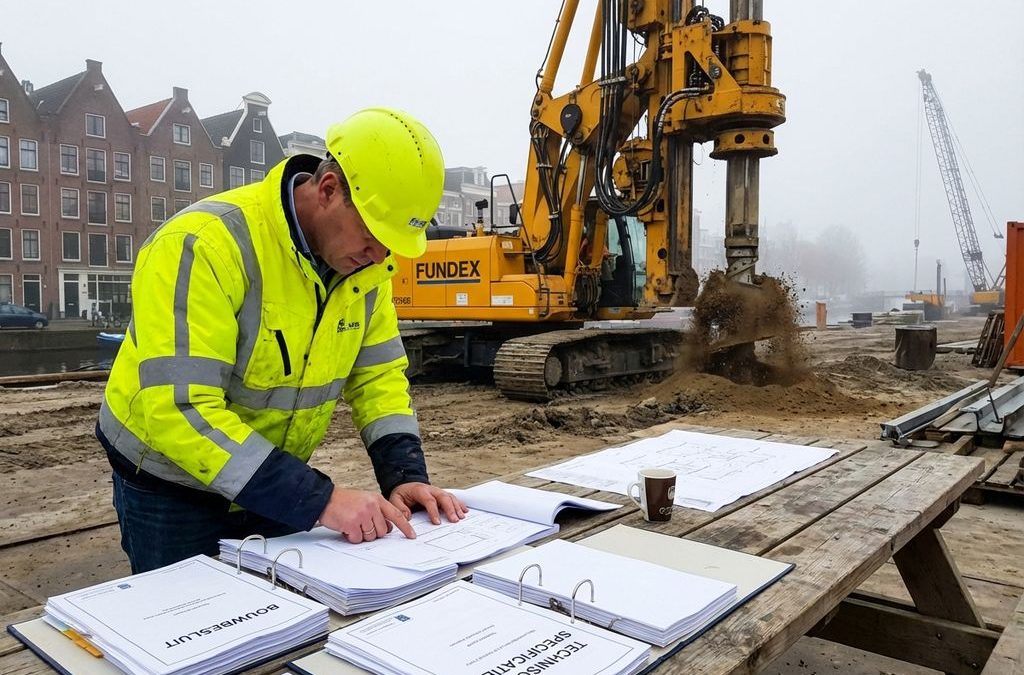
Foundation work in the Netherlands is subject to a comprehensive framework of laws and regulations designed to ensure safety and quality. The Building Decree, the Housing Act, NEN standards, and Eurocode 7 form the primary legal basis. These regulations operate hierarchically, with European codes, national laws, and technical standards complementing one another. In addition, environmental permits and local regulations determine the implementation requirements for each project.
What laws and regulations apply to foundation work?
Dutch foundation law is governed by a hierarchical regulatory framework. The 2012 Building Decree serves as the technical implementation of the Housing Act and sets requirements for the structural safety of foundations. The Housing Act itself grants municipalities the authority to oversee construction activities, including foundation work, through environmental permits.
Eurocode 7 (EN 1997) is at the top of the hierarchy as the European standard for geotechnical design. This code is implemented in the Netherlands through NEN-EN 1997-1 and establishes the design principles for all foundation structures. This includes national standards such as NEN 6740 for geotechnical investigation and NEN 9997-1 for the design of pile foundations.
The Environment Act, which has been in effect since 2021, consolidates various environmental and building regulations. For foundation projects, this means that issues such as soil disturbance, noise pollution, and vibrations are now covered by a single legal framework. This is particularly relevant when choosing between traditional pile-driving methods and modern vibration-free techniques.
What are the permitting requirements for different types of foundations?
For foundation work, you almost always need an environmental permit, and the requirements vary depending on the type of foundation. Standard pile foundations for residential construction require an environmental permit for construction, including structural calculations and a geotechnical report. For more complex projects, such as bridges or high-rise buildings, additional specialized reports are required.
The permitting process begins with the submission of an application to the municipality, accompanied by architectural drawings, structural calculations, and a geotechnical report. Stricter requirements apply to foundations in protected areas or near historic landmarks. The processing time is usually between 8 and 26 weeks, depending on the complexity of the project.
Certain types of foundations have specific requirements. Energy Piles utilize geothermal energy are subject to the Mining Act and require a permit from the ministry. Temporary foundations for construction sites may sometimes require only a notification, but this varies by municipality. Foundations that may affect groundwater also require a water permit.
What technical standards apply to foundations in the Netherlands?
NEN standards form the technical foundation for all foundation work in the Netherlands. NEN 6740 governs the geotechnical investigation that precedes every foundation design. This standard describes which soil investigations are required and how the results should be interpreted for different soil conditions.
NEN 9997-1 specifies the design of pile foundations and has replaced the former NEN 6743 since 2017. This standard is compatible with Eurocode 7 and defines how bearing capacities are calculated, which safety factors must be applied, and how pile tests are conducted. Specific design rules apply to different types of piles.
In addition, there are standards for construction and quality control. NEN 6740 also describes the required pile tests, such as static compression and tensile tests, dynamic tests, and ultrasonic integrity checks. CUR recommendations supplement the NEN standards with practical guidelines for specific situations, such as foundation work in soft soil or near existing structures.
How can you ensure that your foundation project complies with all regulations?
A systematic approach helps avoid regulatory issues during your foundation project. Start by assembling a project team that includes a licensed structural engineer, a geotechnical consultant, and an experienced foundation contractor. These professionals are familiar with current requirements and can provide timely advice on permits and technical specifications.
Follow these practical steps to ensure compliance. Start with a thorough geotechnical investigation in accordance with NEN 6740 to determine the appropriate foundation method. Next, have the foundation design prepared by a licensed structural engineer who works in accordance with Eurocode 7 and NEN 9997-1. Submit the environmental permit application in a timely manner, along with all required documents.
During construction, quality control ensures compliance with all standards. Plan in advance which pile tests will be conducted and which inspections are required. Carefully document all work prior to final acceptance. An experienced foundation specialist can guide you through the entire process and ensure that all regulations are properly followed.
The complexity of foundation regulations requires specialized knowledge and experience. By engaging the right expertise early on and systematically addressing all requirements, you can ensure that your foundation complies with all laws and regulations. If you have specific questions about your project, please feel free to contact us for professional advice.
Frequently Asked Questions
What happens if my foundation project does not meet the applicable standards?
If foundation standards are not met, the municipality may impose a construction freeze or revoke the permit. You risk fines of up to €87,000 and are liable for any resulting damage. In addition, your insurance company may refuse to pay out in the event of structural problems. It is therefore essential to comply with all requirements in advance and to conduct regular inspections during construction.
How long does it take to obtain all the necessary permits for foundation work?
A standard environmental permit for foundation work takes 8–26 weeks to process, depending on the complexity of the project. Simple residential construction projects are often processed within 8 weeks, while complex projects or those in protected areas can take up to 26 weeks. Therefore, plan well in advance and submit complete applications to avoid delays.
When do I need a geotechnical report, and what should it include?
A geotechnical report in accordance with NEN 6740 is required for all foundation projects as part of the permit application. The report must include information on soil composition, groundwater levels, bearing capacity, and settlement behavior. Recommendations regarding the most suitable foundation method and a risk analysis for surrounding structures are also required.
Can I design the foundation myself, or does it have to be done by a licensed professional?
Foundation designs must always be prepared by a licensed structural engineer with specialized knowledge of geotechnical engineering. This professional is responsible for ensuring compliance with Eurocode 7 and NEN standards, and is accountable for the structural safety of the design. Designs prepared by non-professionals are not accepted by local authorities or insurance companies.
What inspections and tests are required during the execution of foundation work?
During construction, pile testing in accordance with NEN 9997-1 is mandatory, including static pressure tests (on at least 1% of all piles) and integrity checks. Geometric checks of pile positions and lengths are also required. The exact scope depends on the pile type and project size, but must be specified in advance in the quality plan.
What are the specific requirements for foundations near existing buildings or historic landmarks?
When constructing foundations near existing buildings, stricter requirements apply regarding vibrations and settlement. You must conduct a risk analysis, perform preliminary inspections of surrounding buildings, and often install vibration monitoring equipment. For historic buildings, additional permits from the historic preservation board are required, and vibration-free foundation methods are often mandatory.
How do I handle unexpected issues that arise during foundation work and deviate from the design?
If you encounter unexpected ground conditions or other deviations, you must stop work immediately and notify the structural engineer and the local government. Often, a revised design and a permit amendment are required. Carefully document all deviations and always have any changes approved before proceeding, to avoid legal and technical issues.