
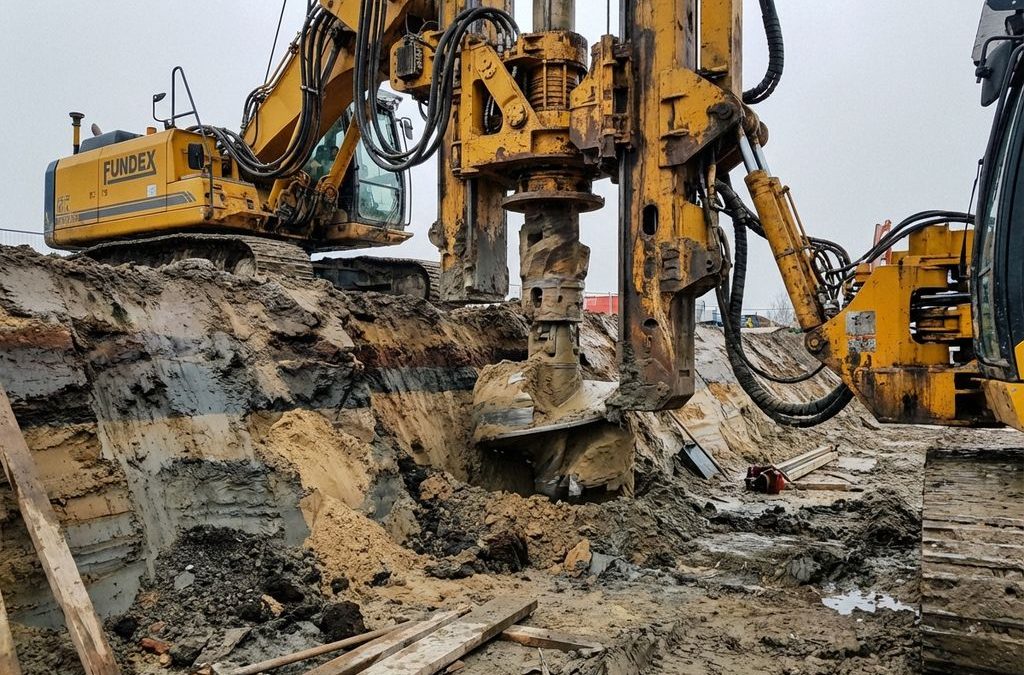
Different soil types place unique demands on foundation techniques due to their specific properties and behavior under load. Soft clay, peat, loose sand layers with groundwater issues, and variable soil layers require specialized foundation solutions, as standard methods often fall short in these cases. Choosing the right technique prevents costly foundation damage and ensures stable structures.
What are the main soil types that require special attention when it comes to foundations?
The most problematic soil types for foundation work are soft clay, peat, loose sand layers with high groundwater levels, and variable soil layers. These soil types have low bearing capacity, are prone to settlement, and can deform under load.
Soft clay poses challenges due to its low bearing capacity (often less than 1 MPa) and its tendency to creep and consolidate. Under load, slow deformation occurs, which can lead to uneven settlement of the structure. The plastic properties of soft clay make it difficult to construct stable foundations without special techniques.
Peat soils are particularly problematic due to their high compressibility and low bearing capacity. Peat can consist of up to 90% water and tends to compress significantly under load. This results in substantial and long-term settlement that can damage structures.
Loose sand layers with groundwater issues present different challenges. Although sand generally has good bearing capacity, loose sand layers can compact under vibration or cause settlement when groundwater is extracted. High groundwater levels further complicate the foundation process by causing instability in excavation pits and increasing the risk of soil displacement.
How do you determine which foundation method is best suited to your soil type?
Selecting the optimal foundation technique begins with a thorough soil investigation that provides insight into bearing capacity, susceptibility to settlement, groundwater levels, and local environmental factors. This data forms the basis for a well-informed selection of the most suitable foundation method.
For soil conditions ranging from 1 to 20 MPa, various techniques can be used, with the specific conditions determining the best approach. For very soft soils (below 1 MPa), systems with permanent casing are often the best choice, as they prevent deformation of the pile shaft.
Environmental factors play a crucial role in the selection process. In densely built-up areas where vibration nuisance must be avoided, vibration-free foundation techniques are essential. The available workspace determines which machines can be used; some projects require compact rigs can operate in confined spaces.
Groundwater levels and drainage characteristics influence the choice between different pile systems. In areas with high groundwater levels or groundwater flow, certain techniques may perform better than others. The desired pile length and load-bearing capacity also determine which method is most suitable.
Why do traditional foundation methods fail with certain soil types?
Traditional foundation methods, such as conventional piles and shallow foundations, fail in problematic soil conditions because they are not designed to address the specific challenges posed by soft soils, peat soils, and unstable subsoil. These methods often cause more problems than they solve.
Vibration issues are a major cause of failure. Conventional pile driving generates vibrations that travel through the ground and can cause damage to nearby structures. In soft soil layers, these vibrations can also disrupt the soil structure and lead to further instability.
Settlement risks increase when traditional methods are used in soft soil layers. Shallow foundations may not provide sufficient bearing capacity, leading to long-term settlement. This problem is even more pronounced in peat soils due to the material’s high compressibility.
Loss of bearing capacity occurs when the foundation method is not suitable for the soil conditions. In very soft layers, traditional piles may lose piles shape or fail to provide sufficient resistance to lateral forces. This can lead to foundation damage and structural problems in the building.
The limited flexibility of traditional methods makes it difficult to adapt them to varying soil conditions within a single project. Modern projects often require customized solutions that traditional techniques cannot provide.
What modern foundation solutions are available for difficult soil conditions?
Modern foundation solutions offer innovative answers to the challenges posed by difficult soil conditions. Vibration-free foundation installation, composite piles with grout injection, and specialized pile systems solve specific soil problems without causing environmental disruption and deliver superior performance in problematic soils.
Vibration-free foundation techniques work by “screwing” piles into the ground, piles it were, rather than driving them in. This method prevents vibration-related disturbances and makes it possible to work in densely built-up areas without damaging surrounding structures. These techniques are particularly suitable for very soft soil layers, as they do not disturb the soil structure.
Combined piles with grout injection provide solutions for both very soft and very heavy soil layers. In soft layers, the permanent casing prevents deformation of the pile shaft, while in heavy layers, grout injection ensures optimal force transfer to the load-bearing layer.
Specialized pile systems can be customized to meet specific project requirements. This includes adaptations for work in confined spaces, special load conditions, or unique environmental conditions. Modern foundation techniques utilize advanced engineering to provide customized solutions for every project.
Sustainable foundation solutions powered by electricity eliminate local emissions and reduce the environmental impact of foundation work. This development is particularly important in urban areas, where air quality and noise pollution are critical factors.
Choosing the right foundation method for your specific soil type requires expertise and experience. Professional advice helps prevent costly mistakes and ensures a durable, stable foundation that will last for decades. For personalized advice on your foundation project, please contact us for a free quote.
Frequently Asked Questions
How long does it take for settlement to occur in soft soil layers?
Settlement in soft clay and peat can take months or even years to fully develop. In peat soils, primary settlement can occur within weeks, while secondary settlement (creep) can continue for decades. That is why it is crucial to choose the right foundation technique in advance to prevent these problems.
How do the costs of modern foundation solutions compare to those of traditional methods?
Although modern foundation techniques may initially cost 10–30% more, they often result in significant savings by preventing future damage and repair costs. The total cost over the life of a building is usually lower due to reduced maintenance costs and greater durability.
Can modern foundation techniques be used on existing buildings?
Yes, many modern techniques, such as micropiles and grout piles, have been specifically developed for the renovation and reinforcement of existing structures. These methods require minimal workspace and can often be carried out without significantly disrupting the existing buildings.
How do I know if my soil is suitable for vibration-free foundation installation?
Vibration-free foundation installation is suitable for most soil types, but the specific technique depends on the soil conditions. A detailed soil investigation involving soil testing and soil sampling is essential to determine the appropriate vibration-free method. Very hard layers may sometimes require special adjustments.
What warranties do suppliers offer on modern foundation solutions?
Professional foundation contractors typically offer a 5- to 10-year warranty on their work, with extended warranties of up to 20 years for specialized systems. The warranty covers both material defects and workmanship issues, but is contingent upon proper installation in accordance with technical specifications.
What happens if unexpected ground conditions are encountered during construction?
Experienced foundation contractors have protocols for dealing with unexpected soil conditions and can make on-site adjustments to the foundation method. This may result in changes to the type of pile, its length, or the installation technique. That is why flexibility in the chosen foundation technique is important.
How long does it take to install modern foundation systems?
Installation time depends on the number piles, site accessibility, and soil conditions. Vibration-free techniques are often faster than traditional pile driving because there are no delays due to vibration restrictions. An average project can piles 2–5 days per 100 piles , depending on the complexity.