
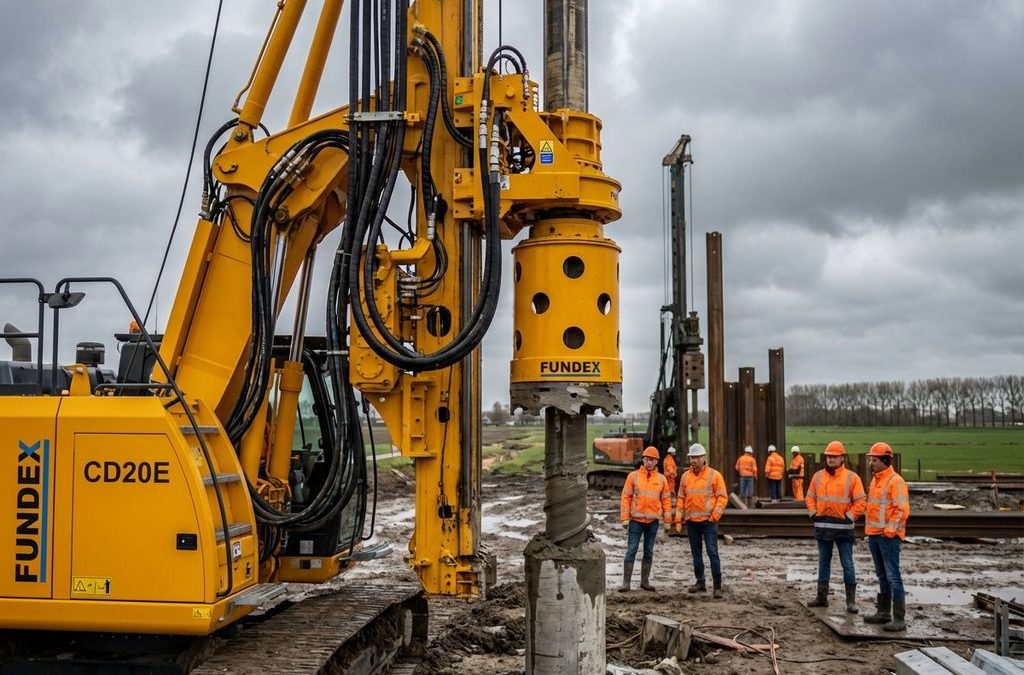
The foundation industry is undergoing a revolutionary transformation driven by technological innovations that are replacing traditional methods. Modern foundation techniques include vibration-free installation methods, patented pile systems, and fully electric machines that operate with zero emissions. These developments offer solutions for urban environments where noise pollution and vibrations are problematic, while simultaneously contributing to sustainability goals in the construction sector.
What are the most significant innovations in modern foundation engineering?
The most significant innovations in foundation technology include vibration-free installation methods, patented pile systems, and advanced drilling machines. These breakthroughs replace traditional pile driving by piles screwing piles into the ground, thereby eliminating disruption and enabling precision work in confined spaces.
Patented systems such aspiles piles transformed the market.piles be installed to a depth of up to 40 meters and are suitable for soil conditions up to 1.20 MPa.piles even further, with capabilities up to 80 MPa through grout injection, and are fully soil-displacing without soil relaxation.
Modern pile-driving machines are equipped with advanced technology designed for a wide range of project conditions. Machines such as the F4800E and CD20E can operate in areas with low clearance and offer bracing ratios of up to 4:1 forward and 3:1 sideways. This makes pile driving possible in locations where traditional methods have failed.
Special applications further expand the scope. Drilled multi-shafts are used for parking (SMART CAREX), heavy-duty foundations (CALEX), and water storage (BUFFEX). This multifunctional approach maximizes the value of foundation work by combining multiple functions.
How does vibration-free foundation work, and why is it so important?
Vibration-free foundation installation operates on the principle of “piling without hammering,” whereby piles are driven into the ground piles rotation and pressure rather than impact force. This completely eliminates vibrations and enables precision work in sensitive environments, such as historic city centers or near existing structures.
The process uses specialized drill bits that displace the soil without disturbing it. Withpiles , a permanent steel tubepiles installed that displaces 100% of the soil without reducing the cone resistance. This results in superior load-bearing capacity compared to traditional methods.
The benefits for urban projects are significant. No vibrations means no damage to surrounding buildings, no noise pollution for residents, and the ability to work just 0.5 to 0.9 meters from adjacent structures. This opens up possibilities for foundation work in densely built-up areas where traditional methods are not feasible.
Vibration-free foundation installation also offers technical advantages. piles be installed in very soft soil layers without the risk of deformation and are capable of withstanding high compressive, tensile, and moment loads. This method works exceptionally well as a temporary foundation solution and in areas with limited headroom.
What sustainable developments are transforming the foundation industry?
Fully electric foundation machines and zero-emission solutions are revolutionizing sustainability in the foundation industry. Machines such as the CD20E are fully electric, while other models use HVO100 fuel to reduce local CO2 emissions by 90%. These technologies make zero-emission construction sites possible.
The modern fleet runs entirely on sustainable fuels. HVO100 (Hydrotreated Vegetable Oil) reduces local CO2 emissions by 90% compared to traditional diesel. For completely emission-free projects, electric machines such as the F4800E and CD20E offer the solution, equipped with Stage V low-emission engines.
Energy Piles foundation work with sustainable energy generation. These innovative piles piping within the reinforcement cage, allowing water to circulate for heat exchange with the ground. The results are impressive: 20 times less energy is required for cooling and 5 times less for heating compared to traditional systems.
The industry is preparing for future ESG (Environmental, Social, Governance) guidelines for 2030, 2040, and 2050. Clients are increasingly opting specifically for sustainable foundation solutions, making sustainability not only environmentally friendly but also commercially attractive. This trend is driving further innovation in cleaner construction techniques.
What do these innovations mean for the future of foundation projects?
New technologies are transforming foundation projects by shortening project timelines, eliminating disruption to the surrounding area, and improving quality control. Vibration-free methods allow for simultaneous work near existing structures, while electric equipment enables 24/7 operation without noise restrictions in urban areas.
Project planning becomes more flexible thanks to compact machines that can operate in workspaces ranging from just 2 x 3 meters to 9 x 14 meters. This opens up possibilities for foundation work at tight construction sites where traditional rigs fit. Custom modifications to equipment make it possible to meet specific project requirements, from confined spaces to extreme ground conditions.
Quality control benefits from advanced testing methods. Static tests accurately measure compression and tension, ultrasonic tests verify pile integrity, and dynamic tests validate performance. This combination ensures reliable foundations that meet strict technical requirements.
The future will bring further integration of sustainability and functionality. Multifunctional shafts combine foundations with parking, water storage, or energy generation. This development maximizes the use of space in densely built-up areas and creates added value for developers and end users.
For professionals in the construction industry, these innovations open up new possibilities for complex projects that were previously unfeasible. The combination of vibration-free operation, sustainable equipment, and multifunctional solutions paves the way for more efficient, environmentally friendly foundation projects. Would you like to learn more about specific applications for your project? Contact us for a tailored solution.
Frequently Asked Questions
How do I choose betweenpiles piles my project?
The choice depends on your specific soil conditions and load-bearing requirements.piles ideal for standard applications up to 40 meters deep and soil conditions up to 1.20 MPa.piles suitable for heavier loads up to 80 MPa thanks to grout injection and offer superior load-bearing capacity in difficult soil conditions.
What is the cost of vibration-free foundation installation compared to traditional pile driving?
Although the initial investment may be higher, vibration-free foundation work more than makes up for this through shorter project timelines, no risk of damage to surrounding structures, and the ability to work 24/7 without noise restrictions. In addition, you avoid potential claims and delays caused by disturbances to the surrounding area.
Can electric foundation machines deliver the same performance as diesel machines?
Yes, modern electric machines such as the CD20E and F4800E offer performance comparable to their diesel counterparts. They even offer advantages such as consistent power, lower maintenance costs, and the ability to operate 24/7 without noise restrictions in urban areas.
How long does it take to install energy poles, and what are the benefits?
Energy Piles installed at the same rate as conventional piles, but require additional piping within the reinforcement cage. The energy efficiency is significant: 20 times less energy is required for cooling and 5 times less for heating, resulting in substantial energy savings over the building’s lifespan.
What preparations are needed for vibration-free foundation work in a historic city center?
Conduct a thorough soil analysis, assess the vulnerability of surrounding structures, and ensure adequate access for compact machinery. Plan logistics carefully due to limited staging space, and coordinate with local authorities regarding any necessary traffic control measures.
What happens if the ground conditions are different than expected during installation?
Modern foundation drilling machines can be adjusted in real time to changing soil conditions by varying the pressure and rotation speed. Special drill bits can be used when encountering unexpectedly hard layers, and in soft soils, the installation method can be optimized to maximize bearing capacity.
How do I check the quality of installed piles vibration-free methods?
Use a combination of testing methods: static testing for precise compression and tensile force measurement, ultrasonic testing to verify pile integrity, and dynamic testing to validate performance. This comprehensive quality control ensures that every pile the technical specifications.