
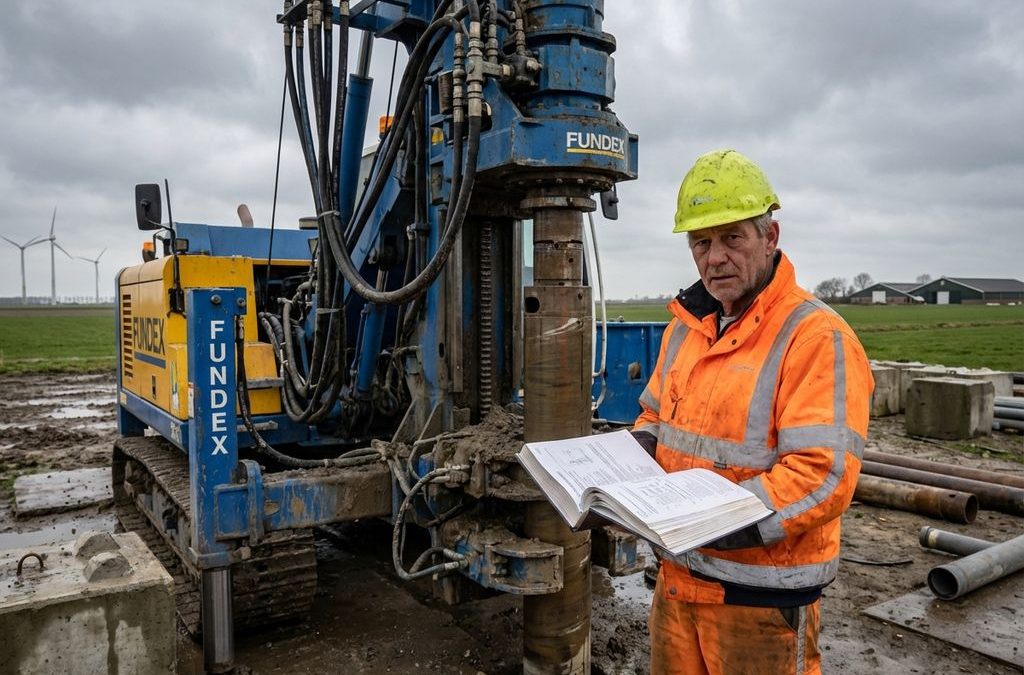
Various mandatory standards apply to foundation work in the Netherlands, ensuring quality, safety, and sustainability. The most important of these are NEN 6743 for precast concrete piles, NEN-EN 1997 (Eurocode 7) for geotechnical design, and additional technical regulations for specific foundation techniques. These standards define design parameters, construction methods, and quality controls for all foundation projects.
Which Dutch standards (NEN) are mandatory for foundation work?
Various NEN standards are mandatory for foundation work, with NEN-EN 1997 (Eurocode 7) serving as the basis for geotechnical design and NEN 6743 applying specifically to precast concrete piles. In addition, NEN-EN 1536 for bored piles, NEN 9997-1 for the Dutch application of Eurocode 7, and various implementation guidelines apply.
NEN-EN 1997 (Eurocode 7) governs geotechnical design and specifies how bearing capacity is calculated, soil properties are determined, and safety factors are applied. This standard applies to all types of foundations and forms the basis for structural calculations.
NEN 6743 specifically addresses precast concrete piles and sets out requirements for materials, dimensions, reinforcement, and quality control. For cast-in-place piles, such aspiles, additional technical provisions from the BRL 2100 assessment guideline apply.
NEN-EN 1536 addresses the construction of bored piles sets requirements for drilling methods, concrete quality, and quality controls. For vibration-free foundation techniques, additional project-specific requirements often apply that go beyond the standard specifications.
How are quality and safety checked for foundations?
Quality and safety are ensured through load tests, integrity inspections, certification of companies and materials, and oversight by accredited bodies. Load tests assess the actual load-bearing capacity, while ultrasonic inspections verify pile integrity and dynamic tests evaluate installation quality.
Load tests are mandatory for new foundation techniques and when there is uncertainty regarding bearing capacity. These tests measure both compressive and tensile loads and validate the design parameters. For patented systems, such aspiles, pre-approved bearing capacity values are often used based on extensive testing programs.
Integrity checks are performed using ultrasonic measurements that detect cracks, inclusions, or geometric deviations. Dynamic tests conducted during pile driving or drilling provide real-time feedback on installation quality and soil conditions.
Company certification in accordance with VCA standards is mandatory for foundation work, as is CE marking for precast elements. Accredited inspection bodies such as TNO or Kiwa verify compliance with technical requirements and conduct periodic audits of certified companies.
What are the environmental regulations for modern foundation techniques?
Environmental regulations include noise limits of 55–70 dB(A) during the day, vibration limits of up to 0.3 mm/s for residential areas, Stage V emission requirements for machinery, and sustainability requirements. Vibration-free foundation techniques, such as screw piles, automatically meet strict vibration standards and significantly reduce noise pollution.
Noise standards vary by municipality, but generally range from 55 dB(A) in residential areas to 70 dB(A) in industrial areas. Traditional pile driving often produces 90–100 dB(A), while vibration-free methods remain below 75 dB(A) and do not cause peak noise levels.
Vibration limits are strict: a maximum of 0.3 mm/s for residential buildings and 0.15 mm/s for historic buildings. Modern electric foundation machines, such as the CD20E, operate on-site with zero emissions, while Stage V diesel engines running on HVO100 fuel reduce local CO₂ emissions by 90%.
Sustainability requirements are becoming increasingly important, with emission-free foundation solutions receiving preferential treatment in tenders. Innovative techniques that optimize material use and extend service life often earn extra points in BREEAM and GPR assessments.
What building permits and notifications are required for foundation work?
Foundation work usually requires an environmental permit, as well as notifications to water authorities for groundwater extraction and to municipalities for heavy transport. In protected areas or near critical infrastructure, additional permitting procedures apply, along with often stricter implementation requirements for vibration and noise control.
The environmental permit for construction automatically covers foundation work, but specific activities require separate notifications. Groundwater extraction exceeding 10 m³ per hour must be reported to the water authority, as must temporary groundwater lowering.
Notifications for heavy hauls are required when axle load or total weight limits are exceeded. Large foundation-laying machines often require transport permits and escorts, especially in urban areas with limited access.
In Natura 2000 areas, near historic monuments, or near critical infrastructure such as railways, stricter procedures apply. Vibration and noise studies are often required in such cases, and vibration-free foundation methods can expedite the permitting process by automatically meeting strict requirements.
Compliance with foundation standards requires expertise in both technical specifications and permitting procedures. Professional guidance helps ensure that projects are completed smoothly and in accordance with regulations. For specific project requirements and regulatory compliance, please contact us for expert advice on the most suitable foundation solution.
Frequently Asked Questions
How long does it take to obtain all the necessary permits for foundation work?
The processing time for permits ranges from 6–8 weeks for standard environmental permits to 3–6 months for complex projects in protected areas. When using vibration-free foundation techniques, the process can often be shortened because strict environmental requirements are automatically met. Therefore, start the application process early and consider holding preliminary consultations with the municipality.
What happens if, during construction, it turns out that the ground conditions differ from those indicated in the geotechnical survey?
If soil conditions differ from expectations, the foundation design must be adjusted in accordance with NEN-EN 1997 procedures. This may result in changes to the pile type, length, or number, which may require additional load tests. Proper preparation, including comprehensive soil investigations and flexible foundation solutions, can largely prevent such situations.
What are the costs associated with the mandatory quality inspections and load tests?
Load tests cost an average of €3,000–€8,000 per test, depending on the load level and test duration. Integrity tests range from €50–€150 per pile, while dynamic tests cost €500–€1,500 per location. These testing costs typically amount to 2–5% of the total foundation costs and are mandatory for quality assurance.
Can existing foundation standards be applied to innovative foundation techniques?
Voor nieuwe funderingstechnieken gelden aanvullende beoordelingsrichtlijnen zoals BRL 2100, naast de standaard NEN-normen. Innovatieve systemen vereisen vaak uitgebreide testprogramma’s en certificering voordat ze algemeen toepasbaar zijn. Gepatenteerde technieken met bewezen prestaties kunnen vooraf goedgekeurde draagkrachtwaarden hanteren, wat de implementatie versnelt.
As a client, how can I verify that my contractor is properly following all foundation standards?
Request certificates such as VCA accreditation, BRL certification for specific techniques, and CE markings for materials. Have inspections carried out by accredited bodies such as TNO or Kiwa, and require reports on all load tests and integrity checks. An independent technical supervisor can monitor compliance with standards throughout the project.
What specific advantages do vibration-free foundation methods offer in terms of compliance with environmental standards?
Vibration-free methods such as screw piles automatically meet strict vibration requirements (below 0.3 mm/s) and produce less noise (below 75 dB(A) versus 90–100 dB(A) for traditional pile driving). This speeds up permitting processes, prevents complaints from nearby residents, and enables foundation work in sensitive environments such as near historic sites or hospitals.
What are the consequences if foundation work does not meet the mandatory NEN standards?
Non-compliant foundations can lead to construction halts, repair work, liability claims, and insurance issues. Municipalities may refuse occupancy permits, while rejections by inspection authorities require costly redesign processes. Prevention through professional execution and adequate inspections is therefore essential for project success.