
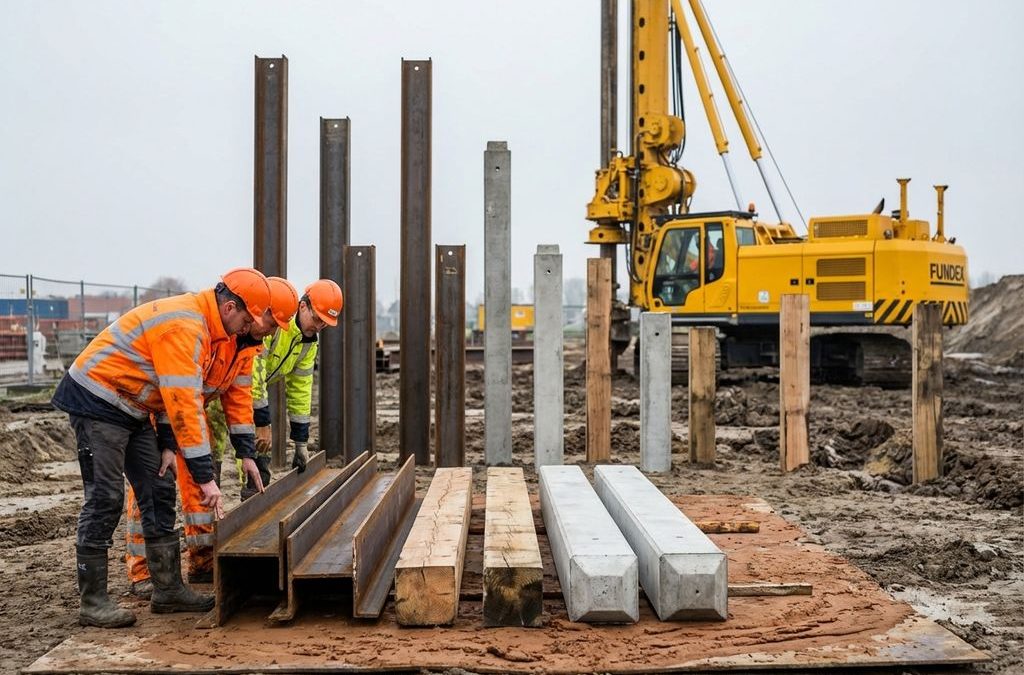
Foundation piles are the unsung heroes of every stable structure. There are various types piles, each with unique properties and applications. The choice depends on factors such as soil conditions, load requirements, and environmental considerations. From traditional concrete piles to innovative, vibration-free systems, each piling method offers specific advantages for a wide range of construction projects.
What are the most important types of materials for foundation piles?
The three main categories of foundation piles are concrete piles, steel piles wooden piles. Concrete piles dominate modern construction due to their strength and durability; steel piles flexibility under heavy loads; while wooden piles are piles used in specific situations, such as in historic districts.
Concrete piles are by far the most commonly used in contemporary foundation projects. They can be poured on site or installed as prefabricated elements. In-situ concrete piles are formed by screwing a hollow tube into the ground and then filling it with concrete. This method ensures optimal connection to the surrounding soil and offers excellent load-bearing capacity.
Steel pipe piles combine the advantages of steel and concrete by incorporating a permanent steel pipe that remains in the ground as part of the structure. These piles particularly well-suited for projects that must withstand high tensile and compressive forces. The steel pipe protects the concrete from aggressive soil conditions and significantly extends the foundation’s service life.
Wooden piles a long history in Dutch foundation engineering, particularly in areas with soft soil layers. Although they are used less frequently in new projects, they remain relevant for restoration projects and specific applications where traditional methods are preferred.
What installation techniques are available for foundation piles?
Modern installation techniques range from traditional pile driving to innovative, vibration-free methods. Screw-in installation is gaining popularity because it eliminates vibrations and offers a high degree of precision. Drilling is used in complex soil conditions, while vibration is suitable for specific pile types and soil conditions.
Vibration-free installation has revolutionized foundation work. By driving piles into the ground piles , no vibrations are generated that could damage surrounding structures. This technique makes it possible to work in confined spaces, even as close as 0.9 meters from existing structures.
The screw process works with a special drill bit that displaces the soil while the pile inserted. This ensures minimal soil disturbance and preserves the natural bearing capacity of the soil. Pile angles of up to 4:1 forward and 2:1 backward are possible, offering flexibility for complex projects.
Traditional installation methods remain relevant for specific applications. Vibratory driving is used for certain pile types in suitable soil conditions, where the high installation speed can be an important advantage. The choice between installation methods depends on the soil conditions, environmental factors, and project-specific requirements.
How do you choose the right foundation pile for your project?
The selection of foundation piles begins with soil testing and load calculations. Soil types with a strength between 1 and 20 MPa determine which pile types are suitable. For very soft layers, systems with a permanent steel pipe are recommended, while hard layers may require grout injection for optimal bearing capacity.
The soil conditions form the basis for every foundation choice. In soft soil layers where pile shaft deformation can occur, permanent steel tubular piles offer the best solution. These systems prevent deformation and guarantee long-term stability of the structure.
Environmental factors play a crucial role in the selection process. In densely built-up areas where vibrations are problematic, vibration-free methods are essential. The available workspace determines which machines can be used, ranging from compact rigs set-up areas of 2 x 3 meters to large machines that require 9 x 14 meters.
Project-specific requirements such as load-bearing capacity, pile length, and sustainability targets influence the final choice. Modern projects often require specialized foundation solutions that take into account both structural and environmental requirements.
What are the latest innovations in foundation piles?
Innovations in foundation technology focus on sustainability and zero-emission installation. Fully electric machines eliminate local emissions, while hybrid pile solutions—such as energy piles—combine foundation work with geothermal energy generation. These developments make foundation work more environmentally friendly and energy-efficient.
Electric foundation machines represent the future of emission-free foundation work. These machines operate completely without emissions and significantly reduce noise pollution. For projects where sustainability is a priority, these innovations offer the ideal combination of performance and environmental awareness.
Energy Piles load-bearing functionality with heat exchange through the ground. Thanks to piping integrated into the reinforcement cage, these piles can use piles 20 times less energy for cooling and up to 5 times less for heating compared to traditional systems. This technology makes a significant contribution to energy-efficient buildings.
Hybrid pile solutions, such as thepile, offer economic advantages thanks to their variable geometry. The thicker upper section provides better resistance to bending moments, while the narrower lower section allows for faster drilling. This results in material savings and shorter installation times.
The evolution in foundation technology shows that innovation and sustainability go hand in hand. From vibration-free installation to energy-efficient solutions, modern foundations contribute to better, quieter, and greener construction projects. For specific project requirements and professional advice on foundation solutions, it is advisable to contact specialized foundation experts, who can recommend the right technology for each unique situation.
Frequently Asked Questions
How long does it take to install foundation piles for an average house?
Installation time varies greatly depending on the method chosen and soil conditions. For an average single-family home with 20–30 piles , screw pile installation typically piles 1–2 days, while traditional pile driving can be faster but requires more preparation time. Although vibration-free methods are slower per pile, they eliminate downtime caused by environmental restrictions.
What are the costs of different foundation pile methods?
Although costs are project-specific, concrete piles are generally the most cost-effective for standard projects. Steel pipe piles cost 20-40% more but offer longer service life in aggressive soil. Vibration-free installation has higher initial costs but can be cheaper in the long run by avoiding damage compensation and vibration restrictions.
Can foundation piles be installed in winter or in bad weather?
Moderne funderingstechnieken zijn grotendeels weerbestendig. Schroevend inbrengen kan bij temperaturen tot -10°C, terwijl betonwerk bescherming tegen vorst vereist. Regen beïnvloedt de meeste methoden nauwelijks, maar extreme weersomstandigheden kunnen veiligheidsrisico’s opleveren waardoor werk wordt stilgelegd.
How do you check whether foundation piles have been installed correctly?
Quality control is carried out using several methods: real-time monitoring of installation parameters (depth, resistance, verticality), test loads on test piles, and integrity checks using ultrasound or other techniques. Modern machines automatically record all installation data for quality control and reporting purposes.
What happens if unexpected soil conditions are encountered during installation?
Experienced foundation contractors can usually make adjustments on site, such as changing pile length or switching to a different installation technique. In the event of significant deviations, work is halted for recalculation by the structural engineer. Good preparation with extensive soil investigation minimizes such surprises.
Can existing foundation piles be replaced or reinforced?
Yes, there are various techniques for foundation repair. Micropiles can be added to provide additional load-bearing capacity, existing piles be reinforced, or a completely new foundation can be installed alongside the old one. The choice depends on the condition of the existing foundation, available space, and structural requirements.
How long do foundation piles last and what maintenance is required?
Modern concrete piles have a design life of 50-100 years, steel tubular piles often even longer due to corrosion protection. Regular maintenance is minimal, but periodic inspection of visible parts is recommended. In aggressive soil conditions, additional protective measures can further extend the service life.