
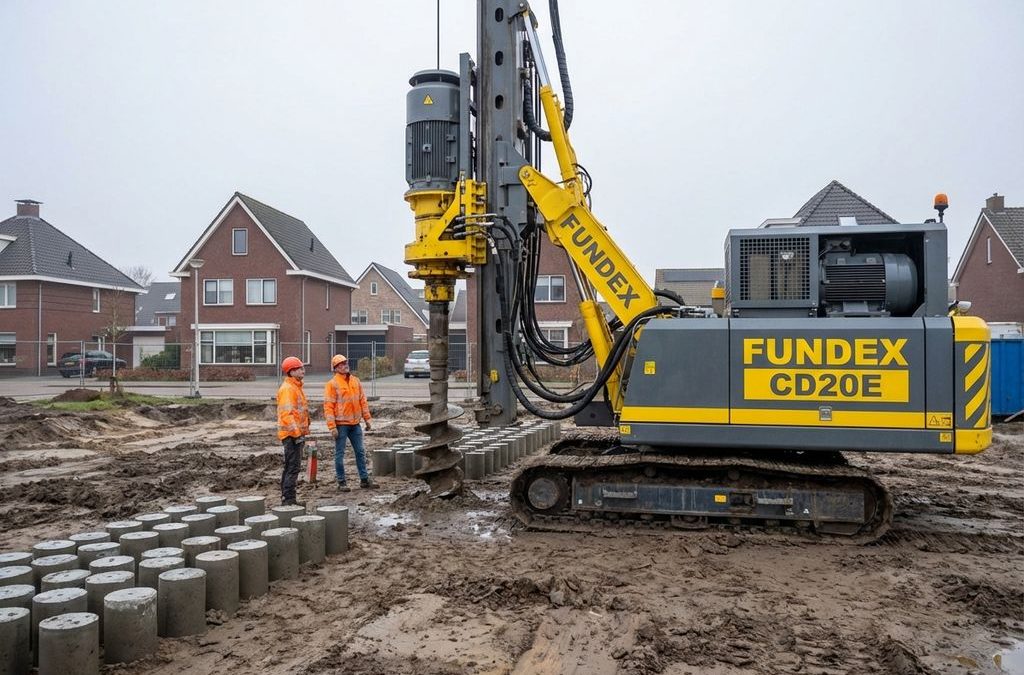
Silent foundation methods are modern techniques that piles installed without causing vibrations, noise pollution, or shocks to the surrounding area. Unlike traditional pile driving, in which piles are driven piles into the ground, these methods use augers, drills, or presses. This prevents damage to nearby buildings and eliminates noise pollution, which is essential in urban areas and for sensitive structures.
What are silent foundation methods and why are they important?
Silent foundation methods are foundation techniques that piles without causing vibrations, noise, or shocks. These methods use controlled movements, such as screwing, drilling, or pressing, instead of traditional impact driving.
The difference from traditional pile driving is fundamental. Whereas conventional pile driving drives piles into the ground piles powerful blows, quiet techniques drive piles depth piles a controlled manner. This is achieved through axial pressure combined with torque, pile screwing the pile into the ground.
In urban areas, these techniques are often not only desirable, but necessary. Noise standards often limit construction activities to a maximum of 55 decibels during the day in residential areas, while traditional pile driving can cause noise peaks of 90 decibels or more. In addition, vibrations can cause damage to historic buildings, monuments, and vibration-sensitive equipment in hospitals or laboratories.
Environmental regulations are becoming increasingly stringent, especially in densely populated areas. Municipalities often require vibration-free methods for projects near existing buildings, making quiet foundation methods the standard for many construction projects.
What vibration-free foundation techniques are available?
There are various vibration-free foundation techniques, each suited to specific soil conditions and applications. Screw piles are driven into the ground using axial pressure and torque, bored piles by drilling out soil, and injected piles additional strength through grout injection.
piles among the most advanced systems available. They are installed using a steel casing fitted with a detachable drill bit. The casing is driven to the desired depth, after which the reinforcement is installed and the casing is filled with concrete. As the casing is withdrawn in an oscillating motion, the drill bit remains in place, resulting in a perfect pile soil disturbance.
piles ideal for very soft soil layers where pile shaft deformation must be prevented. These piles handle soil layers ranging from 1 to 80 MPa and are suitable for high compressive and tensile forces. The system is fully soil-displacing, without causing soil settlement.
piles economic benefits and greater resistance to lateral forces, while twin-tube pile walls are used for specific structural solutions. Drilled tube piles are suitable when highly precise placement is required.
How does vibration-free foundation work in practice?
Vibration-free foundation installation relies on controlled forces rather than impact forces. Machines drive piles depth using axial pressure combined with torque, similar to screwing in a screw. This process does not cause vibrations or sudden jolts.
The machines used are specially designed for these techniques. Modern rigs, such as the F3500 and F4800E, feature Stage V low-emission engines or fully electric drive systems. The latest development is the CD20E, a fully electric-powered, compact foundation machine that operates emission-free.
The work process proceeds step by step. A steel auxiliary pipe with a drill bit is inserted, after which it is brought to depth by turning and applying pressure. Once the desired depth has been reached, the reinforcement is suspended and the pipe is filled with concrete. The pipe is removed by oscillating pulling, while the drill bit remains in place.
This method causes minimal disruption. The noise level is limited to normal construction noise, there are no vibrations that could cause damage, and the work can be carried out in confined spaces, with set-up areas measuring 2 x 3 meters.
When should you opt for silent foundation methods?
Quiet foundation methods are necessary in residential areas, near monuments, near vibration-sensitive equipment, and in projects with strict noise restrictions. These techniques are often the only option in cases where working space is limited or where a minimum distance from adjacent structures is required.
In urban areas with existing buildings, vibration-free techniques are often required. piles be installed just 0.5 to 0.9 meters from adjacent structures, depending on the rig used. This makes it possible to build in tight spaces where traditional methods are not feasible.
Extreme caution is required when working with monumental buildings and historic structures. Even minimal vibrations can cause cracks in old masonry or weaken foundations. Silent foundation methods eliminate this risk entirely.
Hospitals, laboratories, and data centers have vibration-sensitive equipment that can be disrupted by traditional pile driving. Vibration-free techniques ensure that these facilities can continue to operate undisturbed during construction work in the vicinity.
Silent methods are often the only option for temporary foundations or work at limited heights. Brace angles of up to 4:1 forward and 3:1 sideways make it possible to work under bridges, in basements, or other confined spaces.
For projects where sustainability is important, electric foundation machines offer an emission-free solution. This combination of quietness and environmental friendliness makes modern foundation techniques suitable for the most demanding projects. For more information about specific applications, please contact us via our website or request a quote for your project.
Frequently Asked Questions
What are the costs of silent foundation methods compared to traditional pile driving?
Stille funderingsmethoden zijn initieel vaak 15-25% duurder dan traditioneel heien, maar deze extra kosten worden vaak gecompenseerd door kortere bouwtijden, geen schaderisico aan belendingen en het vermijden van geluidsboetes. Bij complexe stedelijke projecten kunnen de totale projectkosten zelfs lager uitvallen door de efficiëntie en het wegvallen van risico’s.
How long does it take to install piles quiet foundation methods?
Installation time depends on the type of pile and soil conditions, but on average, 8–15 piles are installed piles day.piles usually be installed more quickly than bored piles, as there is no need to remove soil. Setup time is minimal due to the compact size of modern rigs.
Can silent foundation methods be used in all soil types?
Most silent foundation techniques are suitable for a wide range of soil types, from soft clay to firm sand layers. Special drill bits may be required for very hard soil layers or rocky ground. A preliminary soil investigation is essential in order to select the right technique and equipment for optimal results.
What happens if obstacles are encountered in the ground during installation?
Modern silent foundation machines can drill through most obstacles such as bricks, small concrete blocks, or old foundation remains. In the case of large obstacles, the pile can pile adjusted in position (within tolerances) or special drill bits can be used. The process is always monitored by experienced operators who can respond immediately to unexpected situations.
How is the quality of vibration-free piles installations piles ?
Quality control is carried out by continuously monitoring pressure, torque, and penetration speed during installation. After installation, test loads can be carried out and the concrete quality can be checked. Modern machines automatically record all parameters, which pile a complete installation file for each pile for quality assurance purposes.
Is a special permit required for the use of silent foundation methods?
Quiet foundation methods usually require the same building permits as traditional foundations, but often have fewer restrictions in terms of working hours and noise standards. In some municipalities, vibration-free methods may even be prescribed for sensitive locations. It is advisable to contact the municipality at an early stage to find out about specific requirements.
Can silent foundation methods be combined with other foundation techniques?
Yes, hybrid solutions are possible in which different foundation techniques are combined within a single project. For example, low-noise methods can be used near sensitive buildings, while traditional techniques can be employed in other parts of the construction site. Existing foundations can also be piles adding piles installed without vibration.