
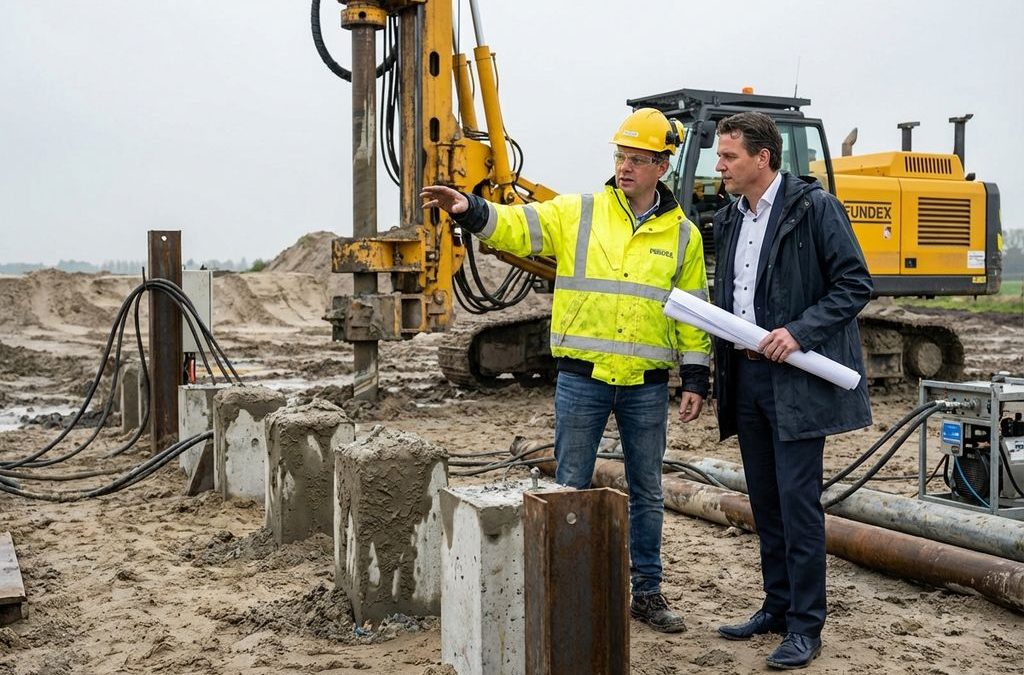
When choosing a foundation specialist, it is crucial to ask the right questions before starting a project. A reputable foundation specialist will help you find the best solution for your specific situation, taking into account soil conditions, environmental requirements, and project specifications. These questions will ensure that you make an informed decision about a reliable foundation.
What is the difference between traditional pile driving and modern foundation techniques?
Traditional pile driving causes vibrations and noise pollution due to the driving of piles, whereas modern techniques such as vibration-free foundation installation piles screw the piles into the ground. This innovative “pile driving without pile driving” method completely eliminates vibrations and allows work to be carried out in confined spaces.
The main difference lies in the installation method and the impact on the surrounding area. In traditional pile driving, piles are driven piles the ground, resulting in vibrations that can cause damage to nearby buildings. Modern foundation techniques such as thepile pile installed using a screwing motion, which gradually displaces the soil without shock loads.
This modern approach offers several advantages. First, projects can be carried out closer to existing buildings without the risk of damage. Second, noise levels are minimal, which is particularly important in urban areas. In addition, these techniques can be used in areas with limited headroom or space, which is often impossible with traditional pile driving.
Which foundation method is best suited for my specific construction project?
The best foundation method depends on soil conditions, loads, and environmental requirements.piles arepiles for soil layers with a bearing capacity between 1 and 20 MPa, whilepiles permanent steel casings are ideal for very soft soils with a bearing capacity of up to 80 MPa. Combi piles with grout injection provide additional strength for heavy loads.
Several factors come into play when making a choice.piles economic advantages due to their thicker top section, which results in reduced concrete consumption and better resistance to lateral forces.piles suitable for sheet pile walls, while bored piles offer flexibility for a variety of applications.
Environmental factors also play a decisive role. In densely built-up areas where vibrations must be avoided at all costs, vibration-free techniques are the only option. For projects with limited access, compact machines can be used. For temporary structures, certain types of piles offer the advantage that they can be removed later without damaging the surrounding area.
An experienced foundation specialist always evaluates the soil conditions through soil testing, the anticipated loads, and the specific project requirements to determine the optimal solution.
How long does a foundation project take, and what factors influence the schedule?
A foundation project typically takes between 2 and 8 weeks, depending on the number piles, site accessibility, and weather conditions. Soil conditions and pile depth have a significant impact on progress, with modern techniques often being faster than traditional methods due to more efficient installation procedures.
Several factors have a significant impact on the schedule. Accessibility to the construction site plays a key role: limited space requires more compact machinery, which may operate at a slower pace. The depth of the foundation piles is also a determining factor, with piles 40 meters deep taking longer to install than shallow foundations.
Weather conditions can disrupt the schedule, especially in the event of frost or heavy rain. Soil conditions that differ from those indicated in the initial soil survey may require adjustments to the work method. The availability of specialized equipment and experienced operators also affects the turnaround time.
Modern electric machines such as the CD20E can have a positive impact on scheduling thanks to their reliability and lower maintenance requirements. Effective scheduling always takes unforeseen circumstances into account and builds in sufficient time for quality checks.
What quality control measures are carried out during foundation work?
Static tests measure both compressive and tensile forces, while ultrasonic tests pile the integrity of the pile . Dynamic tests provide insight into the bearing capacity during installation. This combination of tests ensures that every foundation meets the design specifications and safety requirements.
Static tests are the most reliable method for determining the actual bearing capacity. In these tests, the pile is pile loaded up to the design value or even beyond it to confirm the safety margin. These tests usually take several days, but provide definitive assurance of performance.
Ultrasonic integrity testing detects any irregularities in the pile shaft, such as constrictions or cracks. This non-destructive test can piles applied to all piles and provides immediate results. Dynamic testing during installation provides real-time feedback on bearing capacity and helps optimize the installation process.
Modern quality assurance also includes the documentation of all installation data, such as depth, resistance, and deviations. This data is used for verification and any necessary optimizations during the project. Independent inspection by accredited bodies may be part of the quality assurance process, depending on the project requirements.
What are the costs of different foundation solutions?
Foundation costs range from €50 to €200 per linear meter pile, depending on the pile type, depth, and soil conditions. Vibration-free techniques are often more expensive to purchase, but they save costs through faster installation and by avoiding the risk of damage. Investing in quality foundations prevents costly repairs and ensures the longevity of the structure.
Several factors have a significant impact on pricing. The accessibility of the site may entail additional costs if special equipment is required. Deep foundations up to 40 meters cost more than shallow ones. Grout injection for added strength increases material costs but may be necessary for specific applications.
The total project costs include not only the piles , but also the mobilization of equipment, quality control, and any necessary earthwork. Electric equipment may have higher daily costs, but offers advantages in quiet environments where traditional equipment is not permitted.
A long-term perspective often shows that investing in high-quality foundation techniques is cost-effective. Reliable foundations prevent costly repairs and preserve the value of the structure. An accurate cost estimate requires a customized approach, in which all project-specific factors are taken into account in the quote.
Choosing the right foundation specialist starts with asking these essential questions. An experienced partner will help you navigate the technical options and find the optimal balance between quality, scheduling, and budget. By gaining clarity upfront on methods, scheduling, and costs, you lay the groundwork for a successful foundation project that will deliver reliable performance for years to come.
Frequently Asked Questions
As a layperson, how can I tell if a foundation specialist is trustworthy?
Check whether the specialist is certified under BRL 2100 or comparable quality standards, ask to see reference projects in your area, and request specific examples of previous projects. A reliable specialist provides transparency regarding their working methods, uses modern equipment, and can clearly explain why a particular method is best suited to your project.
What happens if unexpected soil conditions are encountered during foundation work?
An experienced foundation specialist always has a Plan B ready and can adapt flexibly to varying soil conditions. This may involve switching to a different type of pile, adjusting the depth, or installing additional reinforcements. The costs for these adjustments are agreed upon in advance in the contract terms, so you won’t face any surprises.
Can I continue to live in my house while the foundation work is being done?
With modern vibration-free foundation techniques, this is usually possible, as they produce no vibrations and minimal noise. The specialist will schedule the work to minimize disruption, for example by keeping access paths clear and adjusting working hours to fit your daily routine. For complex projects, however, temporary relocation may be necessary.
What warranties do I receive for foundation work, and what exactly do they cover?
As standard, you receive a 5- to 10-year warranty on materials and workmanship, which piles the load-bearing capacity and structural integrity of the piles . The warranty covers manufacturing defects, installation errors, and failure to meet the agreed-upon load-bearing capacity. Please note that damage caused by external factors, such as excavation work or extreme weather conditions, is generally excluded from the warranty terms.
How can I best prepare my construction site for the arrival of foundation equipment?
Ensure there is sufficient access space (at least 3–4 meters wide) for the machinery, temporarily remove obstacles such as garden sheds or fences, and clearly mark any underground utility lines. Inform your neighbors about the planned work and, if necessary, arrange for temporary parking solutions. Proper preparation prevents delays and additional costs during the project.
What are the most common mistakes people make when choosing a foundation solution?
The biggest mistake is making a decision based solely on price without taking into account the specific soil conditions and project requirements. Other common mistakes include skipping a thorough soil investigation, failing to give sufficient consideration to environmental factors such as vibration-sensitive structures, and not factoring future loads—such as expansions—into the planning.
What is the best way to monitor the progress of my foundation project?
Vraag om wekelijkse voortgangsrapportages met foto’s en meetgegevens, laat u informeren over eventuele afwijkingen van het oorspronkelijke plan, en plan regelmatige overlegmomenten in met de projectleider. Moderne specialisten gebruiken vaak digitale systemen waarbij u realtime inzicht krijgt in de voortgang via een online portal of app.