
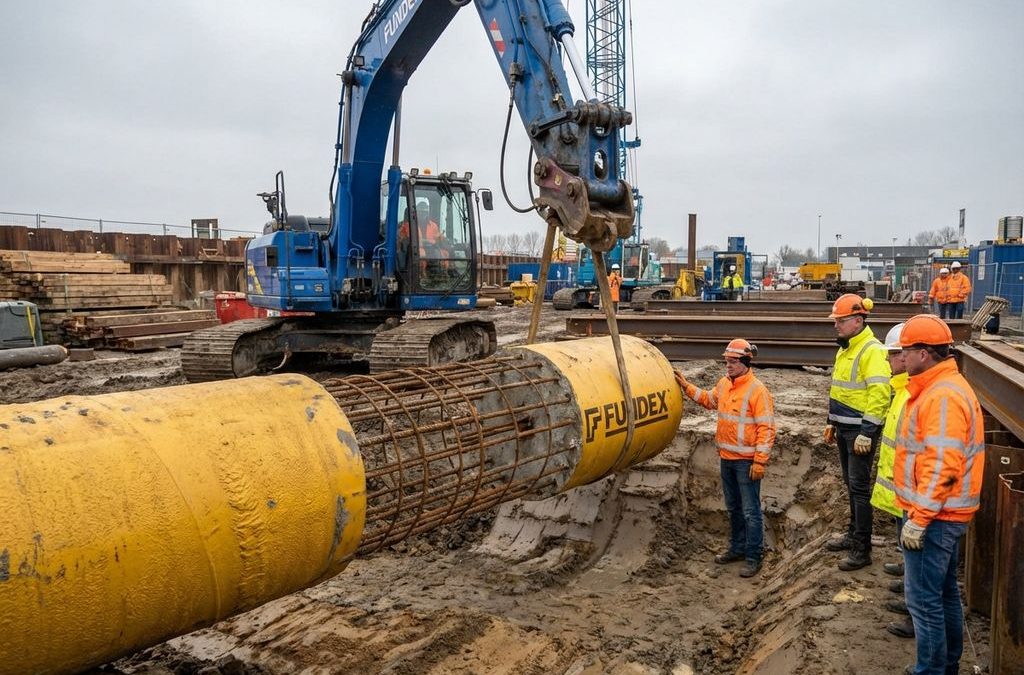
A Fundex pile is a patented, vibration-free foundation pile installed using a unique “piling without piling” technique. This soil-displacing concrete pile is constructed by screwing a steel casing into the ground, after which the pile is cast pile place. This innovative foundation method completely eliminates vibrations and noise pollution.
What exactly is a Fundex pole, and how does it work?
A Fundex pile is a vibration-free, ground-formed, soil-displacing concrete pile manufactured using a steel guide tube that is driven into the ground by a screwing motion. We are the inventors of this innovative pile type, which completely replaces traditional pile driving with a controlled screwing process.
The operating principle is unique in the foundation industry. The pile installed by driving a steel casing with a loose drill bit to the desired depth using axial pressure and torque. Once the desired pile tip level is reached, the reinforcement is placed inside the casing, followed by the pouring of concrete. The casing is then pulled out using an oscillating motion, leaving the drill bit in the ground.
The technical specifications demonstrate the system’s versatility. Standard shaft diameters range from 380 mm to 540 mm, with corresponding drill points ranging from 450 mm to 660 mm. piles be installed to a length of approximately 35 to 40 meters and are preferably reinforced along their entire length with precast reinforcement cages.
Why are more and more construction projects choosing Fundexpalen?
Foundation piles provide 100% soil displacement without vibrations or noise pollution, making them ideal for urban environments and sensitive locations. The only noise during installation comes from the drill motor, similar to that of ordinary construction activities.
The advantages over traditional foundation methods are significant. Because the soil is not disturbed by vibrations, there is no soil settlement or reduction in cone resistance. This results in a high allowable bearing capacity and makes the piles for use as both compression and tension piles.
A practical advantage is that no soil removal is required. The soil is pushed aside during the screw-driven installation process, saving both time and money. Furthermore, there is no risk of damage to adjacent properties during pile installation, which is crucial in densely built-up areas.
For projects with limited working space, Fundexpiles offer flexibility. piles be installed at a distance of approximately 0.9 meters perpendicular to adjacent structures, and bracing ratios of up to 4:1 forward and 2:1 backward are possible.
Which projects are suitable for Fundexpalen?
Foundation piles can be used in soil conditions ranging from approximately 1 to 20 MPa and are suitable for a wide range of construction projects. Residential, commercial, and infrastructure projects all benefit from their vibration-free properties.
In residential construction, Fundex piles are particularly valuable for projects in urban environments where existing buildings must be protected. The absence of vibrations prevents damage to nearby homes and infrastructure. For apartment and office buildings, the combination of high load-bearing capacity and low-noise operation delivers optimal results.
Infrastructure projects, such as bridges, viaducts, and industrial structures, rely on the ability to withstand significant compressive and tensile forces. The piles designed to minimize deformation, which is essential for precision infrastructure.
Specific situations where pile foundations are preferred include projects near hospitals, schools, or other noise-sensitive locations. They also offer the perfect solution for foundation work in historic city centers or near historic buildings, without the risk of vibration damage.
How are Fundexpiles installed without causing vibrations?
The installation process for Fundexpalen follows a seven-step screw-in method that is completely vibration-free. This technique is therefore also referred to as “piling without piling,” because the pile is pile screwed into the ground rather than driven in.
The process begins by placing a steel guide pipe, fitted with a loose drill bit, at ground level. This pipe is then driven to the desired depth by simultaneously applying axial pressure and torque. This controlled process displaces the soil without causing shocks or vibrations.
Once the desired pile tip elevation is reached, the reinforcement is lowered into the tube. The tube is filled with concrete, supplied directly from the batching plant, and any concrete strength class can be used. The key step is the oscillating pull of the tube, which leaves the drill bit in the ground and ensures that the concrete pile is perfectly formed.
Our modern fleet consists of various rigs, such as the F12SE, F15, F2800, and F3500, each optimized for specific project conditions. With a footprint of approximately 7 x 12 meters and a working height of approximately 35 meters, these rigs enable work to be carried out in relatively small areas. For more information about your specific project, please contact us via our quote page.
With over 70 years of international experience, this innovative installation technique has made us the global market leader in vibration-free foundation technology. The process guarantees a perfect pile shaft without discontinuities and delivers the reliability that modern construction projects demand.
Frequently Asked Questions
How much does a Fundex post cost per meter, and what determines the total project cost?
The cost of Fundexpiles varies depending on factors such as pile length, diameter, soil conditions, and project size. For an accurate quote, we recommend contacting us via our quote page, where our specialists can prepare a customized quote based on your specific project requirements.
How long does it take to install Fundexpiles compared to traditional piles?
Foundation piles are generally installed more quickly than traditional piles because there are no waiting periods for vibration-sensitive times and no need to remove soil. An average pile be installed within 30–60 minutes, depending on the depth and soil conditions.
What happens if the ground suddenly becomes hard while driving the screws?
Our modern fleet of machines is equipped with high torque and axial thrust capabilities that can handle varying soil conditions. If we encounter unexpectedly hard layers, we adjust the installation parameters or switch to a heavier machine from our F-series fleet.
Can Fundexpiles be used when groundwater levels are high?
Yes, Fundexpiles are highly suitable for sites with high groundwater levels. Because the pile is cast pile within a closed casing, no groundwater enters during installation. This makes the technique ideal for projects in polders and coastal areas.
How is the quality of the concrete pile checked during the pouring process?
Quality is ensured through the use of certified concrete sourced directly from the plant and the controlled oscillating driving process of the guide tube. In addition, integrity tests such as the PIT (Pile Integrity Test) can be performed to verify pile quality.
Is a special permit required to use Fundexpoles in urban areas?
In general, no special permits are required due to their vibration-free properties. Fundepiles fall under standard building permits. Their lack of vibration and low noise levels make them ideal for urban projects where traditional pile-driving methods are often restricted.