
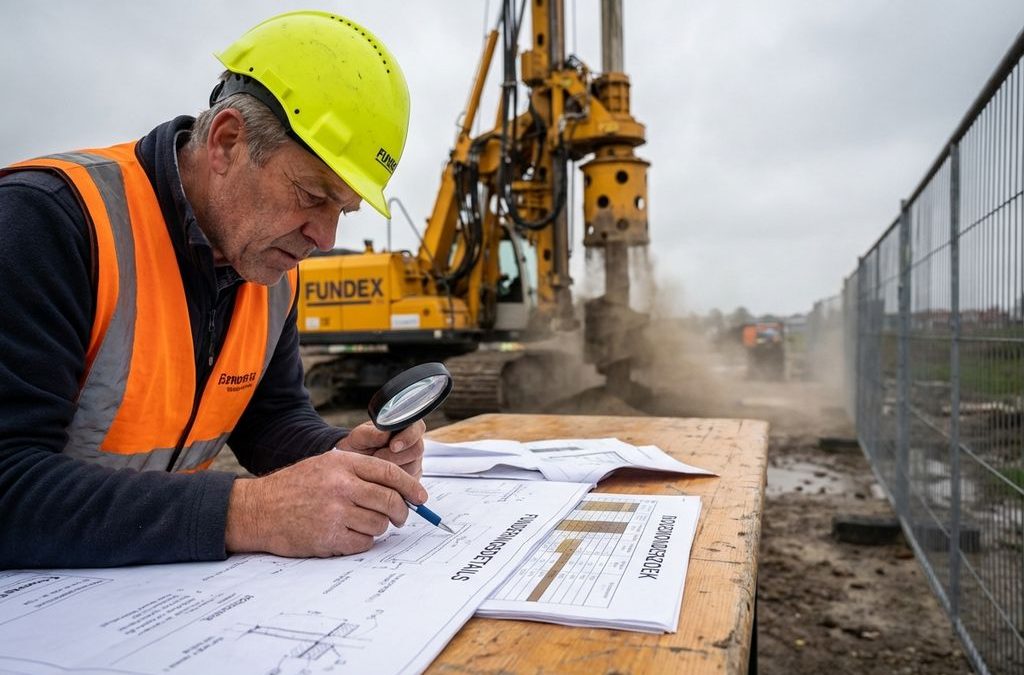
Interpreting foundation research starts with understanding soil layers, groundwater levels, and bearing capacity values. A well-conducted soil survey shows the soil structure, identifies different soil layers and their properties, and determines which foundation method is most suitable. The interpretation of this data determines whether you can use shallow foundations or whether deep pile foundations are required.
What exactly does a foundation survey tell you about the soil?
A foundation report contains essential information about soil composition, soil types, groundwater levels, and bearing capacity per soil layer. This data directly determines which foundation method is suitable for your project. The report shows the different layers from ground level to the bearing layer.
The soil structure is represented in boreholes with exact depths and transitions between layers. Each layer is classified according to NEN standards, such as clay, sand, peat, or gravel. This information tells you where the strong and weak layers are located.
The groundwater level plays a crucial role in foundation choices. A high groundwater level affects the stability of construction pits and may require additional measures. Special techniques are needed for very soft soil layers below the water table.
The cone resistance (qc value) indicates how firm each soil layer is. Values below 1 MPa indicate very soft soil, while values above 15 MPa indicate hard, load-bearing layers. These values determine whether shallow foundations are feasible or whether deep piles .
How do you determine the correct load-bearing capacity from the test results?
The bearing capacity is determined by analyzing the cone resistance (qc) and adhesion resistance (fs), taking safety factors into account. The bearing capacity consists of point bearing capacity and shaft bearing capacity, both of which contribute to the total bearing capacity of the foundation.
For shallow foundations, use the bearing capacity of the upper soil layers. A safety factor of at least 2.0 is applied to the calculated bearing capacity. If in doubt about the soil conditions, choose a higher safety factor.
With pile foundations, you determine the tip bearing capacity from the cone resistance around the pile toe. The shaft bearing capacity depends on the friction along the pile shaft. Different soil layers contribute differently to the total pile bearing capacity.
Be aware of negative adhesion in soft clay layers, which can reduce bearing capacity. Layers that are susceptible to settlement can also pull the pile shaft downwards. You must take these effects into account in your bearing capacity calculation in order to achieve safe foundations.
Which foundation method do you choose based on the soil investigation?
The foundation method is chosen based on load-bearing layers, groundwater level, and environmental factors such as vibration sensitivity. Hard layers within a depth of 2 to 3 meters allow for shallow foundations, while soft upper layers require deep pile foundations.
For load-bearing soil within reach of shallow foundations, choose reinforced concrete foundation beams or slabs. This solution is economically advantageous and technically easy to implement.
Soft top layers with load-bearing layers deeper than 3 to 4 meters require pile foundations. For projects in densely built-up areas, vibration-free techniques are essential to prevent damage to surrounding buildings.
Special systems are required for very soft soil layers extending to great depths.piles a permanent steel casing prevent deformation of the pile shaft in very soft soil. Various pile systems are available for soil layers ranging from 1 to 20 MPa, while very hard layers may require grout injection to achieve optimal bearing capacity.
Environmental factors often determine the final choice. In inner-city areas with limited space and vibration-sensitive buildings, specialized foundation techniques are required that operate silently and vibration-free.
What are common mistakes when interpreting foundation surveys?
Common mistakes include insufficient attention to local soil variations, misinterpretation of groundwater effects, and underestimation of negative adhesion. Ignoring environmental factors such as vibration sensitivity also leads to incorrect foundation choices.
A major mistake is basing the foundation design on too few boreholes. Soil conditions can vary greatly over short distances. One borehole per 400 to 600 m² is usually insufficient for a reliable interpretation.
Groundwater fluctuations are often underestimated. Seasonal changes in the groundwater level affect load-bearing capacity and stability. The impact of drainage or dewatering on surrounding buildings is also regularly overlooked.
Negative adhesion in soft clay layers can significantly reduce bearing capacity, but is often not included in calculations. This can lead to unsafe foundations or unexpected settlement.
Ignoring vibration restrictions in urban environments leads to problems during implementation. Traditional pile driving methods can cause damage to existing buildings. Modern vibration-free techniques prevent these problems and enable foundation work in sensitive environments.
Professional advice is essential for complex soil conditions or special project requirements. We help you interpret foundation surveys and advise you on the most suitable foundation method for your project. Contact us for expert guidance on your foundation project.
Frequently Asked Questions
How often should I have additional drilling carried out if my site is large?
For areas larger than 600 m², we recommend at least one borehole per 400-600 m², but in the case of heterogeneous soil conditions or critical structures, one may be required every 200-300 m². If there is any doubt about soil variations, it is better to have one extra borehole drilled than to encounter problems later on.
What should I do if the groundwater level is different than expected during construction?
Stop digging immediately and consult your foundation advisor. An abnormal groundwater level can affect the load-bearing capacity and stability. Adjustments may be necessary to the construction pit drainage or the foundation method in order to continue building safely.
Can I use a foundation report from my neighbors for my project?
A report from neighbors can provide useful information, but it is never sufficient for your own project. Soil conditions often vary greatly over short distances. For a secure foundation, you always need your own soil investigation at the exact location of your structure.
How can I tell if my foundation consultant has taken all risks into account?
A good consultant explicitly discusses groundwater fluctuations, negative adhesion in soft layers, vibration restrictions, and safety factors. The report must compare different foundation alternatives and include environmental factors such as existing buildings in the recommendations.
What are the costs if I have to switch to a different foundation method afterwards?
Switching during construction can mean 20-50% extra costs due to downtime, design modifications, and potentially more expensive equipment. That is why careful interpretation in advance is crucial. Investing in sufficient soil investigation prevents much more expensive problems later on.
How long does a foundation survey remain valid for my construction project?
A foundation survey usually remains valid for 2-3 years, but this depends on local conditions. In the event of changing groundwater levels, nearby construction activities, or long delays, an additional survey may be necessary to ensure that the information is still up to date.
What additional investigations might I need in addition to the standard foundation investigation?
Complex projects may require vibration and noise measurements, chemical soil testing for concrete aggressiveness, or dynamic probing. Depending on the location, research into existing foundations in the vicinity or archaeological research may also be mandatory.