
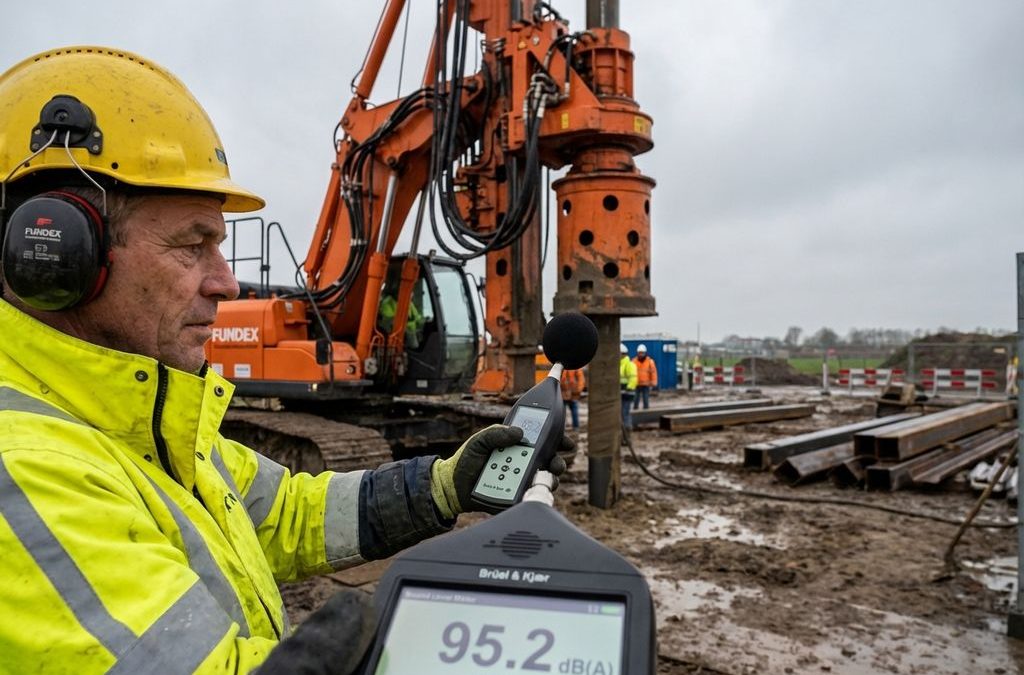
Measuring noise levels during foundation work requires professional noise measurement equipment and knowledge of legal standards. Measurements are taken using calibrated sound level meters at strategic measurement points around the work area. Results are interpreted in accordance with Dutch legislation on construction noise, which sets specific decibel limits for different areas and times of day.
What are the legal noise standards for foundation work?
Dutch law establishes specific noise standards for foundation work through the Environmental Management Act and municipal ordinances. In residential areas, the limit is 55–60 dB(A) during the day (7:00 a.m.–7:00 p.m.), 50–55 dB(A), and at night (11:00 PM–7:00 AM) 45–50 dB(A). Higher levels are permitted in industrial areas.
The exact standards vary by municipality and type of area. Office districts typically have a limit of 60–65 dB(A) during the day, while nature areas have stricter requirements. Municipalities may grant temporary exemptions for complex projects, provided that compensatory measures are agreed upon.
Weekdays are subject to different standards than weekends and holidays. Stricter requirements apply on Sundays and after 6:00 p.m. on weekdays. Exceeding noise standards can result in the suspension of work and fines ranging from €5,000 to €25,000.
Projects in urban areas often require additional measures. This explains why modern technologies, such as the CD20E, a fully electric foundation machine, are becoming increasingly popular, as they operate significantly more quietly than traditional diesel-powered alternatives.
What equipment do you need to measure noise levels during foundation work?
Professional sound measurements require a certified Class 1 or Class 2 sound level meter in accordance with the IEC 61672 standard. Class 1 meters offer higher accuracy (±1.4 dB) and are required for official measurements. Class 2 meters (±2.0 dB) are sufficient for preliminary measurements and monitoring.
Essential equipment includes a sound level meter with A-weighting and C-weighting capabilities, a windscreen for outdoor measurements, a tripod for stable positioning, and a calibration source for daily checks. Modern meters automatically record LAeq (average level), LAmax (peak values), and statistics.
Calibration must be performed daily using a sound calibrator rated at 94 dB at 1000 Hz. Annual certification by accredited laboratories is required for legally valid measurements. Measuring equipment must be protected from moisture, extreme temperatures, and vibrations.
Measurement points are placed at a height of 1.5 meters and at least 3.5 meters away from reflective surfaces. During foundation work, multiple measurement points are required around the work area, especially near homes and other noise-sensitive locations.
How do you interpret noise measurement results in foundation projects?
Noise measurement results are expressed in decibels (dB) using different weighting factors. A-weighting (dB(A)) approximates human auditory perception and is used for legal standards. C-weighting (dB(C)) measures all frequencies equally and is relevant for low-frequency noise from foundation machinery.
LAeq represents the average noise level over a measurement period, while LAmax represents the highest peak value. Both values are important for foundation work, as continuous activities and occasional peaks have different impacts on nearby residents.
Background noise must be subtracted from the total measurements to accurately determine the contribution of the work activities. This is done logarithmically: for a 3 dB difference, 3 dB is subtracted; for a 10 dB difference, the correction is negligible.
The report must include measurement conditions, weather data, equipment specifications, and measurement locations. Wind speeds exceeding 5 m/s, rain, or extreme temperatures can affect measurement accuracy. Measurements taken under representative operating conditions provide reliable results.
Why are more and more projects opting for vibration-free foundation methods?
Vibration-free foundation methods, such aspiles piles, minimize noise issues through “piling without piling.” These techniques use screwing motions and oscillating pulling instead of traditional pile driving, which drastically reduces noise levels and makes it easier to meet legal standards.
Traditional pile driving produces noise levels of 85–110 dB(A), while modern alternatives remain below 70 dB(A). This difference of 15–40 dB represents a reduction of approximately 75–94% in sound energy and a significantly lower perceived sound level, since every 10 dB corresponds to a halving of the perceived sound level.
The benefits of the project include not requiring noise permits, more flexible working hours, fewer complaints from local residents, and shorter turnaround times. Zero-emission electric machines, such as the CD20E, offer additional advantages in environmental zones and densely populated areas.
Urban projects benefit greatly from quiet foundation techniques. Limited workspace, nearby buildings, and strict environmental regulations often make traditional pile driving impossible. Modern methods can be used on areas as small as 2 x 3 meters and can be applied within 0.5 meters of adjacent structures.
The combination of noise level monitoring and innovative foundation techniques makes complex projects feasible. By measuring noise levels in advance and selecting the right methods, projects proceed more smoothly and with minimal disruption to the surrounding area. For project advice on quiet foundation solutions, please contact us via our quote page.
Frequently Asked Questions
How often should you measure noise levels during a foundation project?
Noise levels must be measured at least once a week during active work, and daily when work is being carried out near noise-sensitive locations. If noise levels exceed 90% of the permitted limit, continuous monitoring is required. Additional measurements are also necessary following complaints from nearby residents or changes in work methods.
What should you do if the noise measurement shows that you are exceeding the legal limits?
If the limit is exceeded, you must take immediate action: suspend work during peak hours, install noise barriers, or switch to quieter equipment. Notify the municipality and nearby residents immediately. An adjusted work plan that includes mitigation measures may help you obtain a temporary exemption.
Can weather conditions affect noise measurements, and how do you deal with that?
Yes, winds exceeding 5 m/s, rain, and extreme temperatures can significantly affect measurements. Take measurements only in calm weather or use a windscreen. If adverse conditions are unavoidable, document the weather data and perform corrective measurements under better conditions. Early morning and late evening measurements are often the most reliable.
How do you calculate the costs of switching to vibration-free foundation methods?
Compare the total project costs: traditional pile driving plus noise permits, monitoring, and potential delays versus the additional costs of modern methods. Vibration-free techniques cost 10–30% more per meter, but save on permits, noise mitigation measures, and claims procedures. Shorter project timelines often offset the additional costs.
What are the most common mistakes made when measuring noise levels during foundation work?
Common mistakes include: taking measurements too close to reflective surfaces, failing to perform daily calibration, not accounting for background noise, and taking measurements under non-representative operating conditions. Placing measurement points at the wrong height (not 1.5 m) and ignoring wind conditions also lead to unreliable results.
How can you effectively communicate noise measurement results to local residents and stakeholders?
Use clear, easy-to-understand language and avoid technical jargon. Explain what dB levels mean in real life (compare them to familiar sounds like traffic or conversation). Present trends in graphs, share both positive and negative results transparently, and specify what measures you’ll take if limits are exceeded. Regular updates help prevent misunderstandings and complaints.