
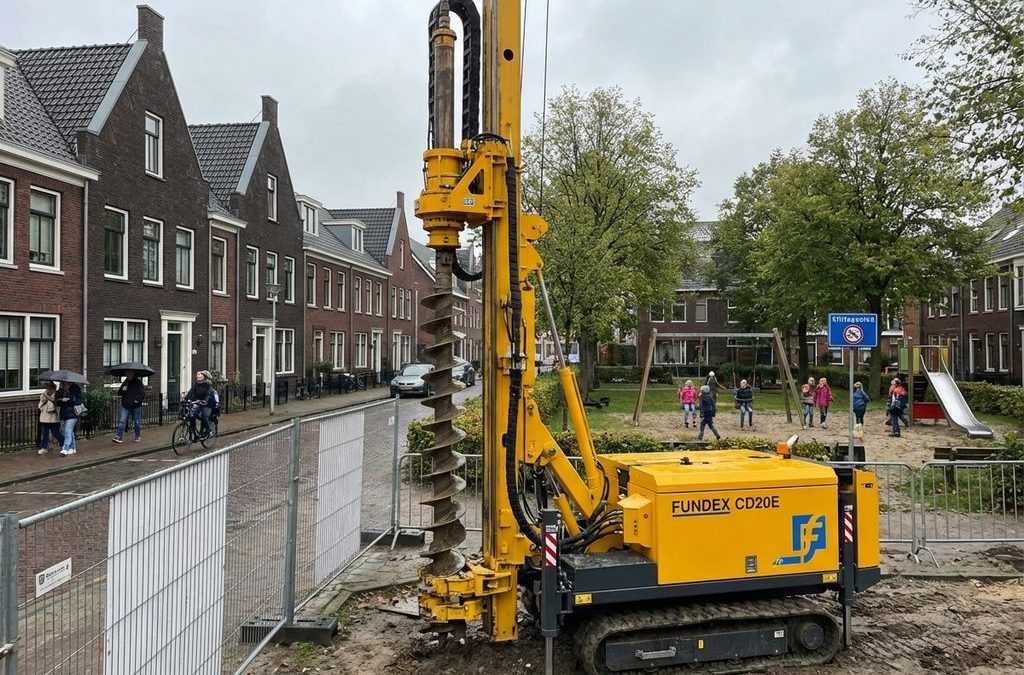
Low-noise pile driving offers significant advantages by eliminating the vibrations and noise pollution typically caused by traditional pile driving. These modern techniques make it possible to install piles the ground without disturbing the surrounding area, resulting in fewer complaints, more flexible working hours, and greater project acceptance. Low-noise methods are particularly valuable in urban areas and near sensitive locations.
What exactly does low-noise foundation mean?
Low-noise foundation installation involves vibration-free techniques in which piles are driven piles the ground without the noise and vibrations associated with traditional pile driving. Instead of driving piles the ground, they are essentially screwed or pressed in, so that only the sound of the drilling machine is audible.
The difference with traditional pile driving is considerable. Whereas conventional pile driving sends vibrations through the ground that can damage buildings and disturb residents, low-noise methods work entirely by displacing soil. The soil is pushed aside laterally, without loosening the ground or reducing cone resistance.
These techniques are gaining popularity because more and more projects are being carried out in densely built-up areas. Municipalities are imposing stricter requirements on noise levels, and clients are looking for solutions that increase social acceptance. Modern foundation methods offer the possibility of 'piling without piling', which is transforming the construction sector.
Why is noise pollution such a problem with traditional foundations?
Traditional pile driving causes significant disruption due to the constant hammering required to drive piles the ground. This noise can last for days and often reaches levels that are harmful to the health of nearby residents and construction workers.
In urban areas, pile driving regularly leads to complaints from residents, businesses, and healthcare institutions. The noise disrupts daily life, can cause stress, and makes concentration impossible. For hospitals, schools, and offices, traditional pile driving often means that activities have to be adjusted or stopped.
The vibrations pose an additional problem because they can cause damage to nearby buildings. Old buildings, monuments, and sensitive structures are at risk of cracking or structural problems. This not only leads to costly repairs, but also to legal proceedings and damage to the image of construction projects.
In addition, noise standards and environmental regulations are increasingly limiting the times at which traditional pile driving can take place, which complicates project planning and increases costs.
What specific advantages does low-noise foundation construction offer for building projects?
Low-noise foundations greatly reduce complaints from local residents and ensure better project acceptance. Construction teams can work more flexible hours because noise restrictions are largely eliminated, which simplifies planning and shortens lead times.
Relations with the local community improve significantly when construction work does not cause any nuisance. This leads to less resistance to projects, faster permit procedures, and more positive coverage in local media. For project developers, this means a valuable improvement to their reputation.
Safety on the construction site is improved because workers are not exposed to harmful noise levels. This reduces the risk of hearing damage and stress-related accidents. In addition, work can be carried out in densely built-up areas where pile driving would traditionally be too risky.
Financially, low-noise techniques offer advantages by eliminating damage claims, avoiding delays due to complaints, and enabling work in areas that would otherwise be inaccessible. Modern foundation solutions make projects possible that were previously unfeasible.
How do modern vibration-free foundation techniques work in practice?
Modern vibration-free techniques involvescrewing piles into the ground rather than driving them in. This method, also known as “piling without driving,” uses controlled rotation and pressure to piles without causing vibrations.
With these techniques, the soil is completely displaced, eliminating the need for soil removal and preserving the bearing capacity of the surrounding soil. The only noise produced comes from the drill motor, which is comparable to the noise level of ordinary construction machinery.
Advanced foundation machines can now operate entirely electrically, which further reduces noise production. These machines are equipped with precision systems that pile the exact depth and position of each pile , resulting in high quality and reliability.
piles often engineered with special designs that provide optimal load-bearing capacity for both compressive and tensile loads. Because they are installed without vibration, there is no damage to adjacent properties, making these techniques ideal for renovation projects and expansions in existing developments.
For which projects is low-noise foundation construction most suitable?
Low-noise foundation work is essential for projects in densely built-up urban areas where traditional pile driving would cause unacceptable nuisance. Hospitals, schools, and care institutions often require low-noise solutions so that they can continue their activities undisturbed.
Renovation and expansion projects on existing buildings benefit greatly from vibration-free techniques. Historic buildings, monuments, and vulnerable structures can be founded without the risk of damage from vibrations. This makes complex urban development projects possible.
Residential areas, office parks, and commercial developments are increasingly opting for low-noise foundations to maintain quality of life. Projects near airports, industrial parks, or other sensitive infrastructure often require vibration-free solutions due to strict environmental regulations.
Temporary foundations, such as those used for events or construction site installations, are ideally suited to low-noise techniques due to their flexibility and minimal impact on the environment. Projects with limited accessibility or small installation areas also benefit from compact, low-noise foundation machines.
For more information about low-noise foundation solutions for your specific project, please contact us for a quote. Every situation requires a customized approach, with the right technology being selected based on soil conditions, environmental factors, and project requirements.
Frequently Asked Questions
How long does it take to switch from traditional pile driving to low-noise foundation construction?
The switch can usually be made within a few weeks, depending on the availability of specialized machinery and experienced operators. It is important to contact a low-noise foundation specialist early in the planning phase in order to select the right technology and adjust the schedule.
Are low-noise foundation techniques more expensive than traditional pile driving?
Although the initial costs may be slightly higher, the savings on damage claims, delays, and more flexible working hours often more than compensate for this. In addition, projects can be carried out in areas where traditional pile driving would be impossible, creating new opportunities.
What happens if the ground conditions prove unsuitable for low-noise foundations?
Modern low-noise techniques are suitable for virtually all soil types, from soft clay to hard sand layers. For very hard layers such as rock formations, hybrid solutions can be used, combining low-noise techniques with drilling equipment that produces minimal noise.
How can I check whether my contractor is actually using low-noise techniques?
Request certification of the equipment used and have noise measurements carried out during the work. Genuine low-noise foundations produce noise levels comparable to normal construction machinery (60-75 dB) instead of the 90+ dB of traditional pile driving.
Can all types of posts be installed quietly?
Most common pile types can be installed with minimal noise, including concrete piles, steel pipe piles, and screw piles. The choice depends on the load-bearing requirements and soil conditions. Your foundation specialist can advise you on which pile types are best suited to your specific project.
What are the most common mistakes when implementing low-noise foundations?
Common mistakes include delaying the planning phase, insufficient ground research, and selecting the cheapest provider without verifying their expertise. Begin the selection of a specialized contractor in a timely manner and invest in thorough preliminary research.