
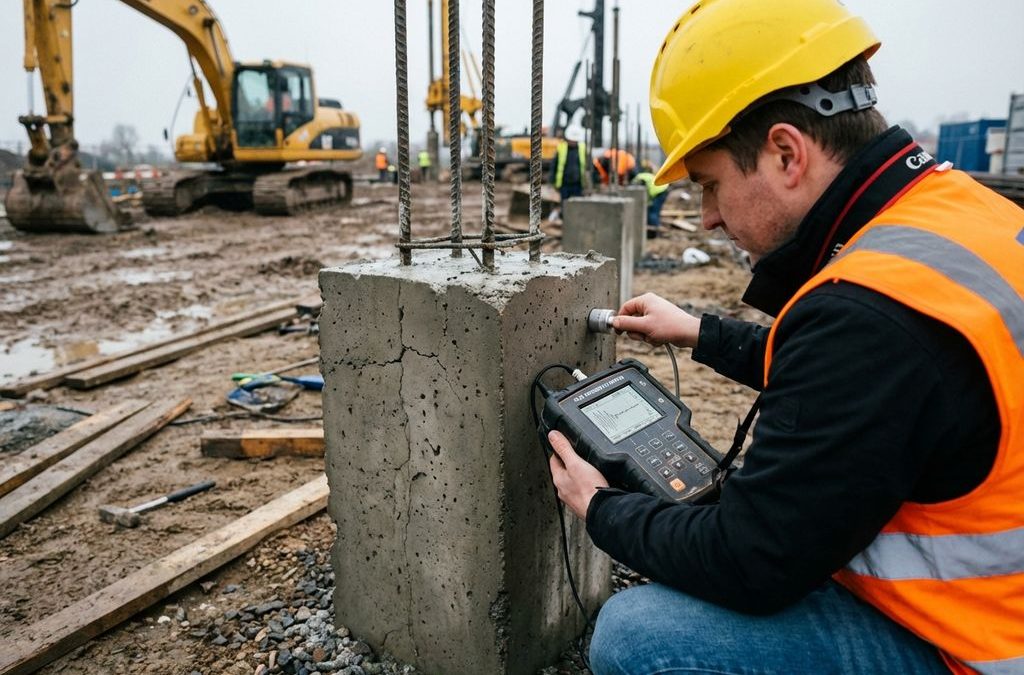
Testing foundation piles is a critical process for piles the bearing capacity and integrity of piles before they are subjected to permanent loads. There are three main methods: static tests for accurate bearing capacity measurement, dynamic tests for rapid evaluation, and ultrasonic integrity tests for detecting defects. These tests ensure that foundations function safely and durably throughout the entire service life of a structure.
Why is testing foundation piles so important?
Testing foundation piles is essential for the safety and durability of structures, as it determines the actual load-bearing capacity and quality of the foundation. Without adequate testing, defective foundations can lead to settlement, cracking, or even collapse of structures, with all the consequences that this entails for human lives and economic damage.
With modern foundation techniques, such as vibration-freepiles, the bearing capacity is calculated in accordance with EC, NEN, and CUR standards, but practical tests remain indispensable. Defective foundations can go unnoticed for years until the load increases or external factors, such as changes in groundwater levels, begin to exert their influence.
Quality control by means of pile testing not only protects against immediate safety risks, but also prevents costly repairs later on. It is much cheaper to detect defects during the construction phase than to carry out extensive repair work later on. In addition, building regulations and insurers often require proof of adequate foundation inspection.
What test methods exist for foundation piles?
There are three main categories of pile testing: static tests for accurate bearing capacity measurement, dynamic tests for rapid evaluation during or shortly after installation, and ultrasonic integrity tests for detecting defects in the pile shaft. Each method has specific applications depending on the purpose of the test.
Static pile tests are used when highly accurate bearing capacity data is required, for example in critical constructions or when there are doubts about the soil conditions. This method measures both compressive and tensile loads by applying gradually increasing forces.
Dynamic tests are suitable for routine checks and quality control during implementation. They use impact energy to determine pile properties and can be performed immediately after installation. For innovative techniques, such as the vibration-free Fundex method, dynamic tests provide rapid insight into pile integrity.
Integrity tests verify the continuity and uniformity of the pile shaft without applying any load. This non-destructive method is particularly valuable for cast-in-place piles, where the quality of the concrete and reinforcement is critical.
How does a static pile test work in practice?
A static pile test applies gradually increasing loads to a pile while measuring the deformation. The test uses hydraulic jacks and reference piles to apply controlled force and measures both the total settlement and the bearing behavior under various load levels up to a maximum of 150 to 200% of the design load.
The process begins with the installation of measuring equipment around the test pile. Hydraulic jacks are placed between the test pile and a reaction system, usually consisting of anchor beams or reference piles. The load is increased step by step according to a predetermined schedule, with each load step being maintained until the deformation stabilizes.
During the test, settlement measurements are taken using precision instruments capable of recording displacements down to tenths of a millimeter. For tensile tests, the pile is loaded pile above to determine its pull-out behavior. This is particularly relevant for piles must withstand tensile loads, such as those used in basements or structures subject to uplift forces.
The results are processed in a load-settlement diagram that visualizes the bearing behavior. From this, the failure load is derived and compared with the calculated bearing capacity. This data forms the basis for the final foundation design and any adjustments.
What is the difference between dynamic and static pile tests?
The main difference lies in the method of loading: static tests use gradually increasing, constant forces, while dynamic tests apply short-term impact loads. Static tests provide more accurate load-bearing data, but dynamic tests can be performed more quickly and are suitable for routine quality control during construction.
Static tests take between 4 and 8 hours per pile require an extensive setup with response systems. They provide detailed information about the bearing behavior under different load levels and are the gold standard for critical projects. The costs are higher, but the accuracy is unmatched.
Dynamic tests can pile performed within 30 minutes per pile and use a falling weight or hammer that delivers a controlled blow to the pile head. Sensors measure the forces and accelerations, from which the bearing behavior is derived using wave propagation theory.
Both methods provide valuable information for modern, vibration-free foundation techniques. Static tests are ideal for design verification, while dynamic tests are suitable for production control and monitoring installation quality. The choice depends on the project requirements, the time available, and the desired accuracy.
How do you test the integrity of a foundation pile?
Integrity tests use ultrasonic technology to check the continuity and homogeneity of a pile shaft without pile the pile . A sensor on the pile head sends sound waves through the pile, which reflect when there are changes in material density, allowing defects such as cracks, inclusions, or diameter deviations to be detected.
The test principle is based on wave propagation through the concrete. Sound pulses travel through the pile reflect when they encounter impedance changes, such as transitions between concrete and soil at the pile base or defects in the pile shaft. The returning signal responses are analyzed to determine the pile length and any irregularities.
This method is particularly valuable for in-situ cast piles, such aspiles, where concrete quality and the continuity of the reinforcement are critical. Integrity tests can be performed immediately after the concrete has cured and provide rapid insight into potential construction issues.
The advantages include rapid execution (a few minutes per pile), non-destructive testing, and the ability to piles 100% of the piles rather than just sampling them. A limitation is that only qualitative information about defects is obtained, without quantifying the bearing capacity. For complete quality assurance, integrity testing is therefore often combined with static or dynamic bearing capacity tests.
Testing foundation piles combines various techniques to ensure both bearing capacity and integrity. Modern foundation methods require customized testing strategies that match the specific properties of each technique. For optimal results, it is important to choose the right combination of testing methods based on project requirements and risk assessment. Do you have questions about the most suitable testing method for your foundation project? Contact us for tailored advice.
Frequently Asked Questions
How often should foundation piles be tested during a construction project?
The testing frequency depends on the project size and risk assessment, but typically 1–2% of all piles are tested piles and 5–10% are tested dynamically. Higher percentages may be required for critical structures or unknown soil conditions. Integrity tests can piles performed on 100% of the piles due to their quick and cost-effective implementation.
What are the costs of different pile tests and how do they compare to each other?
Static tests are the most expensive (€2,000-5,000 per test) due to the complex setup and long test duration. Dynamic tests cost approximately €500-1,500 per pile integrity tests are the cheapest (€100-300 per pile). However, the investment in testing is minimal compared to the costs of potential foundation problems later on.
Can pile tests be carried out in all weather conditions?
Integrity tests and dynamic tests can be performed in most weather conditions. Static tests are more sensitive to extreme weather conditions such as frost, strong winds, or heavy rain, as these can affect measurement accuracy. At temperatures below 0°C, special precautions must be taken for the hydraulic systems.
How long after installation can the various pile tests be carried out?
Dynamic tests can be performed immediately after installation, which is ideal for quality control during construction. Integrity tests require that the concrete has cured sufficiently (at least 7 days). Static tests are usually performed after 28 days, when the concrete has reached its design strength.
What happens if a pile test shows that a pile meet the requirements?
If test results are unsatisfactory, additional tests are first conducted to determine the extent of the problem. Depending on the findings, the decision may be made to install additional piles, reinforce existing piles, or, in extreme cases, replace defective piles. A geotechnical consultant determines the most appropriate solution.
Are there specific standards and regulations for pile testing in the Netherlands?
Yes, pile testing in the Netherlands must comply with NEN-EN 1997 (Eurocode 7), NEN 9997 (Dutch national annex) and CUR publications for specific test methods. These standards describe test procedures, interpretation criteria and reporting requirements. Many municipalities and provinces have additional requirements for foundation testing in their building regulations.
As the client, can I decide which test method is used?
As the client, you have influence over the choice of tests, but the final selection must be based on technical considerations and project requirements. A geotechnical consultant can recommend the most suitable combination of test methods based on soil conditions, construction requirements, and budget. It is wise to establish test specifications during the design phase.