
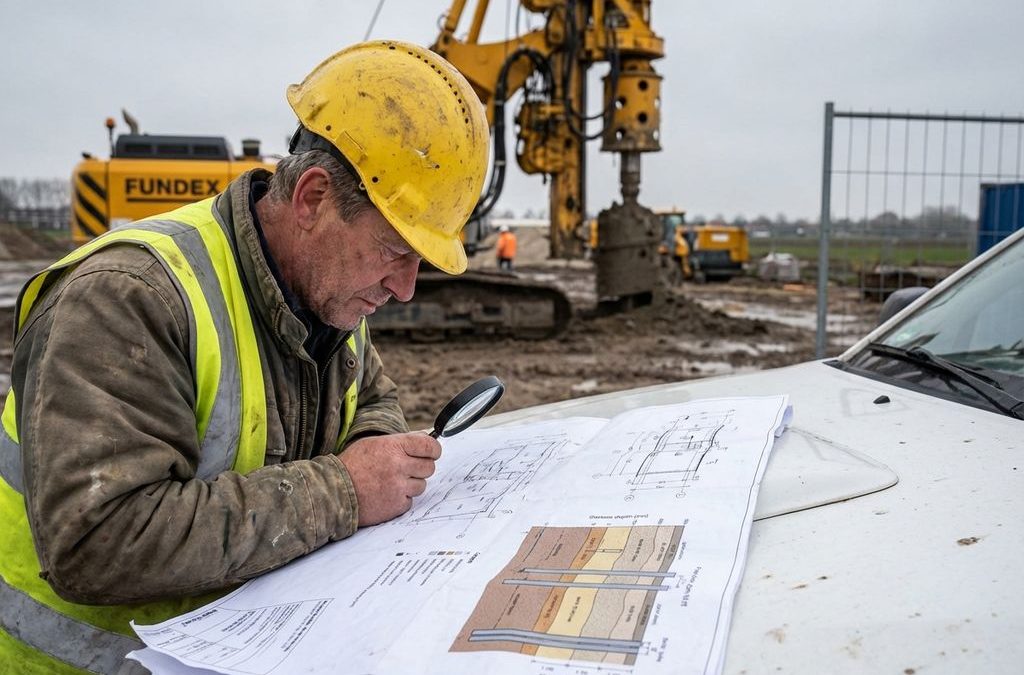
A foundation report is a technical document that describes the soil conditions at a construction site and provides recommendations on the most suitable foundation method. The report contains detailed information on soil composition, bearing capacity, and groundwater levels, and serves as the basis for safe foundation design. For most construction projects, this report is required by law and is essential for obtaining a building permit.
What exactly is a foundation report, and why is it necessary?
A foundation report is a geotechnical advisory report that analyzes soil conditions and provides specific recommendations for the foundation of a structure. The report is prepared based on soil investigations and serves as the technical basis for selecting the foundation.
The report plays a crucial role in the construction process, as it ensures the safety and stability of the future building. Without this report, it is impossible to determine which foundation method is appropriate and what the bearing capacity of the soil is. For residential, commercial, and infrastructure projects, a foundation report is therefore often required by law.
There is a direct link between soil investigation and foundation design: soil investigation provides raw data on soil composition and properties, while the foundation report translates this information into practical construction recommendations. This ensures that architects, structural engineers, and contractors know how to safely design foundations for a specific site.
What information is included in a foundation report?
A foundation report typically consists of five main sections: the soil profile at various depths, the bearing capacity of the different soil layers, current and historical groundwater levels, specific foundation recommendations, and technical specifications for construction.
The soil structure is presented in soil profiles that show which soil layers are located at what depths. These can range from sand and clay to peat or rock layers. The bearing capacity is expressed in megapascals (MPa) and indicates how much weight each layer can support without failing.
The foundation recommendation forms the core of the report and specifies which foundation method is most suitable. This can range from shallow foundations on steel to deep foundations using piles. For modern projects, it is often recommended to use vibration-free techniques, especially in urban areas where noise pollution and damage to surrounding buildings must be prevented.
All information is presented in drawings, tables, and graphs that are easy for construction professionals to interpret. The technical specifications include specific details on pile lengths, load-bearing capacities, and construction methods.
Who prepares a foundation report, and when is it prepared?
A foundation report is prepared by geotechnical engineering firms or specialized foundation consulting firms that employ certified soil scientists and structural engineers. These specialists have the expertise to interpret soil investigation results and translate them into practical foundation recommendations.
The report is typically prepared during the design phase of a construction project, after the soil investigation has been conducted but before the final construction drawings are prepared. This timing is crucial, as the foundation recommendation influences the building’s design and the cost estimate.
Different types of projects require investigations at different stages. In residential construction, investigations are often conducted early in the process, whereas complex infrastructure projects involve multiple investigation phases. Experienced foundation specialists can advise on the optimal timing for investigations, depending on the project’s scope and complexity.
How long does it take to receive a foundation report?
The turnaround time for a foundation report ranges from 2 to 6 weeks, depending on the complexity of the project and the extent of the required soil investigation. Simple residential construction projects can be completed within 2 to 3 weeks, while complex projects take longer.
Several factors influence the turnaround time. The size of the study area plays a role, as do the number of boreholes required and their depth. Weather conditions can delay fieldwork, and a backlog at the laboratory can prolong the analysis of soil samples.
To ensure efficient planning, it is advisable to schedule the soil investigation and foundation report early in the construction process. This prevents delays in later phases and allows sufficient time for any necessary design adjustments. For urgent projects, some firms may offer expedited reporting for an additional fee.
How much does a foundation report cost, and what factors determine the price?
The cost of a foundation report ranges from €1,500 to €15,000, with the price depending heavily on the project size, the complexity of the study, the type of foundation, and the project location. Simple reports for residential construction are significantly less expensive than comprehensive studies for large-scale construction projects.
The main cost factors are the number of boreholes required, the depth of drilling, laboratory analysis of soil samples, and the complexity of the foundation design. Sites in urban areas or in hard-to-reach locations may incur higher costs due to logistical challenges.
Although a foundation report requires an investment, it can lead to significant savings by ensuring the right foundation is chosen. A thorough report prevents costly modifications during construction and ensures that the foundation is not oversized. For a specific price estimate, it is advisable to request quotes from several specialized firms.
A geotechnical report serves as the technical foundation for any well-planned construction project. It not only provides insight into soil conditions but also offers concrete guidance for safe and cost-effective foundation design. By investing in a high-quality report early on, you lay the groundwork for a solid and durable structure that will last for years to come.
Frequently Asked Questions
Can I prepare a foundation report myself, or does it always have to be done by a specialist?
A foundation report must always be prepared by a certified geotechnical engineering firm or foundation specialist. These professionals have the necessary knowledge and experience to correctly interpret soil test results and provide safe foundation recommendations. Individuals or contractors without geotechnical expertise should not attempt this, as errors in foundation recommendations can lead to dangerous situations and construction problems.
What happens if the foundation report differs from what I expected or hoped for?
If the foundation report recommends a different foundation method than expected, this usually means that the soil conditions are different than estimated. It is important to follow the recommendation to ensure the safety of the structure. However, you can seek a second opinion from another geotechnical engineering firm or discuss alternative solutions that fit within your budget. Sometimes, there are several suitable foundation methods available.
How long is a foundation report valid, and when should I have a new one prepared?
A foundation report is generally valid for 5 to 10 years, provided that soil conditions have not changed. In the event of major changes to the construction plan, such as a heavier building or different dimensions, an update or a new report is required. An update is also recommended in the event of a prolonged delay in the construction project or if work has taken place in the surrounding area that may have affected the soil.
What should I do if, during construction, it turns out that the soil is different from what was described in the report?
If unexpected soil conditions are encountered during construction, immediately halt the foundation work and contact the geotechnical consultant. The consultant can conduct additional on-site investigations and revise the foundation recommendations if necessary. It is important to document this situation thoroughly, as it may affect the project’s schedule and budget.
Can a foundation report help prevent foundation problems in the future?
Yes, a comprehensive foundation report often includes advice on the long-term behavior of the foundation and potential risk factors such as settlement or changes in the water table. The report may contain recommendations for monitoring the foundation after completion and for maintenance inspections. By following this advice, you can identify problems early on and prevent costly repairs.
How can I tell if the foundation report is of good quality?
A high-quality foundation report contains clear conclusions, is based on sufficient ground investigations for the scale of the project, and provides concrete implementation specifications. Check whether the firm is certified (e.g., BRL SIKB), whether all relevant aspects have been investigated (soil composition, bearing capacity, groundwater), and whether the recommendation logically aligns with the findings. If in doubt, ask for clarification or a second opinion from another specialized firm.