
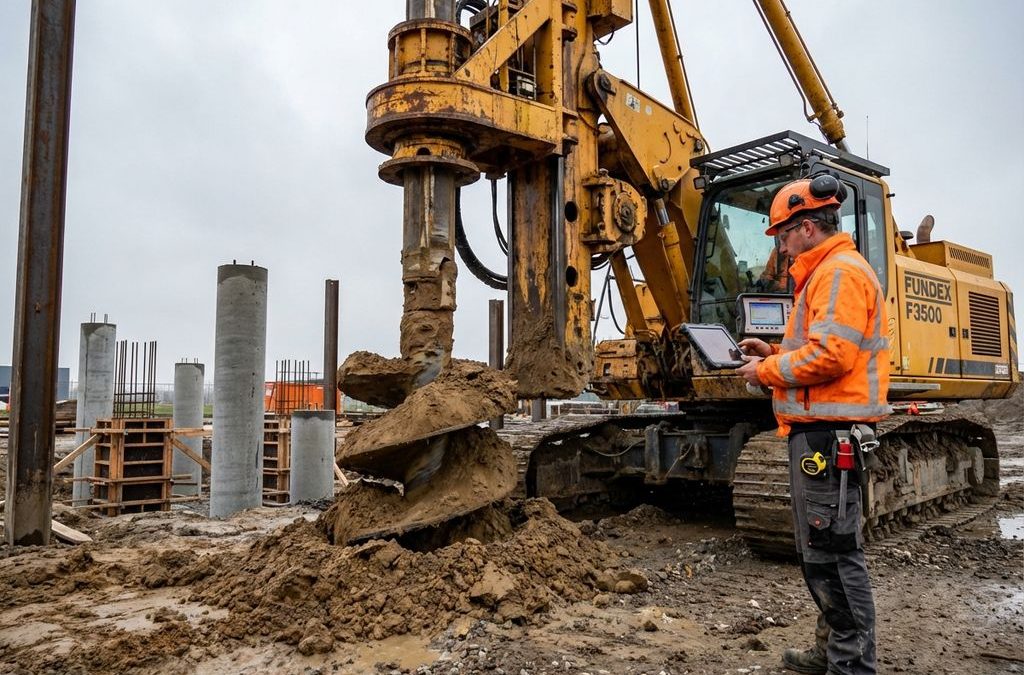
The depth of foundation piles depends on various factors, such as soil conditions, building load, and groundwater level. In the Netherlands, pile depths typically range from 8 to 40 meters, depending on where load-bearing soil layers are found. A soil investigation is essential to determine the correct depth for a stable foundation.
What factors determine how deep foundation piles should be driven?
The depth of foundation piles is determined by soil conditions, the building load, the groundwater level, and the location of load-bearing layers. A comprehensive soil investigation forms the basis for this calculation and identifies where stable soil layers begin.
Soil composition is the primary factor in determining pile depth. In the Netherlands, the topsoil often contains soft clay and peat layers, which means piles must be driven piles to reach load-bearing sand layers. The weight of the building then determines how much bearing capacity is required.
The groundwater level affects both the stability of the soil and the construction method. When groundwater levels are high, special techniques may be required to install the piles . The presence of obstacles in the subsoil, such as old foundations or hard layers, can also affect the required depth.
Soil investigations provide essential data through drilling and test pits. These investigations reveal the bearing capacity of various soil layers, the exact depth at which stable layers begin, and potential issues that may arise during construction. Without this information, it is impossible to determine a safe and cost-effective foundation depth.
How is the required depth of foundation piles calculated?
The required pile depth is calculated by comparing the soil's bearing capacity with the building's load, including safety factors. In the Netherlands, this is done in accordance with EC, NEN, and CUR standards, which provide strict guidelines for safe foundations.
The calculation process begins by determining the total load that the building exerts on the foundation. This includes the structure’s own weight, live loads such as people and furniture, and variable loads such as wind and snow. This total load must be safely transferred to the load-bearing soil layers.
Next, the bearing capacity of the soil is calculated at various depths. This is done using soil parameters from the soil investigation, such as the cone resistance measured during soil testing. The pile be long enough to provide sufficient bearing capacity, both through tip resistance (at the bottom) and lateral resistance (along the sides).
Safety factors are applied to account for uncertainties in soil parameters and loads. Static tests can verify the actual bearing capacity after installation by measuring compressive and tensile forces. Dynamic tests conducted during pile driving provide immediate feedback on the achieved bearing capacity. These tests confirm whether the calculated depth was correct.
What are the differences in pile depth between different soil types?
In sandy soils, piles are piles shorter because sand provides good bearing capacity, whereas in clay and peat areas, piles must be driven piles to reach stable layers. Rocky ground usually requires the shortest piles, but may necessitate special drilling techniques.
Sandy soils generally provide the best bearing capacity for foundation piles. In areas with thick layers of sand, piles can be piles short, often between 8 and 15 meters. The sand provides both good tip bearing capacity and frictional resistance along the pile shaft, reducing the depth required to achieve the same bearing capacity.
Clay soils require more careful consideration when calculating foundation depths. Soft clay has low bearing capacity, but hard clay layers can provide an excellent foundation. In many areas of the Netherlands, it is necessary to drill through soft clay layers to reach sand layers with sufficient bearing capacity, resulting in pile depths of 15 to 30 meters or more.
Peat soils pose the greatest challenge for foundations. Peat has virtually no bearing capacity and can compress under load. piles be driven completely through the peat layers to reach stable sand or clay layers. In peat areas, pile depths of 20 to 40 meters are not uncommon.
In rocky soil, piles can be piles because rock provides excellent bearing capacity. However, drilling into rock requires special techniques and can make the project more expensive. The exact depth depends on the depth at which the rock is encountered and its quality.
What modern techniques are used to determine the optimal pile depth?
Modern soil investigations and drilling provide accurate information about soil layers and bearing capacity at various depths. Advanced testing methods, such as ultrasonic testing and static load testing, verify the actual performance of installed piles.
Soil testing forms the basis of modern depth measurement. During a soil test, a cone is pressed into the ground while the resistance is measured. This cone resistance provides direct information about the bearing capacity of each soil layer. Modern soil testing equipment can also measure frictional resistance and groundwater pressure to provide a complete picture.
Boreholes provide visual information about soil layers and enable sampling for laboratory analysis. When combined with soil testing, they provide an accurate picture of the subsurface. This information is used in advanced calculation programs that determine the optimal pile depth in accordance with the latest standards.
Vibration-free foundation techniques, such as the Fundex method, make it possible to piles without piles disruption to the surrounding area. These screw-in techniques can install piles depths piles approximately 35 to 40 meters with diameters ranging from 380 mm to 540 mm. Because they are vibration-free, these techniques can also be used in confined spaces.
After installation, modern testing methods verify whether the calculated depth was correct. Static tests measure the actual bearing capacity by pile the pile . Ultrasonic tests verify the integrity of the pile its entire length. Dynamic tests conducted during installation provide immediate feedback on the achieved bearing capacity.
Determining the correct pile depth requires expertise in soil mechanics, knowledge of local soil conditions, and experience with various foundation techniques. For complex projects, professional advice is essential for a safe and cost-effective foundation. For specific projects, please contact us via our quote page for customized advice on the optimal foundation depth.
Frequently Asked Questions
How long does it take to determine the correct pile depth after the initial soil investigation?
A comprehensive site investigation, including soil testing and drilling, typically takes 1–2 weeks, depending on the size of the project. Analyzing the data and calculating the optimal pile depth then takes 3–5 business days. For complex projects, this process may take longer due to additional investigations.
What happens if, during pile driving, it turns out that the calculated depth is insufficient?
If dynamic tests conducted during pile driving indicate insufficient bearing capacity, the piles are driven piles until the required bearing capacity is achieved. This may entail additional costs, but it is necessary to ensure a safe foundation. Experienced contractors therefore always build a margin into their schedule and budget.
Can foundation piles be driven too deep, and is this harmful?
piles indeed be driven too deep, which unnecessarily increases costs but does not compromise stability. piles driven too deep actually piles additional safety, but result in a waste of materials and time. A thorough soil investigation and expert calculations can prevent these unnecessary costs.
How reliable are modern methods for calculating pile depth?
Modern calculation methods based on EC7 and NEN standards are highly reliable when soil investigations are conducted properly. The accuracy is typically within 10–15% of the actual values. Static load tests conducted after installation confirm the calculations and provide definitive assurance regarding the bearing capacity.
What is the cost of retrofitting a foundation that is too shallow?
Repairing a foundation that is too shallow is extremely costly and can be 2 to 5 times more expensive than the original foundation costs. This often requires support structures, additional piles even partial demolition. This underscores the importance of conducting a thorough soil investigation beforehand.
Can environmental factors, such as nearby buildings, affect the required pile depth?
Yes, nearby buildings and infrastructure can affect the required pile depth due to ground settlement and vibrations during installation. Existing foundations in the vicinity may also impose restrictions on the installation method. A comprehensive site analysis is therefore an integral part of professional foundation consulting.