
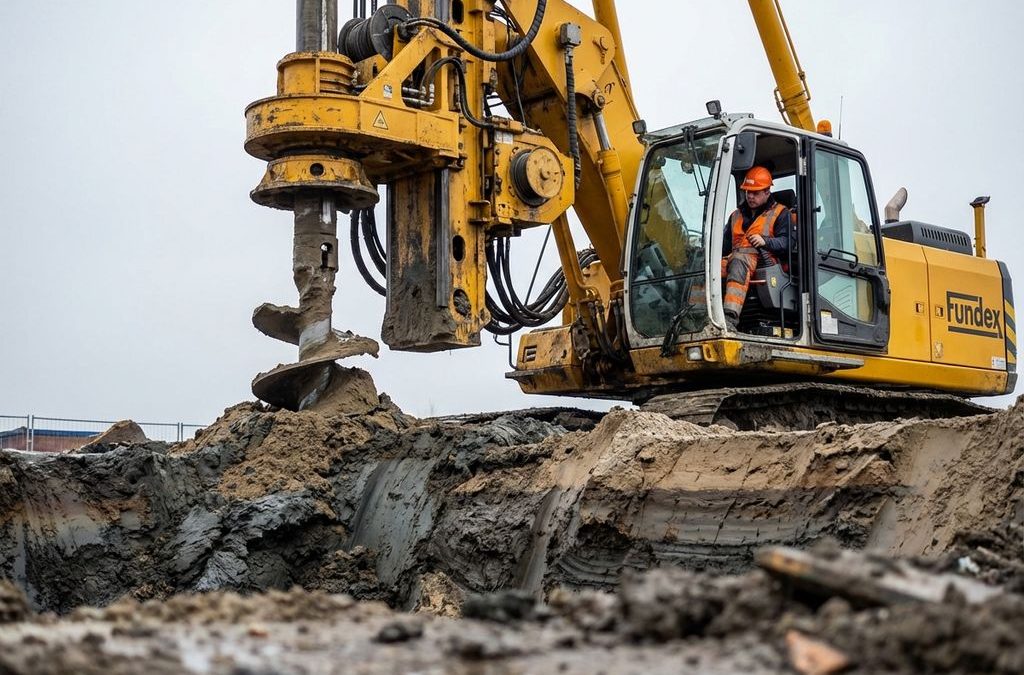
Foundation work is the process of installing piles other structures into the ground to create a stable base for buildings. This is done using various techniques, such as traditional pile driving or modern vibration-free methods, in which piles transfer piles building’s load to load-bearing soil layers. A solid foundation is essential for the stability and longevity of any construction project.
What is foundation work and why is it so important for every construction project?
Foundations form the basis of every structure by safely transferring the load from buildings, bridges, or other structures to load-bearing soil layers. A foundation ensures that the structure remains stable and does not settle, even under varying soil conditions or external loads such as wind and vibrations.
The fundamental role of foundations in construction cannot be underestimated. Without a proper foundation, buildings can settle unevenly, develop cracks, or, in extreme cases, collapse. A professional foundation takes into account factors such as soil type, groundwater level, building loads, and environmental factors.
Modern foundation solutions go beyond mere stability. They must meet increasingly stringent requirements regarding sustainability and environmental impact. Professional foundation companies therefore conduct comprehensive soil investigations and select the most appropriate technique for each specific situation, taking into account both technical and environmental requirements.
How does traditional pile driving work, and what are its drawbacks?
Traditional pile driving involves driving or vibrating piles directly into the ground piles great force. This is done using heavy pile-driving rigs and hydraulic hammers that repeatedly strike the pile head until the pile reaches pile desired depth and bearing capacity. The process requires powerful machinery and causes significant vibrations and noise pollution.
In the traditional pile driving process, concrete, steel, or wooden piles are typically piles . The pile drivers use hydraulic systems to apply enormous forces to the piles, driving them through various soil layers. While this process can be effective in certain soil conditions, it presents several challenges.
The main drawbacks of traditional pile driving are the vibrations and noise pollution caused by the process. In urban areas, these vibrations can cause damage to nearby buildings and foundations. In addition, the noise levels are often so high that work must be restricted to certain times of day, which complicates project planning and increases costs.
What is vibration-free foundation installation, and how does it differ from traditional pile driving?
Vibration-free foundation installation is a modern technique in which piles are placed into the ground piles drilling and screwing rather than driving. This method, also known as “piling without driving,” uses axial pressure and torque to piles drive piles into the ground without causing vibrations or significant noise pollution.
The process of vibration-free foundation installation differs fundamentally from traditional methods. Instead of powerful blows, this technique uses a controlled screwing motion. A steel casing with a loose drill bit is placed at ground level and then screwed down to the desired depth. Once the desired depth is reached, the reinforcement is installed and the concrete is poured, after which the casing is pulled out in an oscillating motion while the drill bit remains in place.
The benefits of vibration-free foundation techniques are significant. No vibrations means no risk of damage to surrounding structures, while the low noise level allows work to be carried out in noise-sensitive environments. Furthermore, these techniques can be applied to relatively small areas, making them ideal for tight construction sites in urban areas.
What are the different types of foundation methods, and when should you use each one?
There are various foundation methods, each suited to specific soil conditions and project requirements. The choice depends on factors such as soil conditions, loads, environmental constraints, and the project budget. Modern foundation techniques offer solutions for virtually any situation.
piles are suitable for soil layers up to 40 meters deep with soil pressures ranging from 1 to 20 MPa. This vibration-free technique is ideal for urban projects where vibrations must be avoided. piles utilize a permanent steel tube and are suitable for soil pressures up to 80 MPa, particularly effective in very soft soil layers where deformation of the pile shaft must be prevented.
piles offer economic benefits and greater resistance to lateral forces thanks to their soil displacement principle. piles create sheet pile walls for specialized applications. For projects involving tensile loads, Fundex tension anchors are available, while bored sheet piles offer flexibility in a variety of soil conditions. The choice is determined by soil investigations, load requirements, and environmental factors.
How is the quality of foundations inspected and tested?
Quality control for foundations involves various testing methods that piles the bearing capacity, integrity, and durability of the piles . These tests are essential to ensure that foundations meet design specifications and safety requirements. Professional testing prevents costly problems and ensures reliable structures.
Static tests measure both compressive and tensile bearing capacity by applying gradually increasing loads to test piles. These tests provide accurate information about the actual bearing capacity of the foundation under specific soil conditions. Ultrasonic tests verify the integrity of the pile shaft by sending sound waves through the concrete to detect any irregularities or weak spots.
Dynamic testing uses controlled blows to analyze the behavior of piles load. This method is faster than static testing and provides valuable information about pile resistance and soil parameters. Modern testing equipment can provide real-time data, allowing for immediate determination during the test whether piles specifications and whether adjustments are needed.
Understanding foundation techniques helps you make informed decisions for your construction project. Whether you’re dealing with challenging soil conditions, environmental constraints, or specific load requirements, modern foundation solutions offer a suitable technique for every situation. For professional advice on the most appropriate foundation method for your project, please contact us for a quote that takes all project-specific factors into account.
Frequently Asked Questions
How long does it take to build a foundation, and what factors determine the timeline?
The duration of a foundation project depends on factors such as the number piles, the depth, soil conditions, and weather conditions. The foundation for an average single-family home can be completed within 1–3 days, while larger projects may take several weeks. Vibration-free methods are often faster than traditional pile driving because there are fewer environmental restrictions.
What is the average cost of foundation work, and what factors influence the price?
Foundation costs vary significantly depending on the number piles, depth, soil conditions, and the chosen method. Vibration-free methods are often slightly more expensive than traditional pile driving, but they save costs due to fewer environmental restrictions and faster execution. A soil investigation and a project-specific quote are always required for an accurate cost estimate.
Can I choose which foundation method to use for my project?
The choice of a foundation method is primarily determined by technical factors such as soil conditions, loads, and environmental requirements. A geotechnical consultant determines which methods are technically feasible based on soil investigations. Among the technically suitable options, you can choose based on cost, lead time, and environmental impact.
How do I know if the soil at my construction site is suitable for vibration-free foundation work?
A soil investigation conducted by a certified firm will determine the suitability of various foundation methods. Vibration-free techniques are suitable for most soil types, but very hard layers or specific soil conditions may impose limitations. The soil investigation also determines the required pile depth and type.
What happens if unexpected soil conditions are encountered during foundation work?
If unexpected ground conditions arise, the project can be adjusted by changing the foundation method, adjusting the pile length, or adding additional reinforcements. Professional foundation contractors have experience with such situations and can quickly offer alternative solutions. However, this may affect the schedule and costs.
Do foundations require maintenance, and how long do they last?
Modern foundations are designed to last 50 to 100 years and typically require no maintenance. However, it is important to monitor groundwater levels and environmental conditions that could affect the foundation. If you have any doubts about the condition of an existing foundation, an inspection by a specialist can provide clarity.