
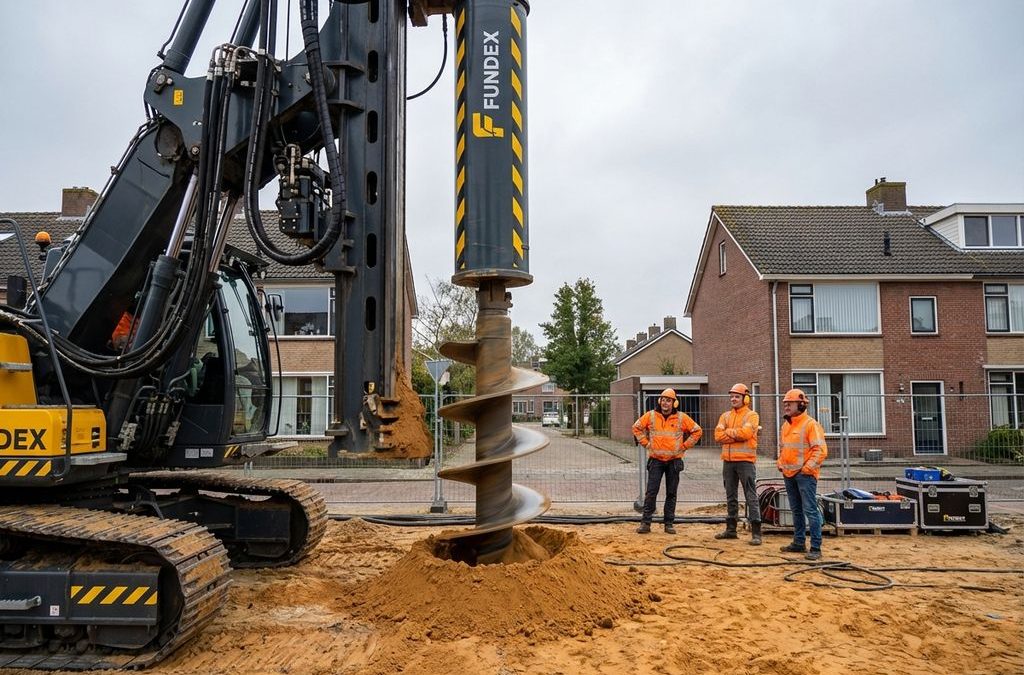
Vibration-free foundation techniques offer significant advantages by eliminating noise pollution and vibrations, thereby enabling construction projects in densely built-up areas and near sensitive structures. These modern foundation techniques, such as screw piles and grouted piles, utilize the principle of “driving without driving,” whereby piles are, piles it were, screwed into the ground. This article addresses the most important questions about vibration-free foundation techniques.
What is vibration-free foundation construction, and how does it work?
Vibration-free foundation installation is a modern foundation technique in which piles are driven into the ground piles vibrations or impact. Instead of traditional pile driving, piles are installed piles , ensuring that the surrounding area is not affected by vibrations, noise, or soil disturbance.
The principle behind “piling without piling” is based on several advanced techniques. With screw piles, the pile is driven into the ground pile rotation and pressure, similar to screwing in a screw. The pile gradually pushed into the ground while rotating, displacing the soil without shocks or vibrations.
Injected piles a hollow tube that is screwed into the ground to the desired depth. Concrete or grout is then injected under pressure as the tube is withdrawn, creating a strong concrete pile. This method ensures high concrete compaction and excellent load-bearing capacity, without significant vibration.
The technical implementation requires specialized machinery designed for vibration-free operation. These rigs operate in relatively small spaces and are often equipped with sound-dampening systems to minimize noise pollution.
Why are more and more projects opting for vibration-free foundations?
The growing popularity of vibration-free foundation techniques stems from changing regulations, stricter environmental requirements, and increasing building density in urban areas. Traditional pile-driving methods are becoming increasingly problematic due to stricter standards for noise pollution and vibration damage.
Municipalities are increasingly imposing strict requirements on construction activities in residential areas. Noise pollution must be limited to specific times and noise levels, which often makes traditional pile driving impossible. Vibration-free techniques make it possible to install foundations even during regular working hours, without causing a disturbance to nearby residents.
The increased building density in Dutch cities means that new construction projects are often carried out right next to existing homes or historic buildings. Vibrations from traditional pile driving can cause damage to the foundations, facades, or interiors of nearby buildings. Insurers and clients want to avoid this risk.
Sustainability requirements also play an important role. Modern, electric-powered foundation machines can operate completely emission-free, which contributes to the climate goals of municipalities and construction companies. This development aligns seamlessly with the growing demand for sustainable construction methods.
What specific benefits does vibration-free foundation work offer for construction projects?
Vibration-free foundation work virtually eliminates noise pollution, protects existing structures from damage, and allows work to be carried out in smaller areas. These benefits lead to better relations with local residents, fewer permitting procedures, and greater flexibility in project planning.
The reduction in noise pollution is the most immediate benefit. While traditional pile driving can generate noise levels of 90–100 decibels, vibration-free systems operate significantly more quietly. This means there are fewer or no time restrictions on the work, and nearby residents experience virtually no disruption from the foundation process.
Protecting existing structures prevents costly damage. Vibrations from traditional pile driving can cause cracks in walls, cause foundations to settle, or damage historic buildings. Vibration-free techniques minimize this risk, often eliminating the need for extensive monitoring of surrounding buildings.
The ability to operate in smaller workspaces offers significant advantages in urban projects. Vibration-free rigs often be set up closer to adjacent structures and require less space for material storage. This makes construction projects possible in locations where traditional foundation methods would be impractical.
Improved relations with authorities and local residents lead to smoother permitting processes. Municipalities are more likely to approve projects that use vibration-free foundation techniques, as the risk of complaints and damage is minimal.
How do the costs of vibration-free foundation construction compare to traditional methods?
The direct costs of vibration-free foundation installation are typically 10–25% higher than those of traditional pile-driving methods, but this investment is often offset by time savings, avoided damage costs, and faster permitting procedures. As a result, the total project costs may actually be lower.
The higher direct costs stem from the more advanced technology and specialized equipment required for vibration-free foundation work. The machinery is more complex, and the work requires greater expertise, which results in higher hourly rates for the foundation work.
Time is saved because there are fewer restrictions on working hours and less waiting time is required for permits. Projects can start and proceed more quickly, which shortens the overall project duration. For larger projects, this can save weeks in planning time.
The costs of damage avoided can be substantial. Damage to surrounding buildings caused by vibrations can cost thousands of euros per incident. Monitoring nearby properties, insurance premiums, and potential legal proceedings often make traditional pile driving in sensitive environments more expensive than initially anticipated.
Faster permitting procedures save both time and money. Municipalities often prioritize applications for vibration-free foundation projects because they involve fewer objections and risks. This can shorten the project preparation time by months.
For more information about vibration-free foundation solutions and a customized quote for your project, please contact us via our quote page. We would be happy to advise you on the most suitable foundation technique for your specific situation.
Frequently Asked Questions
How long does it take to switch from traditional pile driving to vibration-free foundation installation in an ongoing project?
The transition to vibration-free foundation techniques typically requires 2–3 weeks of preparation to deploy specialized equipment and personnel. Most contractors can adapt flexibly if unexpected problems arise with traditional methods, provided there is sufficient budget available to cover the additional costs.
Which soil types are best suited for vibration-free foundation techniques?
Vibration-free foundation methods work exceptionally well in sandy soils, clay, and mixed soil types to a depth of approximately 20 meters. In the case of very hard soil layers or rocky subsoil, costs can rise significantly, and custom equipment may be required. A preliminary soil investigation determines the feasibility and cost-effectiveness of the project.
What are the most common mistakes made when planning vibration-free foundation projects?
The biggest pitfalls are underestimating the workspace required for specialized machinery, insufficient communication with local residents regarding the extended project duration, and failing to reserve specialized equipment in a timely manner. Additionally, planners often overlook the need to factor in the more stringent requirements for soil investigation when developing the schedule.
Can vibration-free foundation techniques be used in renovation projects for historic buildings?
Yes, vibration-free techniques are ideal for historic buildings because they do not cause vibrations that could damage historic structures. However, custom solutions are required to address the limited accessibility and specific requirements of historic buildings. Collaboration with a restoration specialist is often necessary.
How do you measure and monitor the quality of vibration-free foundations during construction?
Quality is ensured through continuous monitoring of driving force, rotation speed, and penetration rate during driving. For cast-in-place piles , concrete pressure and volume piles also recorded. Post-installation sonic integrity tests confirm pile quality and continuity.
What permits and notifications are specifically required for vibration-free foundation projects?
Although less restrictive than traditional pile driving, building permits and notifications under the General Local Regulation (APV) are still required. The advantage is that municipalities impose less stringent conditions regarding working hours and noise restrictions. A vibration and noise assessment is usually not required, which speeds up the permitting process.
What happens if unexpected obstacles are encountered in the ground during vibration-free foundation work?
Bij obstakels zoals oude funderingen, leidingen of puin kan de schroeftechniek worden aangepast of kan worden overgeschakeld op boren met spoeling. In extreme gevallen is handmatige verwijdering van obstakels nodig. Goede voorbereiding met KLIC-meldingen en historisch onderzoek minimaliseert deze risico’s aanzienlijk.