
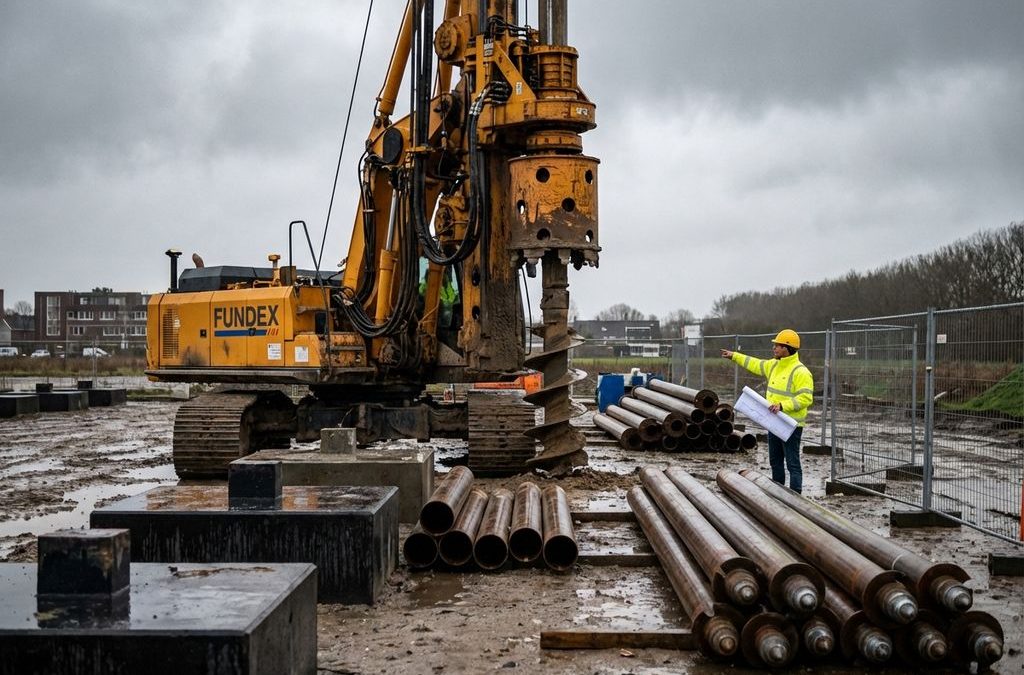
There are various foundation techniques available for modern construction projects, ranging from traditional pile driving to innovative, vibration-free methods. The choice depends on soil conditions, environmental factors, and project-specific requirements. Modern techniques such as screw piles, composite piles, and renewable energy piles offer solutions to specific challenges in today’s construction industry.
What are the main foundation techniques currently in use?
The most commonly used foundation methods include traditional pile driving, vibration-free screw piles, composite piles with grout injection, and specialized systems for extreme soil conditions. Each technique has specific applications and advantages, depending on the project conditions.
In traditional pile driving, precast concrete piles or steel piles are driven into the ground piles impact force. This method is effective for stable soil layers, but causes vibrations and noise pollution. For projects in urban areas or near sensitive structures, this technique is therefore being used less and less.
Vibration-free foundation techniques, such as the Fundex pile, operate on the principle of “piling without piling.” A steel casing with a detachable drill bit is driven to depth using axial pressure and torque. After the reinforcement is installed and the casing is filled with concrete, the casing is pulled out using an oscillating motion, leaving the drill bit behind.
Specialized solutions are available for extreme soil conditions. In very soft soil layers (1–20 MPa), Tubex piles are used, which are 100% soil-displacing and do not require settlement. For very heavy soil layers, combination piles with grout injection provide the solution, in which prefabricated pile elements are installed within a grout-filled casing.
What is the difference between traditional pile driving and vibration-free foundation installation?
Traditional pile driving uses impact force to drive piles the ground, while vibration-free pile driving installs piles , without causing vibrations or noise pollution. The difference lies in the installation method and the impact on the surrounding area.
Traditional pile driving generates vibrations that travel through the ground to surrounding buildings. This can cause damage to existing structures and results in significant noise pollution. In addition, a large amount of workspace is required for the large pile-driving rig and transport vehicles.
Vibration-free foundation techniques eliminate these problems by using a completely different method. The piles , as it were, screwed into the ground, so the surrounding area is not affected by vibrations. This makes it possible to work on relatively small sites and in densely built-up areas.
A key advantage of vibration-free piling is the flexibility it offers in terms of pile angles. piles be installed at angles of up to 4:1 forward, 2:1 backward, and 3:1 to the side. This provides greater design freedom and enables foundation work in confined spaces where traditional methods are not feasible.
Which foundation method is best suited for your project?
The appropriate foundation method depends on soil conditions, environmental factors, budget considerations, and specific building codes. A thorough analysis of these factors will determine which technique yields the best results for your specific situation.
For projects in very soft soil layers (below 1 MPa), systems with permanent casing, such as Tubex piles, are the recommended choice. These prevent deformation of the pile shaft and can withstand high compressive and tensile forces. In very hard soil layers (above 20 MPa), systems with grout injection offer the best solution.
Environmental factors play a crucial role in the decision-making process. In urban areas with existing buildings located at close proximity, vibration-free techniques are often the only option. The minimum distance to adjacent structures is approximately 0.9 meters at right angles, with recessed corners requiring more space.
Budget considerations include not only the direct foundation costs but also indirect costs, such as potential damage claims associated with traditional pile driving. Although vibration-free techniques may involve higher direct costs, they eliminate the risk of damage to surrounding buildings and delays caused by complaints from neighbors.
For temporary foundations or projects with limited headroom, specialized systems—such as Tubepiles—offer additional benefits. These systems can be used in spaces with limited headroom and can be reused later, resulting in cost savings for temporary structures.
How do modern sustainable foundation solutions work?
Modern sustainable foundation solutions combine emission-free installation with innovative energy concepts, such as geothermal energy generation. Electric-powered machinery and energy piles contribute to more sustainable construction without compromising on quality.
Electrifying foundation equipment eliminates local emissions and significantly reduces noise pollution. Machines such as the CD20E and F4800E can be powered entirely by electricity, resulting in a cleaner construction site and less disruption in urban areas. Clients are increasingly requesting these sustainability measures specifically.
Energy Piles, such as the Fundex Energy Pile, combine the load-bearing function of a foundation with heat exchange through the ground. The only difference from conventional foundation piles is that the reinforcement cage is fitted with piping, allowing water to circulate to absorb or release geothermal heat.
The energy performance is impressive: energy poles use twenty times less energy to cool a building and five times less energy for heating than traditional systems. This technology helps reduce energy consumption and offers cost savings for end users throughout the building’s entire lifespan.
Fundex is preparing for future ESG (Environmental, Social, Governance) guidelines for 2030, 2040, and 2050. By collaborating with suppliers of batteries, software, and electrification expertise, the company is constantly developing new sustainable solutions that meet increasingly stringent environmental requirements.
Choosing the right foundation technique not only determines the success of your project, but also its impact on the environment and your sustainability goals. With over seventy years of experience in innovative foundation techniques, we can advise you on the optimal solution for your specific situation. Contact us for a no-obligation quote and discover which foundation technique best suits your project.
Frequently Asked Questions
How long does it take to install vibration-free piles to traditional pile driving?
Vibration-free foundation techniques are often faster than traditional pile driving because there are no delays caused by vibration-sensitive work and less preparation time is required. On average, 15–25 piles can piles installed per day, depending on soil conditions and pile length. The exact installation speed depends on the chosen technique and project conditions.
What is the cost of vibration-free foundation work compared to traditional pile driving?
Hoewel trillingsvrije technieken 10-20% hogere directe kosten kunnen hebben, vallen indirecte kosten vaak lager uit door het wegvallen van schaderisico’s en omgevingsklachten. Bij projecten in stedelijke gebieden kunnen de totale projectkosten zelfs lager uitvallen door snellere uitvoering en geen vertragingen door trillingsbeperkingen. Een kosten-batenanalyse per project geeft het beste inzicht.
Can energy poles also be installed in existing buildings, or only in new construction?
In principle, Energy Piles also be installed in existing buildings, but this requires a thorough analysis of the current foundation and available space. For renovation projects involving foundation reinforcement or expansions, energy piles offer an excellent opportunity to achieve sustainability goals. Feasibility depends on accessibility, soil conditions, and the existing heating/cooling system.
How is quality controlled in vibration-free foundation techniques?
Quality control is performed in real time during installation by monitoring parameters such as torque, axial pressure, and installation speed. In addition, test loads are applied, and ultrasonic testing can be used to verify pile integrity. This digital monitoring often provides more detailed information than is possible with traditional pile driving methods.
What happens if unexpected soil conditions are encountered during installation?
Modern foundation machines can be adjusted on the fly during installation to accommodate changing soil conditions by modifying parameters such as torque and pressure. In the event of highly unusual conditions, it is possible to switch to a different foundation technique, such as composite piles with grout injection for very hard layers. Real-time monitoring provides immediate alerts in the event of abnormal conditions.
How long do modern foundation piles last, and what kind of maintenance do they require?
Modern foundation piles have a design life of at least 100 years, comparable to traditional piles. Energy Piles periodic inspection of the piping (every 5–10 years), but the support structure itself is maintenance-free. The materials and coatings used have been specifically selected for long-term durability under ground conditions.