
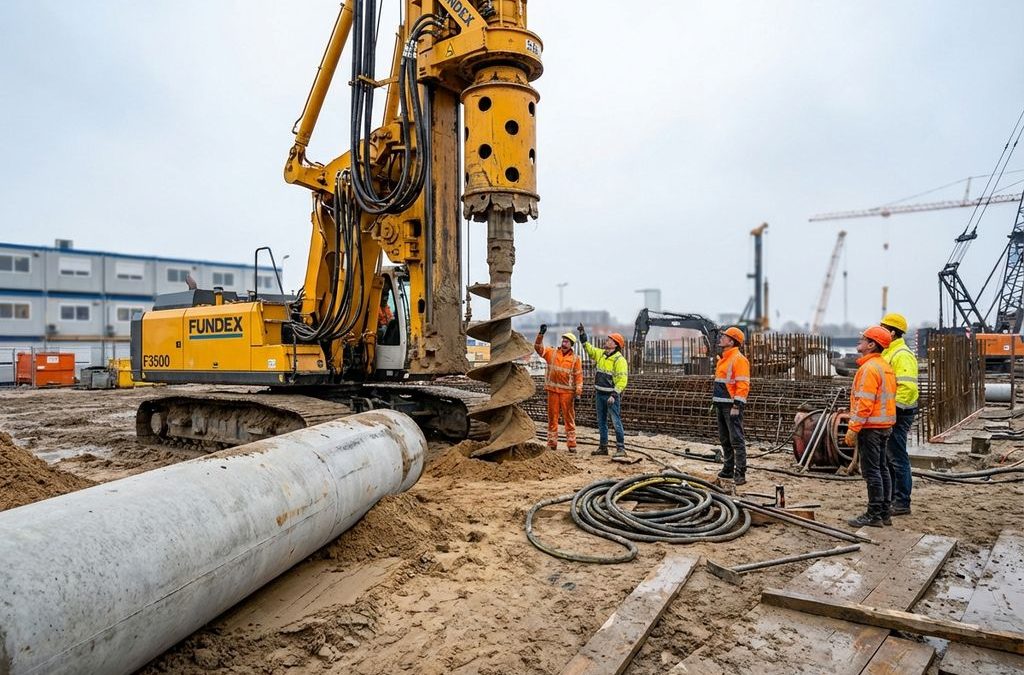
The foundation work for a building consists of five main phases: soil investigation and permitting, selection of the foundation method, site preparation, execution of the foundation work, and quality control. This process ensures that buildings stand stably and safely on the ground. A good foundation literally forms the basis for every construction project and determines the lifespan of the structure.
What exactly does the foundation process entail, and why is it so crucial?
Foundation work is the process of creating a stable base on which a building can rest. This involves safely transferring the building’s loads to the load-bearing soil layers. A good foundation prevents settlement, tilting, and structural problems throughout the building’s lifespan.
The foundation process consists of several phases that follow one another in a logical sequence. The first phase involves research and planning, during which the soil conditions are assessed and the appropriate foundation method is determined. This is followed by the preparation phase, which includes permit applications and technical design.
The construction phase involves the actual installation of foundation elements, with modern techniques such as vibration-free foundation installation becoming increasingly popular. This is particularly important in urban areas, where vibrations can cause damage to surrounding buildings. The final phase involves quality control and handover.
A solid foundation is crucial because it supports the entire structure. Foundation problems are very costly to repair later on and can compromise the safety of the building. That is why great care is taken in planning and construction.
What preparatory steps are needed before the actual foundation work begins?
Soil investigation forms the basis of every foundation. This involves examining the soil structure down to the required depth to determine the bearing capacity and composition of the soil. This investigation determines which foundation method is appropriate and at what depth the foundation should be placed.
While the soil investigation is underway, the necessary permits are being applied for. This usually involves an environmental permit and possibly additional permits, depending on the location and the type of project. Any existing cables and pipelines must also be mapped.
Based on the soil investigation and building specifications, technical drawings and calculations are prepared. These documents specify the exact design of the foundation, including dimensions, reinforcement details, and material specifications. These documents serve as the basis for construction.
Work planning also involves organizing materials, machinery, and personnel. Specific foundation techniques require specialized machinery, such as drilling rigs for installing foundation piles. The schedule must take into account weather conditions and site accessibility.
How is the right foundation method chosen for a specific project?
The choice of foundation method depends on soil conditions, the type of building, and environmental factors. If the soil has sufficient bearing capacity at shallow depths, a direct foundation is often sufficient. If the soil is soft or the loads are heavy, pile foundations are necessary.
The soil conditions play a decisive role in the choice of method. For soil conditions ranging from 1 to 20 MPa, various techniques can be applied. For very soft soils, systems with permanent casing are used, while for very heavy soils, grout injection can be used to increase the bearing capacity.
Environmental factors have a significant influence on the choice of method. In urban areas with nearby buildings, vibration-free foundation methods are often required. These techniques prevent damage to surrounding structures and minimize disruption to nearby residents by eliminating vibrations during construction.
Practical considerations such as available space and accessibility also determine the method. Compact machines are required in tight spaces, while special rigs used where headroom is limited. The distance to adjacent structures also plays a role; typically, a minimum of 0.9 meters of space is required perpendicular to the adjacent structure.
What are the key steps involved in the foundation work itself?
The foundation work begins with staking out and marking the pile locations according to the technical drawings. Next, the foundation machine is positioned, and all systems are checked to ensure they are functioning properly. The work area is cordoned off to ensure safe operations.
In pile foundations, the casing is installed with a drill bit and driven to the desired depth through axial pressure and torque. This method ensures a vibration-free installation. Once the desired pile tip elevation is reached, the reinforcement is placed inside the casing.
After the reinforcement is installed, the casing is filled with concrete or grout, depending on the method chosen. The casing is then pulled out using an oscillating motion, leaving the drill bit in the ground. This process creates a continuous concrete column without voids.
During the process, all steps are documented and verified. Once each pile is completed, the rig pile rig moved to the next location. The process is repeated until all foundation elements have been installed according to the design.
How is the quality of foundation work inspected and guaranteed?
Quality control for foundation work includes static tests to measure both compressive and tensile forces, ultrasonic tests to assess structural integrity, and dynamic tests. These tests ensure that the foundation meets design specifications and is safe for use.
Static pile tests are conducted to verify bearing capacity. In these tests, a test pile is loaded well beyond the design load to determine its behavior under extreme conditions. These tests provide definitive results regarding the actual bearing capacity.
Ultrasonic integrity testing verifies the continuity of the concrete column. This method pile any voids, constrictions, or other defects in the pile . This non-destructive testing method provides rapid insight into the quality of the piles.
Dynamic tests can be conducted during construction to obtain real-time information about the pile installation. All test results are documented and evaluated by a structural engineer. Only after all inspections have been approved is the foundation cleared for further construction activities.
A carefully executed foundation process with proper quality controls ensures a stable and durable structure. For specific projects and advice on the most suitable foundation method, please contact us via our quote page. With the right approach and expertise, every foundation becomes a solid base for future construction projects.
Frequently Asked Questions
On average, how long does it take to complete a foundation project?
The duration of a foundation project varies greatly depending on the project’s size and complexity. For an average single-family home, the foundation work takes 3–7 business days, while larger projects can take several weeks. The preliminary soil investigation and permitting process can take 4–8 weeks.
What are the costs of different foundation methods?
Costs vary depending on the foundation method: direct foundations are usually the least expensive (€50–100 per square meter), while pile foundations are more expensive (€150–400 per linear meter pile). Vibration-free methods cost 10–20% more, but often save money by preventing damage to surrounding buildings.
Can foundation work be done in bad weather or during the winter?
Foundation work can be carried out in most weather conditions, but extreme conditions require adjustments. In freezing temperatures, concrete must be protected from freezing, and during heavy rain, work may be postponed for safety reasons. Modern machinery is equipped to handle a variety of weather conditions.
How can we prevent vibrations from causing damage to nearby buildings?
Vibration-free foundation methods, such as screw drilling, completely eliminate vibrations. In addition, vibration sensors are installed near sensitive structures to enable real-time monitoring. If vibration limits are exceeded, work is stopped immediately and alternative methods are employed.
What happens if unexpected soil conditions are encountered during foundation work?
If unexpected soil conditions are encountered, work is temporarily halted and additional soil investigations are conducted. The structural engineer adapts the foundation design to the new conditions. This may result in a different foundation method or adjusted pile depths, with associated additional costs.
How long must we wait after the foundation work is completed before construction can continue?
After concrete foundation elements have been completed, a minimum of 7 days must elapse before any further load is applied. For optimal strength, a period of 28 days is recommended. When using fast-setting concrete or special additives, this period can be reduced to 3–5 days.
What warranties are provided for foundation work, and how long are they valid?
Professional foundation contractors typically offer a 5- to 10-year warranty on the work they perform. This warranty covers structural defects and failures of the foundation. In addition, there is a 20-year statutory warranty for hidden defects in the main structure, which includes the foundation.